The Clearing with Katherine May
Martha Beck and Rowan Mangan on the magic of communing with every living thing
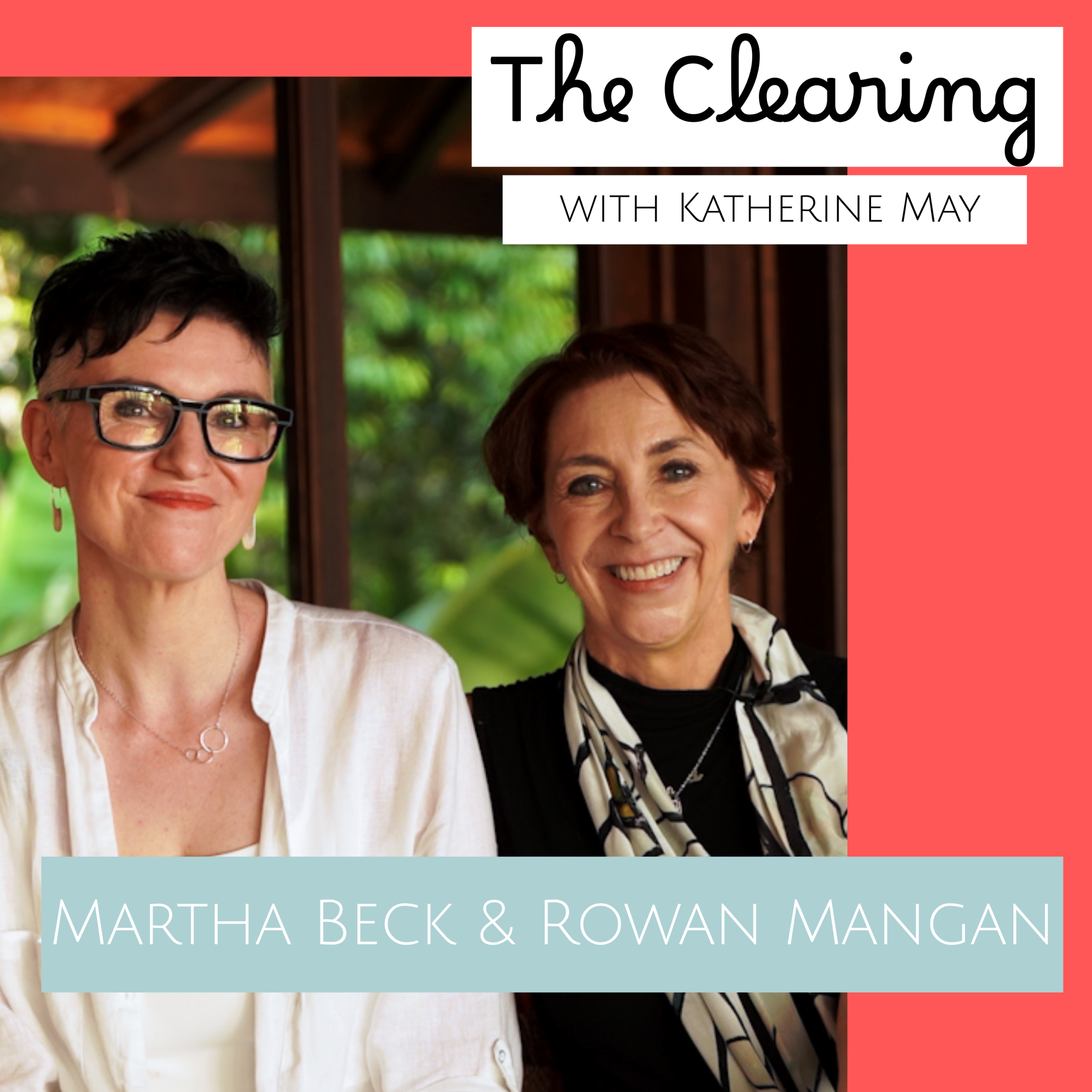
This episode of The Clearing with renowned, Oprah-endorsed American life coach Martha Beck and her wonderful wife and podcast co-host Rowan Mangan skips the small talk and delves right into the mysteries and wonder of life and death.
From the consciousness of stones to the nonsensical hierarchy of different sentient beings on earth. From the spiritual repression of our age to the societal need for a shaman. From the realities of living in a liminal space as an autistic person, to parenting neurodivergent children to each of their own unique ‘awakenings’.
With uncannily similar experiences of the world, Martha, Ro and Katherine roll through a dizzying array of mind-expanding subjects and shared interests, resulting in a truly captivating and enriching episode.
Transcript
Please note this is an automated transcript and as a result it may contain errors
Katherine May: [00:00:00] Hello, it’s Katherine here. How are you? I am speaking to you in the middle of an intensive pottering session. Pottering is very important sometimes because I’m not a consistent housekeeper. I’m not someone who keeps up with all the things that need to be done. I’d love to be, I’m not someone who really enjoys routines and I’m someone who likes to follow my bursts of creative madness every now and then, and therefore to drop everything else.
And I’m sorry I’m like this, but I am like it. So we have to go with it. [00:01:00] That means every now and then I have to sort everything out in one go. I’m the kind of person that quite enjoys sometimes emptying out all the cupboards, scrubbing everything, throwing out all the old stuff, making the whole kitchen clean with a toothpick, you know?
And then other times, who leaves it for months? I’m inconsistent. What can I tell you? Anyway, the first thing I wanna say today is thank you so much for all of your amazing feedback on this podcast so far. All of your welcoming messages, just for listening. It’s just been really, really lovely. It’s, uh, it’s always, you know, a nerve wracking risk to put something out in the world.
Um, and of course, you know, you work really hard on it and you hope that you’ve [00:02:00] thought up something that will be welcome and that will be meaningful to people and that we’ll entertain them and just bring a little bit of joy for a change. ’cause there is a big lack of that in the world right now. And then it’s lovely when that actually happens.
So I’m really, really grateful. Thank you for listening. Thank you for telling your friends. Thank you for subscribing and doing all that stuff that we’re always encouraging you to do, which I know is really boring. Um, it’s so appreciated. Secondly, I want to tell you about today’s episode because we have our first married couple on the pod.
We have the wonderful pairing of Rowan Mangan and Martha Beck. Who are co-hosts of the Bewildered [00:03:00] Podcast, and actually the reason I wanted to ask them together is ’cause I love the way they speak to each other on that podcast. I love the reality that they present of two people that clearly love each other very dearly and are very intimate and know each other really well, but who also drive each other crazy sometimes.
I love the slight bickering that goes on on that podcast and the dynamic between the two. And when I wanted to ask them, I really, really wanted to ask them together because I kind of fascinated to know how other couples dreams about rest. Key together. I don’t think mine and my husband’s match very well, honestly.
I think I mentioned this at the beginning of the pub, but, um, we [00:04:00] would probably rest in very different ways. And, you know, every now and again, again, when the world seems too much for him, I say, well, why don’t you go off on your own for a little while and, you know, we’ll get you a nice hotel or something and you can have a little break.
And he’s always like, no, I don’t wanna, I’ll be really lonely on my own. Whereas you see, that’s exactly what I want to do when it’s all too much. So I am sterilizing some jars, by the way, now in case you’re wondering what all this noise is, this is the kind of thing that drives him insane and makes him need to have a break sometimes.
Um, so I was really curious to ask these two. ’cause I know they’re not afraid to disagree, uh, but also because these are two people who know rest really well, Martha, as. Probably know is an author, a coach, a speaker? Her most recent book is called Beyond Anxiety, and it’s a brilliant, uh, kind of exploration of where anxiety emerges and how we can [00:05:00] tackle it.
It’s, it’s a really great read. Uh, and she has a podcast called The Gathering Room. She often runs retreats herself, and, uh, I know that she is a, um, passionate meditator too, and often teaches techniques from that. We talk about that a little in the podcast. And Rowan, uh, has a newsletter called Wild In Ventures.
She’s also a fantastic voice in, I don’t know, broadly understanding ourselves and how to take care of ourselves, uh, particularly in a world that’s often hostile to us. Um, both of them proudly neurodivergent women, uh, who have gained a lot of understanding and self-knowledge. Through exploring that. Um, just brilliant, brilliant, interesting people.
Anyway, I don’t think you’re gonna be disappointed by the conversation we had because when you get a group of neurodivergent folk in a room together, they go deep very quickly. We [00:06:00] don’t mess about, we we’re not great at small talk. Uh, we get right down into it. And of course, for me that meant abandoning the format quite a lot actually.
That was important. Uh, the format is there to help us through, but um, we had more interesting things to say, but we did get some really beautiful visions of what it means to. Dive out of the world and the fantasies that we all have entertained along those lines, but also the ways that we are all coming back into the company of others after periods of thinking that maybe we weren’t quite ready for the world around us.
Um, I wanted to add just a little content heads up. Um, we do talk a little bit about suicidal ideation. Um, I share my experiences, uh, of those [00:07:00] feelings when I was younger. Um, so if that’s a really tender subject for you, then, you know, maybe, maybe skip this one and, uh, and go for a fresh air walk instead.
Uh, there’s no obligation to listen if it feels like not the right thing for you. Uh, but just to reassure you, it is, uh, handled in a, I was about to say a positive way as if that could be positive, but, uh, in a sensitive way and in a way that draws. Wisdom and sees a future. Uh, but if it’s not right for you to skip anyway, um, I hope you will be really nourished by this conversation.
I was, I was just delighted after it in the aftermath. You know, I had had such a lovely, lovely, what I like to call a brainwash sometimes, you know, like I’ve been in the right company and rather than feeling exhausted by it, which I so often do, I feel like kind of cleaned out on the inside. Um, I hope it has the same [00:08:00] effect.
I’ll see you afterwards. Rowan and Martha, welcome to The Clearing. It’s lovely to have you here. It is so lovely to be here. Absolutely. Thank you. I’m so glad to get you both together as well, because I love listening to your podcast and I love the kind of slight tension that exists sometimes between you.
Well played, Katherine May
Rowan Mangan: well played. I’d like to say it’s all like a contrivance, but it’s not. It’s how
Katherine May: we are. It’s real. It’s how we are with our partners. And I think, I think that’s why it’s delightful, actually, because that is, I mean, there’s always that slight relief that like, oh yeah, good. I’m so glad that, that I, you know, I’m not the only person that’s constantly bickering with my husband, being openly mocked by their partner in public.
It’s a hard life. Honestly, what can I say? This is, this is how we, we kind of bring each other’s egos down. It’s probably good for, I I was sent to keep her humble. Yeah. Yes. Well, there we go. Um, so tell me, this is a podcast that’s about [00:09:00] rest. What is your relationship to rest? Are you the kind of people that find it easy to take a break or is it go, go, go in your household?
Martha Beck: What a great
Katherine May: question.
Martha Beck: Go, go, go. In. Our household is like this. Are you, are you gonna have coffee in the living room? I’m there now, but I can’t speak. I’m trying to come to meet you there then. Wait. Okay. Okay. Quick, quick. Next thing. Commune.
Rowan Mangan: Commune is our most important verb in our house. Okay. That’s nice.
We used to be go, go,
Katherine May: go people. Yeah. Now we’re more rusty people. Were you? I, yeah, I try not to be go, go, go. But I’m very, I’m a very kind of fidgety person that gets bored easily. So, well, she can’t stop walking from one end of England
Rowan Mangan: to the
Katherine May: other, for instance. There’s that. Yeah.
Martha Beck: Wind lost. You carried us with you, Katherine, [00:10:00] because we’re not going Well, you were walking in England earlier in the year, weren’t you?
In the Cotswolds.
Unknown: Oh, lovely. And
Martha Beck: it was divine. I really, I I I thought about you the whole way. Oh, I, because I come with you. Yeah. I, I didn’t understand the long walks, like where you can walk part of a path and then go back the next year. I’d never heard of that. Yeah. And when I started doing, now, I’m addicted.
Katherine May: It’s really, it’s lovely. It’s lovely to kind of get somewhere, I think to really, when you begin to rack up the miles and you start thinking, wow, this would actually be a quite a long way to drive. And I’ve walked it. I, that’s the bit I love. Yeah. It, but it takes a long time. Yes, it does. But yeah, I mean, I think that rest for me is often more like that than it is sitting down and being still, I really, I find stillness quite hard to achieve.
Um, I can do it for short periods of time, but what I can’t do is sit down all day or, or go on holiday and sit on [00:11:00] a sundown. That’s my worst nightmare actually. I wouldn’t, I wouldn’t find it restful.
Martha Beck: I know, especially not by a pool or something, although we both spent a lot of time in meditation. I, I don’t know if it was hard for you, ro but when I started it was like sitting on a hill of fire ants for two or three hours at a time.
It was horrible. Yeah. For months. And then it was exquisite. Yeah.
Rowan Mangan: Well, it’s always like, that’s the, the challenge right of meditation is that stillness is so hard to come by for us, you know? Mm-hmm. That you have to kind of get over that initial fire ance stage, the, that’s what Pascal
Martha Beck: said, that the majority of our misery comes from the fact that we are unable to sit quietly alone in a room.
Katherine May: It’s very true. I mean, I, it’s funny because when I first started meditation, I was really relieved by the stillness, actually. I thought I was gonna find it impossible. And I told everyone I was gonna find it impossible, you know? Uh, which now [00:12:00] people say to me, when I say that meditation’s a great thing to do, they say to me, well, I couldn’t possibly do that.
And it’s kind of like, look, do I look to you like I’m sort of uniquely docile and under occupied because
Martha Beck: I’m not sure I give that vibe out. Can we put that on your next book?
Katherine May: Yeah. Docile under, actually, I’ll ask you for a quote and I, I, I insist that that’s what it’s, Katherine, is do, do and Under Occupied.
But, but actually I was, I was really surprised that I could do it at all. Like I’ve always had to move, but when. When I got frustrated with the initial technique I’d been taught and I um, I went to see Lauren Ro, I dunno if you know Lauren, I dunno if you’ve ever come across him, but he’s an extraordinary meditation teacher.
And he then bought the movement back into my meditation and he kind of, it was before I’d had my autism diagnosis. I think what he was really talking about was how busy my hands [00:13:00] have to be all the time. And you know, that sort of, and he was like, that’s how you soothe yourself. You soothe yourself by moving your hands.
And so why would you stop doing that? And that that was actually a really big insight for me too. So I do often incorporate a bit of movement, but
Rowan Mangan: that’s, how does that look Katherine? Like what do you do? ’cause we are the exact, I think we both share your neuro type, like completely Yeah. To a really surprising like, extent, like it’s a very strong Venn diagram overlap and we are both the same.
Um, with, yeah. Sitting as we ohe, we’re
Martha Beck: both doing things. The, and I took so much flack as a child. Martha, stop moving your hands. Stop it. Stop fidgeting. Stop moving. Yeah. Over and over. Yeah, that’s right. What do you do?
Katherine May: Well, I, I quite often I wig on my fingers. That’s, that’s really soothing to me. I love the feeling of the surface of my fingers touching and I find that like stuff
Unknown: Yeah.
Katherine May: Which other people find annoying watching me do it, but I find that very soothing. So I’ll quite often do that. I do that, but on other [00:14:00] people. Sorry. Do
Rowan Mangan: they
Katherine May: like
Rowan Mangan: it? It does. It’s lovely. It’s tickling. I get a back rub.
Katherine May: Oh, that’s quite nice. Yeah. Um, but he also, he noticed that I quite often roll my hands like this, like together, like roll them, like, like a disco dancer, you know?
Um, and he, he, he observed me doing it and said, try that. And I, and so quite often I do just kind of turn my hands together, um, and look for the, and then, and actually kind of resting my attention on how that motion wants to change. Oh, interest can be really lovely for me. Like the, ’cause then I start to notice the pull towards stillness that I don’t think I’ll be able to find.
And it’s, it’s kind of,
Martha Beck: yeah. So do you have like a set time when you do that? It sounds like a really good, like trap door you could go through into rest. Yeah,
Katherine May: I think, I mean, I think most of the time now, now that I’ve meditated for a long time, I find it quite easy to just sit down and [00:15:00] start. But you know, I’ve, I now it becomes a bit like tuning into a frequency almost.
Yeah. Like I’m looking for that note in my mind. And that’s much easier to find a course than it used to be. Mm-hmm. But on days where I think, oh no, I can’t, I can’t do this today. I just haven’t, I haven’t got the capacity to get calm, you know, I can’t move from here to there. That’s when I will then. Wr my hands, which doesn’t sound very cool, but, um, but you know, it, it does kind of work.
Yeah.
Martha Beck: Talk about a simple solution. I need to be enlightened. Wr your hands. No, that’s too weird. Why not? It turns out the hand ringing was a
Katherine May: meaningful gesture after all.
Rowan Mangan: Yeah. All those like Victorian washer women on the MOS or whatever ringing their, I mean that’s what I, that’s what I think of when I think of ringing your hands.
I just think of lady making half. Yeah. I’m like, I know that
Katherine May: I took it too far. I feel maybe it’s the guilt that’s surfacing in me. [00:16:00] I dunno. But, um, but I also, I, I dunno if you ever do this, but find it useful for that reason to hold stones. Yes. Move those in my hands. Yes, yes, yes. Like that’s, that’s a more elegant version of that.
Martha Beck: Yeah.
Katherine May: Mm-hmm.
Martha Beck: I have quite a little rock collection of just stones. I’ve picked up
Katherine May: on beaches and forests everywhere. So many, my desk is surrounded with them. I, as you’re saying that, I’m like glancing at all the different stones. Yeah. I think it’s how we, how we soothe ourselves. And it’s a lovely relationship to have with a stone.
It is totally. It’s, they’re good rest models. They don’t do a whole lot. Mm, yeah, that’s right. They, they know what they are and they, they stay there.
Martha Beck: Do you think that they’re conscious? I mean, do you feel the electricity of a living animal? What do you feel in inanimate objects? I mean, I, I think you’ve written about this, but I forgot.
Unknown: Yeah.
Martha Beck: I feel it pretty strongly
Katherine May: in stones actually. Yeah. Yes. So why I, everything feels kind of alive to me, really. Um, yeah. Water stones. [00:17:00] Yeah. Water for sure. I mean, how could water not be, um, right, but stones like I, yeah, I really, I just, I feel like everything, I feel like the whole planet’s alive to me.
That’s my universe’s my experience of it. Yeah, yeah. Yeah. And it surprises me when people find that weird, like, it seems so obvious.
Martha Beck: It’s so weird that they don’t see that. It’s very strange. It’s like nobody noticed that, um, heat rises or something. It’s so, it’s so evident if you pay just a little attention from my perspective.
Yeah.
Unknown: Yeah.
Martha Beck: And it’s like pretending that it, that it isn’t conscious. Very weird.
Katherine May: Like, is it like, would. Would those people perceive it if they took the time to, or is it just something that we can pick up that other people can’t? I don’t know.
Rowan Mangan: Well, I think there’s something about, you know, where people would say, would use the term tree hugger in a derogatory way.[00:18:00]
Yes. And I’m like, what? That tells me that you are being rude to trees every day, like you are disrespecting the trees. Give it a hug. Then maybe you, like you, you’ve clearly never communed commune with a tree properly, which is such, is just
Martha Beck: rude. It’s such an impoverished existence. I, I sounds so judgmental because I am, you’re allowed, it’s fine, you know, to go for a walk and not.
Experience the forest as alive, like every part of it, the mist, everything. Yeah. It just seems so empty and
Katherine May: sad.
Martha Beck: Yeah.
Katherine May: I agree. And I, I think that’s why I love like Japanese anime so much and Yes. And that kind of Yes. Cultural basic understanding that everything is sentient. Yeah. It’s, that’s just fundamental to that whole worldview.
Yeah. And I just, yeah. Makes more sense to me. Yeah.
Martha Beck: Princess not on. Okay. [00:19:00] Isn’t that great? Use the film. Oh,
Katherine May: absolutely. Beautiful.
Martha Beck: So, so is that rest for you to, to, to experience the consciousness of everything. And for, because for me, the thing I need to rest from is pretending to see the world the way it’s.
Mm. Conventionally seen within our culture. That is exhausting.
Katherine May: That’s absolutely exhausting. And not, and, and like, not just not noticing the t of the world, but also pretending to have, pretending that that other people can be used as kind of instruments. I find that absolutely exhausting. I wanna make deep relationships with everybody that I come across, or it’s just not interesting to me.
It’s not human to me to treat everybody like an object in this weird game of chess that only you are playing. That it, it’s so tiring to live like that. Yeah.
Rowan Mangan: And the extension of that to me is, you know, from childhood is this thing of, it’s, it’s absolutely evident [00:20:00] that animals are inferior and less imp less objectively important.
Right? Like, how could you care about that when there are people, right? And, and that was, that was to me, like the, the same thing of. Why, how does that come in as Yeah. How you see things,
Martha Beck: the hierarchy of value of, of different sentient beings. What? Mm. That, that makes no sense whatsoever to me.
Katherine May: Ugh. But it’s interesting.
I mean, I think, you know, we are gradually unpeeling the experience of people who grew up autistic and without knowing. And I think one of the common threads is that we were told over and over again that our worldview was weird and not correct. Mm-hmm. And now we get into each other’s company and we are like, stones are alive.
Right. You know? Yes. Right. That’s the first thing we say. Yeah,
Martha Beck: exactly. Exactly. You [00:21:00] say that kind of thing to, to like other people, because I do, and it doesn’t go down well, but I, I mean it almost sits, I got like into my fifties, I was like. Who the hell cares what anybody thinks of me, so I just like. I, I end up, um, saying to people at a party, like, when were you ever attacked by an animal?
And tell me how it was feeling when it attacked you. That’s what I wanna know.
Katherine May: Yeah, I mean, that’s interesting conversation guys. Like if, if we wanted explore what interesting conversation is that is Yes. Interesting. Yes. What people are wearing, whether they’ve had surgery, you know, what’s in fashion.
Gossip about people’s private lives, not interesting conversations. Even
Martha Beck: worse financial situations, stocks and bonds, where to get your like, oh, there’s a lot of that in sort of the new world. Thankfully that falls outside
Katherine May: of English for not politeness to talk about money. Very grateful about that. [00:22:00]
Martha Beck: God, it’s so weird because for them, and money has all the energy and for me the energy of money is this kind of this hapless victim of human value assigned to it and it’s just like.
I’m just like a duck or something. I don’t care. Like, why don’t you, I’m truly an random object. Gimme a hug. Right. So I relate to it, but only the way I relate to stones it and which is very difficult for my financial managers. Yeah,
Katherine May: I
Martha Beck: think, I think
Katherine May: there’s a whole, there’s a whole other podcast to talk about neurodivergent women and their relationship to money because Oh, that’s good.
Yeah. We just wanna pet it. It’s funny. Oh, so we, yeah. Oh, you ing Well listen, welcome to my clearing. Um, thank you. Can feel at home here. Everything is sentient in the clearing. Everything will speak to you. So welcome to Welcome Home.
Rowan Mangan: Oh, thank you.
Katherine May: I’m gonna [00:23:00] invite you to imagine a place that you’d go to rest, perhaps after a difficult time, but perhaps just after the progress of everyday life and, and what it takes from us.
Um, but I am very curious to invite you together and to wonder if you would rest in different places or whether you’d find the same kind of place. Because I think if you ask me and my husband about where we’d go to rest, we might say very different things. He, he might hold up in a record store Yeah. Of, of like infinite, infinite, rare funk.
Like he That’s so cool. Whereas I would not do that. That would, that would not be my place. We haven’t talked about this. Yeah. Where do you go? Well, wait, let’s start with, um, a landscape that you would land in. Oh. Where would it be? It could be, it could be imaginary, but it could be a place that you know and love.
Martha Beck: I have had for [00:24:00] my, for a large portion of my life, my whole adult life, there is a place I go to in, uh, it’s energetic. It’s not so much, it doesn’t feel imaginary, so to me, so much as constructed, but it’s not three-dimensional. 20 dimensional. It’s a, it’s a place I called truth island. Uh, ’cause I was living among all these Mormons who, and I was Mormon and they were always talking about the truth.
And it was so confusing ’cause it didn’t feel like the truth.
Unknown: Right.
Martha Beck: And so truth island was this, it was a bare wind swept island. Um, there wasn’t much vegetation, no habitation. But when you were there, if you lied with your actions or your words, you turned blue. And the more you kept lying, the more blue you became.
So nobody could hide their lies. They could say things, but they would be bright blue and then you would know.
Unknown: Mm-hmm.
Martha Beck: And I used to go there for sanctuary all the time. And then over the years it became, is the plant started growing on it, and then trees. And now it’s, [00:25:00] it’s kind of a cloud forest. And, um, actually everybody who turned blue is gone.
Unknown: Right.
Martha Beck: But the conditions still remain. But I, I kind of clock back in there when I sit down to be quiet.
Katherine May: Hmm. It feels, it feels almost like the island couldn’t thrive while everyone was lying or was not telling the truth. Like as soon as the truth actually established itself, it grew into this beautiful, lush place ecosystem.
Well noted. That’s cool. I never thought about it that way. That’s so beautiful. So Truth Island, Rowan, would you, uh, fancy Truth Island?
Rowan Mangan: No. I, I’ll be, I’ll be like across the channel on like White Lies Island. I’m just kidding. Gray area island. It depends which way you look at it Island. Um, so, no, you know what I thought of Katherine when you said that was, do you remember in the, um, Nia books, [00:26:00] the, I think it was The Magician’s Nephew, the first one?
Oh. Um, there’s a place called The Wood Between the Worlds right? Where you go and it’s just this very peaceful place and there are these little pools in it, and you can jump into the pools. You have to, it’s kind of complicated. You have to wear a ring of a certain color or something. A green wing and a yellow ring.
Is that right? That’s right. I can’t remember which is which. Yeah, yeah, yeah. And then you jump. But while you’re in the wood between the worlds, I feel like that’s, you know, because we were talking about autism and, and it’s like the place where you can completely unmask, right? Like, yeah, I’ll go back into one of these worlds and I get to choose which one.
But right now, just in this place between them, you know, it’s like the, the silence between the notes or the like bathroom in the middle of a party or something. You know, just that breath that you can take.
Martha Beck: You’re literally Schrodinger’s Rowan in there. Yeah. You can take any form depending on what any state consciousness decided.
Katherine May: [00:27:00] Yeah, I am. I’m really interested in the way that neurodivergent people are pulled towards liminal space. Like I, I think we, we are forced into, onto the kind of edge lands quite often. We are forced out of the center. We don’t, we grow up not, you know, maybe wondering why we can’t access that center. Mm-hmm.
We come to kind of love it and I, we don’t actually like being pulled into the center because the center is full of that kind of weird pretending that feels so deeply uncomfortable. Yeah. Yeah. There’s also in, is it in the magician’s nephew as well, that there’s all the stuff about the. Um, the kind of attic spaces are like behind the, of the house and connect to houses together.
Yeah. I used to fantasize about that as a child.
Martha Beck: Me too. And I used to pretend I had a, I actually have one now, a magical bracelet, but in my case, I could see, I watch, I could bring up a human person. And I remember doing this with a, a teacher when I was 12 and I [00:28:00] could step into their consciousness and they wouldn’t know that I was there, but I could experience the world from within their life.
And I remember doing this with my history teacher and crying all night because she was so lonely. Um, but they wouldn’t know. And then I could step back and be myself. But I took the memory of being them with me. And I wonder if we all. Have been using portals of one kind or another into a different space of knowing?
Yes. And if we’re imagining it, um, basically everything real, everything we construct is real because we first imagined it. So to me it has a measure of reality. Like we’ve, maybe, we’ve really been using portals through the power of human imagination to step into different perspectives. It’s kind of the life coach origin story, Marty.
Katherine May: Okay. Explain that to me. ’cause I don’t, I don’t fully understand the [00:29:00] world of life coaches. It’s not something I’ve like, oh God, come up and, ugh. Should I have one? Just kill me. What should I have a coach? Oh. Uh, all
Rowan Mangan: right.
Katherine May: I’m pro I’m probably quite hard to it. It’s good. You know what,
Rowan Mangan: you know what? Here’s the thing is that Marty talks about cultural cover stories, and this really does link into the conversation we were already having because it’s like even on truth island, you sometimes have to be able to, um, present the truth in a way that.
The culture can understand the mainstream culture, the center can, can understand. ’cause otherwise it’s baffling, right? Mm-hmm. To them. And so one of the things that I just love in Marty’s work is when she talks about the kind of charman archetype, Charman born like, and how cultures other than ours, we maybe used to have it and it’s been lost.
But this person who [00:30:00] fulfills all these roles, um, that in our culture are separated out. And the best Marty’s been able to do, like even with all her brains, like to, to, to locate that job, that calling in our coaches is life coach, life challenge,
Martha Beck: life coach. I gotta call my life coach. Believe me. I, my, my professors at, at Harvard have this rank of significance, um, in and, and, uh, impressiveness.
And at the top is like, I don’t know, Supreme Court justice or, you know. High court judge. Yeah, high court judge. It would be if we understand Supreme Court, don’t worry. We, we follow all your politics. We’re, we’re right in
Katherine May: there
Martha Beck: with all your stuff. Don’t you worry about it. No one has a choice anymore. No.
But then there’s Harvard professors and then below that is like trades people and below that is cosmetologist and then sex worker and then life coach under that. Um, it’s just not where I thought I would end up, but I can’t come up with a different. [00:31:00] Term for it. And I think it’s because it exists in liminal space.
Mm-hmm. It, it exists between language and the un and the unspeakable, the unsayable, and it’s right on that lemon on that threshold. And there is, it is formless and there’s no name for it because all I have, and I have no idea what other life coaches do. I went to a convention once I was a keynote speaker for all these lovely people.
I’d never met another life coach. And, um, I, I found out I was a life coach because I read it in the newspaper and I was like, really? Martha Beck,
Rowan Mangan: the best known life
Martha Beck: coach in America except to herself, I did not know. And that’s one hell of a way to be outed as a life coach.
They asked me, what’s your marketing strategy? And I truthfully answered concealment and evasion. Like, I’ve been running from people my entire career. They will not go [00:32:00] away. So, so
Katherine May: this is really interesting to me because I’m also interested in, in the shaman, the idea of the shaman. And I, you know, we, we have a societal craving for somebody in that role.
Yeah. You know, not just for wisdom, because we have too much supposed wisdom thrown at us in, you know, in very blunt ways, in ways that don’t really teach us because it’s pre-made knowledge and it’s, it’s just kind of handed down. But for that teacher role, that person who lets you do the learning. Mm-hmm.
And who embodies otherness. Yeah. And who embodies a relationship with the other? You know, which is so far away from the center of our world now.
Martha Beck: And, and it’s a pathway into the mystery. I think that when Freud, uh, created his theories, he was living in a society that repressed sexuality, which is a normal part of the human genotype.
And so [00:33:00] everybody was repressed sexually, and that’s where he saw all his patients. So that’s what he said was wrong with everybody. Yeah. But I think now we’re not repressed sexually, we’re repressed spiritually. We are, we have the magic squeezed out of us. And neuro diversion people do not do well with that.
Unknown: No, it
Katherine May: doesn’t. Doesn’t because we are in contact with it all the time and we’re having to deny it. Deny this sensing. Yeah. It’s another sensory input that we are supposed to pretend isn’t bothering us.
Martha Beck: Mm mm That’s so true. Yeah. So do people put you in that position? Because I would. Like, do people come to you and say, tell me of the mystery?
Katherine May: Yeah. Yes, A little, but not in a way that they would ever learn anything. You know, they, they’re like, summarize the mystery for me and give me five, five ev steps of how to get through it. And it, and it’s like, well, that, that’s not gonna work for you though. Like, you, and they [00:34:00] don’t like the answer, which is, yeah, it’s gonna take a while, you know?
Oh, it’s gonna take a little while. Mm. Um, it’s very, yeah, we are very far away from understanding that anything might take patience and that also might, you know, that might be about your individual sensing and not about a set of rules that were imposed from the outside. Um, I find that really hard. And, and, you know, they’ll say, well, how did you, how did you get to have a relationship with a stone that you hold?
It’s like, well, I. Was patient with it. You know,
Unknown: I sat
Katherine May: through some very weak signals until I got a stronger one. So true.
Martha Beck: We spent a lot of time talking about how to discern, how to read the signals that were getting energetically and have, I mean, once we finally found someone, you know, it took me a long time to find someone who really understood the way I experienced the world, and now we’re [00:35:00] talking about, okay, given this, how do we work with it?
Yeah. You know, it’s like you have an extra sense, so, or an extra port palette of senses. Yeah. How do you avoid becoming fatuous and, um, and false with it? How do you, how do you not make stupid mistakes?
Unknown: Mm-hmm.
Martha Beck: Yeah.
Rowan Mangan: And, and I think the answer to that, to some extent has to be to never. Arrive at an answer.
Right. To never, like that’s the whole point about the, the liminal to be comfortable with the quest.
Katherine May: Yeah,
Rowan Mangan: yeah, yeah. And
Katherine May: live on the threshold. Yeah. And, and not to, not to be living on the threshold in a way that the ultimate aim is to be sucked into the middle. Like learning to stay on the threshold. Yeah.
’cause that’s where all the good people are. That’s right. Yeah. Yeah. I, I find it fascinating and I, um, I also, you know, a lot of newly [00:36:00] diagnosed or identified autistic people sort of ask me like, what, what now? And it’s like, well, yeah, you’ve got this idea of what you are, which is great. But it’s not gonna solve any of the problems that you bought into it.
Yeah. So now you have a framework through which to solve them, but you still have to hold yourself accountable to the rest of the world. And that’s the really painful bit. Like it doesn’t, I mean, I think it’s probably a bit like realizing you’re an addict. You know? It doesn’t forgive you of any of the bad things you did.
It gives you a toolkit to unpack it, but the work is still there.
Rowan Mangan: I think the temptation is, is like diagnosis or whatever is such a, like, again, it’s like back into the culture, back into the middle and the way things are like, here is what you are this one thing [00:37:00] and it explains everything now, you know, figure out how to fix yourself or whatever, you know?
And, and it’s always, it’s always like the wrong question or the, like the destination is the wrong thing to be looking for. And we were talking about this last night actually, just the how tempting it is in all kinds of things in life to be, you know, to, to be looking for something that means you are not eternally gonna be looking like you’re not always gonna be navigating something and, and doing the discerning and trying to figure out, ’cause you wanna just be done.
Unknown: Mm-hmm. Yeah. But
Rowan Mangan: that’s, that’s what death is for and we don’t
Katherine May: like that. Like, we don’t like the idea of death. I
Martha Beck: think we have so much to learn from Asian culture. I was in a Chinese, uh, I majored in Chinese. You know, I spent time in Asia. I read a lot of Asian philosophy and you know, they actually have a, a dedicated path of learning that takes you to don’t know mind, which is considered the [00:38:00] highest.
Way for a human intellect to position itself. Yeah. You know, the, the one true thing that the intellect can say is, I do not know. Mm-hmm. And we don’t have that. And the, you know, and Tibet, the Tibetan Buddhists are so obsessed with death and impermanence and it sounds very gloomy, but when people go there, they say, these are the happiest people they’ve ever met in their lives.
Yeah. Because they’re comfortable with death and impermanence and they’re comfortable with not knowing. Mm-hmm. And they’re, it’s not the not knowing of the fool if you do tarot, there’s the fool as the original card and goes all the way through every experience. Yeah. To the, the realization of everything.
Mm-hmm. Um, and it goes all the way back full circle. Not to naivete, but to simplicity and to the openness of the beginner’s mind. I find it incredibly calming and I’m so glad that I chased some boy off to China. ’cause that’s why I majored in Chinese. He was going to Asia. I was like, I’ll switch my major.
Um. [00:39:00] I did that. Um, but sometimes that works, you know? Yeah. But it, uh, it gave me a set of conceptual tools
Unknown: Yeah. That
Martha Beck: I don’t think are available to Western culture.
Unknown: Yeah.
Martha Beck: So, yeah. Yeah. If somebody out there is thinking, where can I go for wisdom? That’s where I went and it really helped
Katherine May: traditional route, but we, we do need to find a way to knit it into our culture.
Like we’ve, we’ve got to find a way back to that. It’s so, it’s so exhausting living in a deathless society that believes it can live forever. It’s just we can’t, we can’t keep doing it. Like, I, I cannot believe the conversations that I’ve read in the papers this year where tech CEOs are literally saying, oh, I think I might just never die now.
I think that’s, I think that’s possible. Yeah. It’s like, do you have any idea how undesirable that is? Like the fact that you are even entertaining that idea says everything about you. Yeah. [00:40:00] The brevity of human life is actually a very beautiful and difficult thing. And
Rowan Mangan: yeah. Katherine, have you read a, a novel by Don DeLillo called White Noise?
I have it on my shelf
Katherine May: and I don’t think I’ve ever actually opened it. You should read it. It’s brilliant. It’s, sorry. Now we’re on True silent. I had to say. Oh yeah. I was about to turn blue. Yeah,
Rowan Mangan: blue. Most of the books on my shelf are there because they look pretty. Um, I have good intentions when I buy them, you know?
Right, yeah, no, totally. Um, so white noise is about a, um, it’s about many things, but it’s about a drug is developed that takes away the fear of death. Like by the end of the novel, sorry, spoilers, but by the end of the novel, the people who are taking this drug that eliminates their fear of death have completely lost their mind.
And they’ve basically become, you know what I, I, I studied the book right? At university, and so I was, I was very earnest [00:41:00] about it all. And, um, of course, because that’s what we do. Yeah. And I had thought that white noise was like the sound that is made between radio stations, right? Mm-hmm. But it is actually supposedly the sound that is made when all stations are emitting at once.
And so, so it’s like the color white, that’s all the colors. Yeah, exactly. If you no longer have the, the idea of death to give. Meaning and color and, and discernment and differentiation to the experience of life. You’re basically this antenna that is just like spewing culture and spewing white noise the whole time.
And it, everything is meaningless.
Katherine May: There’s nothing to bring it into focus. There’s just everything all at once. No interpretation. Exactly.
Martha Beck: Have you seen the film? Come See me in the Good Light about the poet Andrea [00:42:00] Gibson?
Katherine May: No, I have not seen it yet. It’s I’ve, but I, it is on my list. It looks beautiful. It’s incredible.
It’s brilliant. And the whole thing, did
Martha Beck: you know Andrea?
Rowan Mangan: No, we never met them. Yeah.
Martha Beck: We’re one degree of separation away by, by any number of friends. Yeah. I, I could see that there were people that I know are close to you that, yeah. Mm-hmm. Yeah. And, um, Andrea Gibson, who had they, them pronouns, uh, they were the, um, poet laureate of Colorado and quite famous for being.
Tortured. Mm-hmm. So, you know, talking about suicidal ideation in their poetry, a series of relationships that always went south. And then at 48 they were diagnosed with terminal cancer and suddenly everything became beautiful. Suddenly their relationship was healed. Suddenly, um, all the pain was gone. And even though they were in so much pain mm-hmm.
There’s this scene where they’re coming out of a chemo session where they’re emaciated and bald and exhausted, and they stagger up to the person [00:43:00] with the camera who says, how are you? And Andrea says, I’m so good. I’m so good. And it’s just the whole movie is this incredible portrait of how death allows life to be joyful.
Katherine May: Yeah. Yeah. Which is so counterintuitive for
Martha Beck: us. Yeah.
Katherine May: Yeah. Culturally, there’s um, there’s a British comedian called Paul Foot. I don’t know if I don’t mm-hmm. You’d have come across him because I don’t think he’s crossed the pond, but he, I dunno. Um, I would say he’s probably a neurodivergent man. I don’t think that’s a controversial thing to say.
Um, and he’s, he standup show this year was about, uh, a very similar thing in that he’d lived his entire life. Well, it’s maybe not quite similar, but it, it relates, um, he’d lived his entire life with suicidal ideation and it was, uh, you know, it’s related to abuse that he suffered as a child. Um, and he experienced this moment last year.
When it was [00:44:00] like a switch flicked and suddenly all of it dropped away and he just felt this incredible joy and he’s felt it ever since. It’s not gone away. And he’s like, he’s like a very clever, very snarky comedian. He’s a mathematician. He’s extraordinarily smart. And I think he would probably know that a lot of that has often got in the way of him feeling his way through the world.
But he’s suddenly had this incredible transition into a person who just feels extraordinary joy all the time. And, and the show is him trying to articulate that. And it’s so beautiful. It’s like, it’s almost like there was a rock bottom that got hit and it, it was like yes or no to life. Mm-hmm. And yes was everything.
Mm-hmm. And it was so, it’s beautiful. Wow. We’ve got to, yeah. I’m obsessed with this. I think
Martha Beck: with people, because of the Asian philosophy background, there are people who have this awakening experience and they describe it as the fruit growing [00:45:00] riper. And riper is a, a pro progressive, slow thing. As you said, it takes time.
Yeah. But then as people move through, and sometimes when they’re in their worst moments, the fruit falls from the tree and it can never go back. Mm-hmm. And I actually think it’s an epigenetic phenomenon. Interesting. Um, and I’ve known some people, most prominently Byron Katie, who is a a mm-hmm. Spiritual teacher here who just woke up at 43 out of a lifetime of misery.
I’m so interested hearing you talk about this, because I’ve been, I was exposed to the idea of this awakening as a sort of sudden irreversible switch. Mm. Um, pretty early in life. And then I, I, what they say is, it does, it’s not gonna happen to you. So relax. And then I started to think, no, it’s. I think it is gonna happen now.
It’s never historically happened to more than a few people, but it’s always happened. Like I think Shakespeare went through that. I think Dante did. Um, and probably thousands of women we never heard from. [00:46:00] Um, almost. But I think it’s a real phenomenon and I, I kind of like, I think I
Katherine May: have slight personal experience of it, not as strong as Paul foots, but, um, I was, you know, I was a very unhappy child.
I, you know, really just hated myself because other people hated me and I couldn’t, I couldn’t ever make that contact with the world that I wanted to make. Like it always seemed to go as askew. Um, and when I was 17, I became, I, I dealt with suicidal thoughts from young childhood, like from, you know, eight, nine, you know, I, yeah.
And as I grew up, I assumed that that would be. The end of, you know, that I, I hadn’t planned for my twenties. Like I really, I felt so sure that I would end my own life. Um, and I, when I was 17, my grandmother died, who was, who I was very close to. Um, and I fell into like a deep, deep depression. And I, you know, I wasn’t eating, I wasn’t sleeping, I wasn’t, I just wasn’t doing anything.
I [00:47:00] wasn’t communicating with anyone. And my memory of that time was I was sitting at the bottom of a pit, um, like a big deep pit in the ground. It’s hard to explain it. I can see it as I say it, like it’s kind of conical. I, it’s flat bottom, it smells of earth. And I was, I was just sitting there for several months, you know, um, weighing life, like weighing whether I would carry on with this, honestly.
And there was a day when I just thought. If you wanted to die, you’d have done it by now. So you want to live. Hmm. And that was it. That was the switch. And life just changed profoundly for me since then. Like it, you know, it took a long time to crawl out of that pit. Like it wasn’t simple, you know, it wasn’t a simple thing.
I had to go back into life and I guess, as [00:48:00] I said earlier, like think about my own behavior despite my isolation, you know? Mm-hmm. I still had to take responsibility for my own reaction to my alienation. Right. Like, it wasn’t, it wasn’t enough just to blame everybody else. It was also about, you know, changing my behavior, changing the way I saw things.
But it was, it was a fairly abrupt change. Fascinating. And I, and it, it’s why I’ve committed to working towards like. Happiness and connection, honestly, ever since I’ve not done it perfectly and I’ve had dips, but, uh, but yeah, I can, I can recognize that.
Martha Beck: That’s, that’s really fascinating. I think, I think it can happen several times.
I mean, when I train people to be coaches, um, I, you’re gonna have to, you’re gonna have to let go of that dislike of the word coach, you know? Um, it’s my,
Katherine May: instead it’s my primary [00:49:00] identity
Martha Beck: is, you know, my self-loathing has found a place to be. Um, but I tell them, you know, caterpillars only go through it once.
But I think humans can either skip it entirely and just remain unevolved or unchanged from birth, happy life, happy death, whatever. Um, but that if you decide to live in the liminal space, you’re gonna go through it again and again, and again and again. And it just, it. We were talking about this this morning
Unknown: about
Martha Beck: how Dante and the last book of the Divine Comedy continues to have these illuminating experiences, and he is like more illuminated than he is ever been before.
And then he, things are even more illuminating and he passes out and he gets up and it’s just, the par was like illumination, as I said, Toro shit, or get off the pot, dude, are you enlightened or are you not? And you never even know. It’s, it’s a, a, a suspense ending. He steps into the light that moves the sun and the other stars switches into present tense.
So he is [00:50:00] now saying, I’m right there with you. And we don’t hear the end. And I think maybe it’s because there is no end. And that, that experience, I had an experience like that at 19, similar, a little bit similar to that.
Unknown: Mm-hmm.
Martha Beck: Uh, I had a huge one at 29 when I had a near death experience, um, during a surgery.
Uh, and I, I think I’ve had little. Yeah. Progressive. Yeah. And, and I think we are both familiar with like, I’m eight years old, I don’t plan to be 20. Yeah,
Katherine May: yeah. Yeah. That’s how we, that’s how we have to live. And I, you know, tragically for loads of people in our situation, they don’t flip that switch. Yeah.
They don’t get the chance to flip that switch. Yeah. And they don’t have the steely sense of will that I, that I have honestly like that is Yeah. You know, I do attribute some of that to my like iron will really? Yeah. Like, I’m gonna, I’m gonna thrive now. That’s it. I’m flipping it. I’m done. I’m done. I’m done struggling.
I’m not having it anymore.
Martha Beck: I love it. Rose Roe’s mother [00:51:00] calls that in her, the, the arrow of determination. Yes. Which basic She’s in numerology. Yeah. Okay. She’s an Australian novelist and poet. And, um, basically what she means if, if Roe wants something, get out of the way. But yeah. That’s the only reason you survived probably.
Katherine May: It’s survival. Yeah. Yeah. Okay, so wait, I’m gonna take us back into our various spaces, the island of truth.
Rowan Mangan: Mm.
Katherine May: And I’m gonna get us back on track and this wonderful CS Lewis, like in between Forest. Lovely. What do you do in this place when you are there? Like what, what would feel restful for you while you were in there?
What
Martha Beck: would feel restorative? I know what it is for me. It’s, I am simply with the people I love and that includes folks like Dante and Shakespeare. Um. Also people I met once, or people I was close to. [00:52:00] But I grew up so devaluing human relationship. I was very, very individualistic, almost solipsistic. Mm-hmm.
And not really able to connect at all. Yeah. I mean, just disconnected from the world. I did not fit in the world, didn’t like me and I didn’t like it. The human world. I liked the world of nature. I didn’t like people. I still don’t still like, like people. I’ll go to my grave serving humanity, but I do not like people.
But yeah, you know, on truth island, nobody could come there except the honest and they all are in love with nature. You can come, Katherine. Oh, thank you. I’d love to. And again, commune. I would commune. Yeah. And, and Likee eat pasta commune, that lovely
Katherine May: thing. Yeah. What would you, what would feel restful.
Rowan Mangan: It’s so interesting because I think 10 years ago, I would not be able [00:53:00] to even frame up an answer to the question that doesn’t involve solitude.
Like there it used to be that my nervous system was never at rest. If there was another human being in the same room and sometimes in the same. Like block. Yeah. You know, and like within a square mile radiation, like, no. Yeah. Yeah. Absolutely not. Like there’s, there’s always some level of alertness or readiness or vigilance or whatever it is, if anyone’s around.
And, uh, I remember like when I, when I got my h my house, my first house where I was by myself and not share housing and um, yeah. The feeling of coming home at night and closing the front door and no one was gonna come. And if they did and knocked, I didn’t have to answer. I would hide there. Yeah. And it’s really only been like, [00:54:00] since getting to know Marty and the people that I love now, that over a long time, in fairness of running away and going to another building and like closing a door, but like really gradually like some sort of skittish animal, I’ve been trained to be able to feel at rest around a certain other people.
And so that’s now the case for me. But it was so interesting when you were talking, because that’s been such a process and right now, what’s,
Katherine May: what’s changed that? What’s shifted that for you? Like where did that change originate? Because it’s huge, isn’t it? It’s huge. Yeah. And I think it.
Rowan Mangan: I think it just had to honestly, like, I think it just had to be these people and a lot of patients.
Yeah. Yeah.
Martha Beck: Can I jump in? Yeah. I was hoping you would actually answer. The only place I would demure at all is when you said, I’ve trained, I’ve been trained to tolerate it. I think you were untrained like a dog. Yeah, exactly. And that’s how we all grew up trying to train ourselves. [00:55:00] You will get a pellet if you pretend that you, if you walk on your hind legs, even though it’s not natural to you or whatever.
But, um, my experience of Roe is that she was so smart and so well defended that I just had to sort of keep my distance and be trustworthy.
Unknown: Right.
Martha Beck: You know? But
Rowan Mangan: that’s kind of what I mean, like my nervous system over time, like maybe changes the wrong verb, but it’s like it regulated, it learned that nothing bad was gonna happen.
Right, right. Yeah. And it did. It took you a long time. A long time. It
Katherine May: learned that it was safe here and that, that, that, that defense was not helpful anymore. Yeah. Yeah.
Martha Beck: Not necessary anymore.
Katherine May: Yeah.
Martha Beck: Yeah. And, but I do think that’s our natural state. We’ve got a little 5-year-old who has the same diagnosis.
Unknown: Mm.
Martha Beck: And we’re very alert to her need for time alone, um, for space, for her autonomy. And, um, yeah. I think that she just lives in that place of trust. I don’t think she has to be trained to it at all. I don’t think. I [00:56:00] think it’s all of our nature when we get to a place, when we feel truly safe. Yeah.
Rowan Mangan: I’d be curious, Katherine, about your experience as a parent, like for us, ’cause we’re, what we’re balancing though at the same time is that, um, she has the, the part of our job is to let her develop the fortitude to be out there among the world.
Yeah. And the people and the center. Yeah. And the culture and. Yeah. We wanna provide a space where home is, is is truth island or the wood between the worlds or the space where all the masks can come off. Yeah. But un like, unfortunately, fortunately, uh, you know, unavoidably, there’s also the muscle that has to be built of going out there.
Katherine May: Mm. And we, you know, I, I think about this a lot and I, those of us that are trying to parent neurodivergent kids in a way that respects [00:57:00] their nervous system are doing it complete without a roadmap and Yeah. And also often in defiance of what we are told we should be doing. Yes. You know, there’s still so much language of force that’s applied to neurodivergent kids like, well, you must get them to do this and this because otherwise, and, and it’s like.
I mean, it’s, it’s such a hard mediation to make. Yes. Yeah. Because I do, you know, I’m, I, I find it hard not to mask, right? Like, I train myself for so long to mask it’s, yeah. I, I’m not even sure what part of it is masking anymore and what’s me.
Unknown: Mm-hmm.
Katherine May: And I, and I do sometimes value it. Honestly, I’m so grateful for it sometimes because I can co, I know I can cope.
I know it’s, I know now that it’s gonna drain me and that knowledge is really helpful. I used to be like, why am I so tired? I’ve just talked to some [00:58:00] people and they were perfectly nice. Totally. Like, now I understand that. But Yeah. But actually not, not every autistic person can wear a mask and, but tho and those of us that do, do it with some privilege actually, that we are able to That’s so true.
That’s such a great point. Go out and cope. Um. When it comes to my own child, I think a lot, like I, I want him to be able to choose to, to manage when he wants to and has to like, yeah. But I don’t want it forced on him and I want him to have an, an analytical understanding of it, you know? Yeah. Whereas for me, it wasn’t forced in a mean way by, you know, by anyone around me, but IW it was just assumed that I would be able to go out into the world and do that.
Yeah. And so I had to, and I wasn’t able to articulate how and why it was hard. Um, but then their desires change as they get older as well. And that’s the other thing. Yeah. Like I, [00:59:00] I try and coach him into doing the stuff that he wants to do because there are, there are times when. It’s convenient to him, but I, I have extolled the virtues of autistic space, like seeking out autistic space on neurodivergent space.
Yeah. And that actually not all outside space is that hard, that it’s, it’s the space that makes you pretend you’re a neurotypical. That’s, that’s exhausting. Mm-hmm.
Rowan Mangan: That’s right. And,
Katherine May: and actually very, very harmful over the long term I think. Yeah.
Martha Beck: So if you don’t mind my asking, where do you go to rest? Like, is it in the artistic space?
Like
Katherine May: Yeah, I think, again, like, I, I think really similar to you, Rowan. I, um, when I, 10 years ago, you know, just after I realized I was autistic, I’d be like, oh my God, I’m such a mega introvert. I need to be alone all the time. Like, I can’t rest around other people at all. And I, and that was [01:00:00] true to me for ages.
I was recovering from. Something, you know, like I, it took years for my nervous system to just calm down and not need complete silence.
Martha Beck: Yeah.
Katherine May: And I, I still do need a lot of solitude for sure. Yeah. And I, I need to be in a natural soundscape. I need to be by the sea. I need to be among trees like that really, that really matters to me.
Those complete sensory landscapes that are, that hold you, you know, and everything’s lovely. You know, like a nightclub’s also a complete sensory landscape, but in a way that’s really jarring like a forest is, you know? Um, but I would increasingly say that actually I. Love the company of the, of the right people.
Yeah. Um, and I now go on retreat once a year with a group of other writers. Um, and it is so restful to me, and we are all, all the same in that we’d all normally say, oh God, I wouldn’t do this kind of thing. I wouldn’t like it. I would find it really [01:01:00] hard to be among these people. And we all get together and we’re like, let’s be in the same room the whole time.
Wow, that’s so cool. That’s great. And it’s profoundly restful. Um, and I, that’s taken me by surprise. I, I thought that my learning was that I needed to be alone, but it wasn’t, it was, yeah. That I needed to be allowed to be alone when I needed it. Mm. Yeah. And it takes a while to trust that, right? It does. But I love being around people and I, you know, it goes back to that idea of, um, what constitutes good conversation.
Well, conversation that shares interesting ideas. Like, that’s restful for me. Like people that walk up to you are like, what’s your idea of God? They’re my people. Yeah. They’re the people I wanna, I wanna, that I feel rested afterwards. Yeah. ’cause rest isn’t just calmness, it’s recharge. It’s like stoking the battery.
Martha Beck: Yeah. And connection that, I mean, I came a long way round to that and um, it’s only been in the last two or three years that I have realized that the [01:02:00] company of certain other people restores me is more restful than any other single variable. Yeah. And it’s really changed the way I live. It really has.
’cause I’m looking for people now, and I’m incredibly selective about it. Instead of just, you know, come one, come on, I really, I can’t handle any of this. Uh, when and I’ll cook you dinner. Yeah. Yeah. And, and now I’m incredibly selective, but also much more social than I’ve ever been.
Katherine May: Yeah, it’s funny, it’s funny, like once you’ve charged that battery again, you realize that your social desire come is a thing.
You have social desire, which I wasn’t really aware that I had. Yeah. Yeah. I thought I only had avoidance.
Martha Beck: I love what Sylvia Plath said about, um, the herb sorority or something. Um, I could not do small talk and large talk was not encouraged. All we can do is large talk.
Katherine May: I cannot tolerate anything else. No.
[01:03:00] So boring. I boredom is a big problem for me, I think, and I, you know, yeah, yeah, yeah. Need stimulate.
Martha Beck: What do you do when you’re bored? Because I go to places in my mind and I do things. Oh, yeah, yeah,
Katherine May: yeah. I mean,
Martha Beck: I, I just write
Katherine May: books. Like, I just say, ah, in my head, you know, like I, I’m spinning off little stories and things.
Yeah. Very productive. Or I pick fights for people. That’s what my mother would say, I think. Uh, okay. I just wonder. How, you know when it’s time to return to the world, when you’ve retreated or rested or taken a break. Like, what are the signals that would tell you that it’s time to turn around again and, and come back?
Do you start to crave something in the real world, ever? I
Rowan Mangan: feel like there’s this sense of when you’re like bursting to share something. Yeah. Like mm-hmm. When you’re sort of like, I’ve gotta look at my thing. I’ve got a thing. And the thing is like, I had a thought or, um, you know, or [01:04:00] I, I drew a picture of, read the, read Katherine May’s book.
You’re gonna Love it. Yeah. Yes. Yeah, yeah, yeah.
Katherine May: It’s, yes. That’s, that’s exactly right. Yes. But there, that’s, it’s, that’s the, I mean, I guess that’s what we’re talking about is creative people. Mm. When we rest, we create, we make something somehow. Yeah. It’s like an idea or a concept or a, you know, a poem or something.
Yeah. And it wants to be shared. Yeah. It’s got to be shared. Yeah. I,
Martha Beck: I experience it as, um, there’s a, an Indian sage I love named Nassar Maharaj. And he said at one point, when I look inside myself and see that I am nothing, that is wisdom. When I look around myself and see that I’m, everything that is love between these two, my life turns.
So I, I need to be alone to look inside and realize there’s just this enormous openness is all I really am. And then comes compassion and delight, and that [01:05:00] wants to go out, and then it comes back like an infinity loop. So I always say I rest until I feel like playing, and then I play until I feel like resting.
Katherine May: Mm. Perfect. It’s like the way a motor’s created between two poles, you know? Right. I always say that I need to be alone in order to feel the connection. With other people. Like that stuff rises up in me when I’ve had time alone. Yeah. And then, then I want to go out and act on it. Then I’m like, oh, I, you know, I, I love this person actually.
You know, I’ve just, yeah. I feel like I’ve spent time with them, but I, I need the noise to drop down before I can Yeah. Truly do that sometimes.
Martha Beck: And I, I know I need to go back inward when I feel like being physically violent toward people and telling them that I hate them and they bore me. Yeah.
Katherine May: No, no, no.
But there is, there are those moments where everything feels annoying, essentially. Yeah. Why do they, why are they asking me this? And you look back and you think that was actually a very reasonable question.[01:06:00]
Yeah. What about you, Ron? Are you, are you someone that, can you be, be away infinitely or do you get pulled back?
Rowan Mangan: I think there’s definitely. Inhale, exhale. Quality to it. Yeah. Yeah. I think, um, that, and I was just thinking it’s almost like the, the thing where if, if we are not aware of death, if silence and stillness is not something that is part of the ecosystem, even if it’s not right now, then everything is you’re annoying me and I wanna kick you in the knee.
Um, but if, if there’s the knowledge of the room where we can go, or the wood between the worlds that we can go to me, that in itself is kind of regulating. And so I know that it’s there. I can go back, I can [01:07:00] drink the cool, lovely, cool water of solitude and stillness and space, and then at a certain point.
I’m, yeah. I’m, I’m drawn back into the world and it does have that lovely feeling. I think we’re all describing
Katherine May: why we meditate. I really do.
Rowan Mangan: Yeah. We,
Katherine May: we have this little world that we can slip into and that we have this resource that’s, that’s there.
Martha Beck: John of the cross said, I go to the place to meet my beloved.
I go to the place where no one ever is. Mm. Perfect.
Katherine May: Yeah. Well, you guys, thank you so much. That has been such a beautiful conversation for me, and I hope you, I hope it’s been refreshing for you too.
Rowan Mangan: It is so fun hanging out with you, Katherine. Yes. Let’s do it
Martha Beck: more often. Absolutely. Yes, yes, yes.
Katherine May: Welcome back. Hey, I hope you really enjoyed that [01:08:00] while you’ve been gone. I have been moving. Chutney in smaller jars so that I can give it away as gifts, which makes me feel really domestic, goddessy and virtuous, even though I’m very patchy on that front. I just loved that conversation. You know, I think there should be more opportunities for us to talk like that rather than skimming along the surface of things and trying all the time not to embarrass ourselves by giving away our deeper, more tender feelings.
We need those feelings, we need those relationships, and we need to talk about [01:09:00] the darkest times in our lives too. ’cause there are so many shared insights from those moments. I say this quite often, but people often take me to one side or an interview say to me, um, you know, you share such a lot, you know, do you, do you worry about how vulnerable you are when you tell people the dark parts of your life?
And it’s always the opposite for me. I find the more I say about the difficult times, the more I build relationships with other people. We need to talk about that stuff. I mean, talk about it without shame. I don’t feel any shame for those times. I’m sad about them, but. They were part of me and part of my story[01:10:00]
clanking around. Anyway, you’ve been touched by issues like that. My love to you. I hope that conversation helped a little bit, but I also hope that you have wild and vibrant fantasies of glorious escapes into forests in between the worlds and islands where, oops, dropping piece of paper, an islands that flourish because people are honest.
Oh, what a vision that would be. Anyway, you guys, until next time, take lots of care.
Martha and Rowan’s Links
Martha’s website where you can find her books
Rowan’s website
Martha’s Instagram
Rowan’s Instagram
Martha and Rowan’s Bewildered podcast
Mentioned in the show
Poet Andrea Gibson’s website and movie Come See Me in the Good Light
Nisargadatta Maharaj wiki
The Magician’s Nephew by C.S. Lewis here