The Clearing with Katherine May
Ece Temelkuran’s landscape of belonging
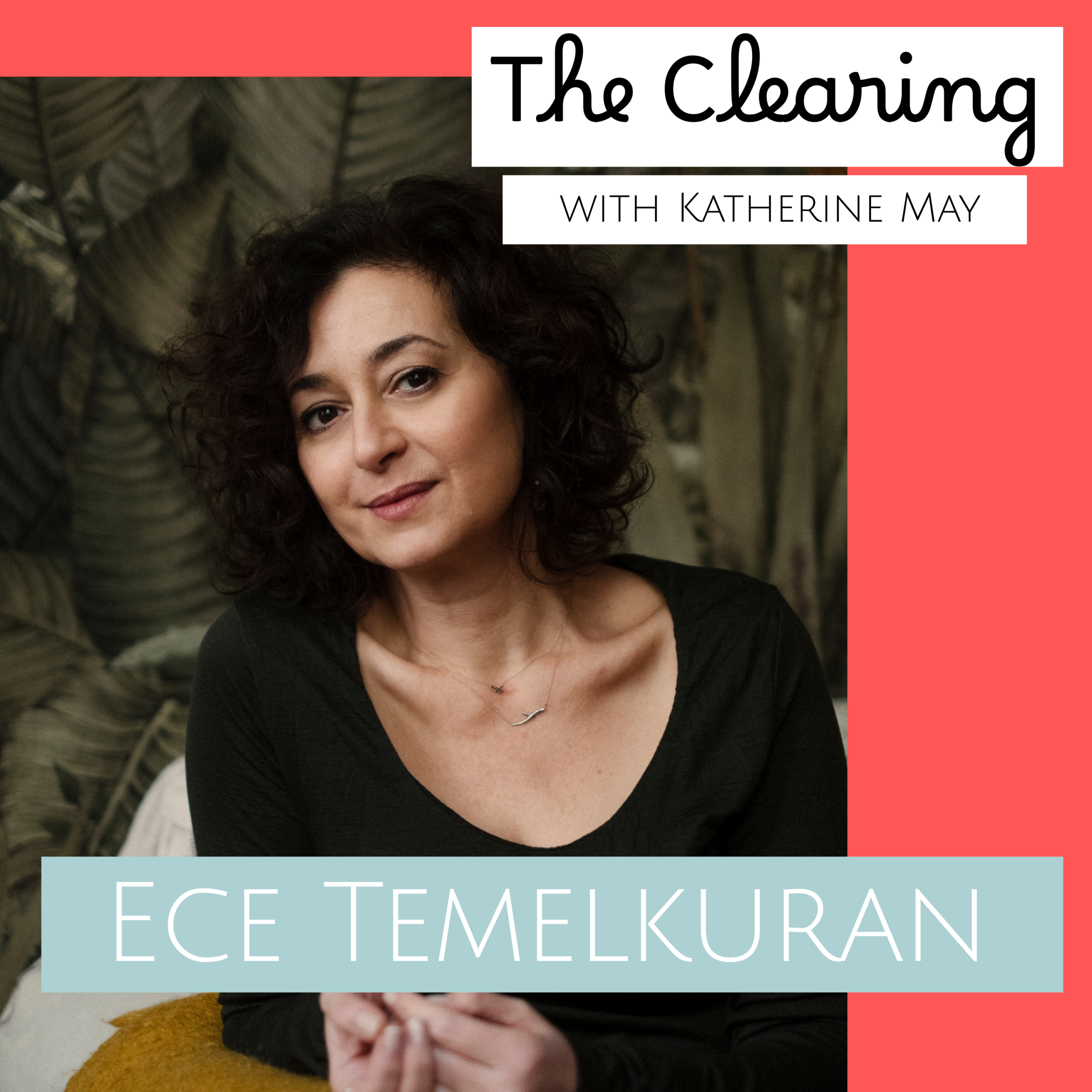
A modern sage who forewarned the world of the rise of fascism, writer Ece Temelkuran explains why she ‘put her heart in the freezer’ ten years ago when she fled her country of birth and how finding traces of home all around are helping her to heal.
From a beloved old cardigan to episodes of Downton Abbey, from being surrounded by Turkish food in Berlin to talking to her three favourite trees in the park; in this moving conversation Ece reveals the power of finding joy in the little things, as we collectively go through what she calls our ‘winter of humanity’.
A powerful call to arms and a must-listen for those of us searching for hope in difficult times.
Transcript
Please note this is an automated transcript and as a result it may contain errors
Katherine May: [00:00:00] Hello, it’s Katherine here, accompanied by my familiar soundtrack of shingle crunching on the beach on the best noises. I’m walking over a load of oyster shells right now. They have a particular jingle. It’s so nice. I am just taking a little break ’cause there’s always plenty to do in January. And I’m also trying to live out my sole New Year’s resolution, which is to remember to leave the house for things this year.[00:01:00]
Last year I was stuck in a lot looking after people trying to get my work done. In between things are settling and so easy to get out of the habit of actually stepping outside the front door for things rather than always feeling that there isn’t enough time.
I always say that walking creates time. ’cause you get to actually think rather than just act all the time.
It’s really important for me in my work and in my life to make sure I do that. But there’s a extra extension to that New Year’s resolution, which is. Particularly relevant [00:02:00] to my guest today, the brilliant Ece Temelkuran political philosopher, if that’s not such a grand word to use, an all round, deeply interesting woman.
Who writes about how we can resist the role towards right wing authoritarianism that we’re seeing throughout the world.
And one of the things she talks about is rebuilding communities, and that’s part of my small New Year’s resolution this year, which is to do more things in person rather than online. Listen, I’m an autistic woman. I have very happily run with open arms towards [00:03:00] the convenience of doing stuff online, and by stuff I mean anything from getting my prescriptions delivered to my door to ordering groceries.
To booking appointments or tables at restaurants. I have been so happy to do those things anonymously and without any social contact, because social contact is often very tiring. But what I’ve realized is that it’s very easy to wind up having no contact with other people, with strangers, and therefore to become almost likely suspicious of the outside world to see it as more burdensome than it needs to be.
One of the things that my husband’s illness [00:04:00] last year really showed me was actually how kind and helpful complete strangers often are. And it’s made me begin to try to reverse out of my default position of doing everything online if I possibly can. I started backtracking. I started getting my prescriptions from the local pharmacist who has been so helpful to us.
This year. I’ve started ordering in the basics for my groceries. You know, the boring things like washing powder, but actually wandering into town when I need some carrots or some onions, or whatever else it is that I can buy in the grocers. I know not everyone can do this, [00:05:00] and I’m very lucky to live by a row of good old fashioned shops where I can buy the stuff to make dinner.
But it’s right that I go and do it. Get some fresh air, say hello to people. Get to know them. You know, it’s one of the things that we all need to think about is how to, Ooh, sorry. I spotted a curlew and I stopped talking. Mid, mid word, not even mid sentence. I dunno if you can hear him on the recording.
That lovely fluting sound so beautiful this time of year. Sorry. Anyway, yeah, I felt a bit lonely towards the end of last year and I realized that some of that is definitely my own doing and that I [00:06:00] can trust people to just past the time of day. I’ll try and remember to check in on how my New Year’s resolution is doing, but you know what?
Already the step count has gone up on my Fitbit, which can be no bad thing at all. Anyway, that was a long way of saying that I think you will find edgy, brilliant, intelligent, fascinating, and inspiring. She’s, uh, a little lantern in the darkness, I would say. Anyway, you have a listen, see what you think, and I will be back a little later.
Ej, welcome to The Clearing. It is so lovely to have you here.
Ece Temelkuran: You too, Katherine. I’m like, it’s amazing to see you [00:07:00] again after a very long time.
Katherine May: No, it’s been a while. We first met in a very glamorous place in Switzerland, didn’t we? Do you remember?
Ece Temelkuran: Yes. No, my
Katherine May: place was amazing.
Ece Temelkuran: Switzerland, the mosts, glamorous place on, on the planet.
Katherine May: So fancy. Yeah. That was incredible. Um, well, look, I’m so, so delighted to have you here, and this is a podcast about how we take a break in hard times and how we kind of crave for rest. How’s your year been? How are you feeling? How, how much of a rest do you need?
Ece Temelkuran: Already living in January, 2026. Uh, so, um, the book is coming out.
Nation of Strangers is coming out in several countries. So in my head I’m in January already, like
Katherine May: Yeah,
Ece Temelkuran: yeah, yeah. Mid January. So, uh, and I was thinking how exhausting this is to live in two times, both in now and in the future, so to speak. Uh, my year has been, uh, well half of it was trying to finish the [00:08:00] book until May, uh,
Katherine May: know the feeling.
Ece Temelkuran: Yeah. And I live, and I moved to Berlin like two years ago and I started writing the book until May. I didn’t really. Connect it to anyone. I didn’t do anything. And by May I kind of raised my head, oh, here it is, Berlin. There are people living here. So since May it’s a little bit more humane. Uh, but yeah, I, um, at the moment in the future already.
Katherine May: Yeah. I think, um, a book launches are so hard in a way that’s really hidden from the outside world. Like, it doesn’t sound like a very hard thing to launch a book, but it just, I think particularly when you’ve got multiple countries that you’re thinking about, it just feels like a lot of stuff coming at you at once.
And your mind feels so scattered. Well, mine does. Anyway.
Ece Temelkuran: You know, what is most interesting about these, uh, this period, you know, book coming out to the world is that you write a book, uh, it has [00:09:00] deeper, you know, meanings for you. Of course it comes from a very deep place and so on, but then you have to. Rip up the meaning of the book formulated in punchlines, so to speak.
You know, the world pushes you to do that. Yeah. And resisting that, uh, sort of obligation and also having to do that in a way, uh, it’s kind of, this is the period right before the book comes out. This is the period where you have to redefine the book, uh, for the outside world. So it is interesting. Yeah.
Katherine May: It’s like brain Jim.
Ece Temelkuran: Yeah. It’s like wrapping your baby Yeah. In nice clothes or, you know, wraps so that people like it kinda,
Katherine May: yeah. And you, it sounds, I’ve not read the book yet, I’ve not had a chance to yet, but, um, nation of Strangers, it’s sounds like it was quite a big project to pull together as well.
From the format is letters between strangers, right.
Ece Temelkuran: Yeah. Uh, it is [00:10:00] written in letters in that sense. Um, you know, it’s a series of letters, but these letters are also chronological, so it looks like a diary a little bit as well.
Katherine May: Right.
Ece Temelkuran: So it tells the story about, it tells the story between me and the world in a way.
Katherine May: Mm-hmm.
Ece Temelkuran: Um, it was a big, uh, ambitious thing to do. Uh, and one of the reasons, uh, that this is a special project, so to speak or work. That this is the first time I think I really talked about myself. Um, you know, it is the conclusion of a 10 year long sentence. Mm. Uh, and this sentence began when I left Turkey in 2016, when I started writing How to Lose a Country.
And it carried on with together a manifesto against the heartless world. And then now it is the completion of a period in my life. It’s 10 years, like, uh, [00:11:00] the return journey of ore in a way. Yeah. Yeah. So I am returning home, um, and also I’m returning to literature a little bit.
Katherine May: Mm-hmm.
Ece Temelkuran: Uh, because when I left the country, there was this urgency, uh, that I, I, I felt.
I felt like I have to write about politics. I had to write about, uh, you know, what’s going to happen in Europe and in western countries in general about fascism, about the political insanity that they will witness. They will suffer.
Katherine May: Yeah.
Ece Temelkuran: Um, and then came together as the solution to today’s political insanity.
Uh, and I write, wrote about values, politics of emotions, and several other things in that book. And finally, I think I had the stamina or the courage to talk about myself. And you can read it as I think, um, as a, you know, I don’t [00:12:00] know, something like, what does today’s world do to a person?
Katherine May: Mm.
Ece Temelkuran: This is the, you know, this is the account of that, I think Nation of Strangers,
Katherine May: well, I mean.
You’ve been living for a decade now, outside of a sense of safety, I think kind of under slight threat because of the things that you’ve said and how they land in your country. You’ve been living a fairly itinerant life, you know, living across different countries. You’ve been, you’ve been this extraordinarily powerful voice.
Predictive voice of like the, the political situation that you could see coming, but which we were often too complacent to believe could happen to us. It’s not surprising. That’s quite tiring. I mean, I, you know, hate to hate to suggest it, but that’s, that’s a lot to have carried with you for,
Ece Temelkuran: well,
Katherine May: a
Ece Temelkuran: decade.
You know, [00:13:00] there were several tiring or exhausting things to be honest. Uh, but one of them was, um, you know, when I. Came to Zagreb, uh, from Turkey after the attempt and after the life has become absolutely unsafe for me at home.
Katherine May: Mm-hmm.
Ece Temelkuran: Um, I didn’t have a plan. Um, I literally came to Zagreb with, uh, two shirts and one pair of pants.
I was going to stay there for three days and then go, go back home. And then after sleeping one night and feeling that, oh, this was what sleeping looked like, sleep, um, I decided to stay like suddenly. Um, so leaving the country like that without a plan was, you know, made my life, you know, a little bit hard, I think.
Yeah.
Katherine May: Tricky. Yeah.
Ece Temelkuran: But, you know, then I started writing How to Lose a Country when it was published. Um, I went around the world for two times, uh, almost, uh, telling the audiences what’s going to happen from [00:14:00] Australia to, I don’t know, New York, Washington, and so on. Uh, the most tiring thing was. That people, as you said, they were in a bit of, uh, denial, so to speak, and I understand that like, you know, a woman coming from Turkey saying that, uh, what had happened in her crazy country will happen to them.
It was, uh, I think it was hard to bear that, no, that idea. Um, and it was hard to tell everything over and over again and not, and seeing people were not convinced. Mm. I’m like, here’s a funny story. Have to lose a country. I. The original subtitle was Seven Steps From Democracy to Dictatorship. And I wanted subtitle to be from democracy to fascism.
And none of my editors in Europe thought that, like, what are you talking about? What’s fascism? You know, that’s a retro, uh, concept.
Katherine May: That’s sofa.
Ece Temelkuran: And then now it’s republished with a new [00:15:00] preface from Canon Gate and the subtitle is Fascism. And all my editors in Europe want that word in the subtitle. So this is how the world changed.
Katherine May: You must get so frustrated with the outside world. You are, you are five years ahead of everyone all the time, if not more. It must drive you crazy.
Ece Temelkuran: Well, one has to mature, uh, enough not to say I told you so,
Katherine May: do you though?
Ece Temelkuran: No, I mean, like, the thing is when you write such books about such subjects, you cannot, uh, indulge in yourself.
I mean, like, you cannot feel triumphant to, uh, you know, to see that you are, you, you have predicted things. Yeah. Rightly.
Katherine May: Yeah.
Ece Temelkuran: It’s like, you know, oh, you are suffering. And I told you that already.
Katherine May: Yeah. Yeah. It’s hard to feel pleased when that, when it comes to pass. Really? Yeah.
Ece Temelkuran: Yeah. I cannot go basking in that.
Um, yeah, I think the exhausting thing, which Nation of [00:16:00] Strangers, uh, came out of is that when I left the country, when I saw the political situation and when I had that urgency of telling about the new form of fascism, I made a pact with myself. I said, uh, you know, be, because suddenly I realized that, you know, losing a home or leaving the country, it will get to me, it will be really painful.
So I made a pact with myself saying that, uh, I am going to put my heart in the freezer. And I literally imagined the organ, the heart in the freezer, in the fridge,
Katherine May: held in suspension, not, not feeling all the
Ece Temelkuran: stuff, not feeling, because I, I, I, I felt like if I start to feel it, it will be impossible for me to think, you know, I will be, become pain, only pain.
That heart that I put in the freezer, I think was exhausted to be there for such a long [00:17:00] time. And in 20, 22, 23, when I started writing the book. That was the process that happened, you know, with Nation of Strangers. It was melting of the frozen heart. Um, and I wanted to talk about what is being un homed.
What, what being homeless feels like. Uh, because, um, and this is the, you know, main idea behind the book. It’s not my homelessness, uh, but the homelessness of our times because I noticed that many of us are putting our hearts in the freezer not to feel. Not to feel too much. We are asked by our times to numb ourselves.
And that is a very exhausting thing. So I think there is a parallel with my homelessness, uh, between my homelessness and the homelessness of the world, of the zeitgeist that we are in soul of our times because we are becoming homeless on [00:18:00] so many different levels. We are becoming morally homeless when such cruel things are happening in the world, and we have no institution to turn to.
That is moral homelessness. And you know, there are many political parties, but there is not that one political party that we would feel at home when we vote for.
Katherine May: Yeah.
Ece Temelkuran: And there is, with ai, there is this spiritual homelessness. I mean, there’s this thing that we created that speaks, and this idea, this knowledge in our head is, is so ingrained that if something speaks that’s human.
So we are encountering with an entity that speaks but not human. So that is making us ask questions such as like, what is human then? So we are losing our spiritual of home, of being human as well. Yeah.
Katherine May: Yeah.
Ece Temelkuran: And of course there is the physical, homelessness, refugee crisis, migrants,
Katherine May: which is, is growing and growing and growing all the time.
Ece Temelkuran: Yeah. And in London and several other places, people are lose afraid of losing their homes to [00:19:00] migrants, to refugees, which is a real, sometimes manufactured, but also a real fear as well. Mm-hmm. So I wanted to come, uh, bring together these, you know, my personal homelessness and the homelessness of the world and to tell people that this is what’s going to happen to you.
You will have to put your hearts in the freezer. You will have to ask yourself what dignity is. ’cause one of the big concepts when you, you have to face after becoming homeless is dignity. And then you will have to learn to live on. Other people’s kindness because that becomes your home, the only home that you can build.
That’s why the subtitle of the book is Rebuilding Home in 21st Century. Yeah, yeah.
Katherine May: So it’s re it reconnecting with that idea of a sanctuary, like a, a place where we feel safe and secure, which feels Yeah. Increasingly distant for, for so many people. And, and I think we can see on the [00:20:00] horizon that it will be more of us.
Ece Temelkuran: Yeah, okay. I mean, like, you talk about these things, wintering and so on, like we are in a winter of humanity and, uh, I think this should, this should humble us and this should make us realize that we have nothing but each other. And sometimes there is not even hope. And, but then we have to believe that having each other is enough and we have to have faith in each other, in ourselves, that we can rebuild something new, a new world, and so on.
But then one has to. Become humble enough to accept this fact. And if I may connect it this, to how to lose a country, one of the things that stopped people understanding what’s happening to them and therefore act upon it was, uh, that their arrogance, I think they weren’t humble enough to accept that, yeah, my country can, can go through something Turkey that crazy country went through.
So yeah, humility is [00:21:00] something that is very much in the heart of nation of Strangers. Something I think we don’t think about because that concept such together with love and impression, uh, is so much monopolized by religion.
Katherine May: We, I tried to write a book about humility a couple of years ago and everybody was like wary of it as a concept.
Like I think it’s one of the most important qualities that we, and it, that we can practice. ’cause I, you know, it is, it’s hard, it’s hard to allow yourself humility. Like it’s, it feels much more protected to not. Allow humility in.
Ece Temelkuran: Yeah.
Katherine May: Um, but actually, yeah, people were just very wary of the idea of it and of
Ece Temelkuran: I
Katherine May: telling people to be humble.
Was sinners like quite politically difficult as well.
Ece Temelkuran: Yeah. But then I think there’s a political reason behind it that we don’t really acknowledge. Mm-hmm. Uh, and there is a big, you know, letter about this in national strangers. I think that [00:22:00] we have the fear of equality.
Katherine May: Yeah.
Ece Temelkuran: Although we ask for equality deep inside, we are contaminated by this neoliberal morality or lack of it rather lack.
We feel like if we are equal, we are pulled down. So there is a fear of equality, you know, uh, that is stopping us, uh, from being humble. There is some sort of fear connected to that lack of humility, uh, but then only with humility, I think we can create real relationships that can become our home in this un homing century.
Katherine May: Everyone wants to be above equality.
Ece Temelkuran: Yeah. I’m like, I’m talking about these concepts quite a long time, especially since together, like love, humility, compassion, uh, and so on. And I. You know, when people, especially politicized groups hear about these concepts, they go like a little bit [00:23:00] suspicious, so to speak.
Is a pastor talking as a reverent?
Katherine May: Yeah, it is. Is the, is this religion? Wait, no, don’t trick me. Yeah,
Ece Temelkuran: yeah. But then I think there is some sort of arrogance there as well. Let me tell you a funny story. Uh, Vienna, I was in Vienna in a symposium and I was talking about humility, care, love, and so on. And then suddenly I’m like, abs, I didn’t plan it.
I went down the uh, stage and I started shaking people’s hands and I said, we should go back to the, not go back. We should adopt these, um, gestures of humility, gestures of love. Uh, we should reclaim them from the church. You know, normally in a church, people would do that.
Katherine May: Turn
Ece Temelkuran: around, hello, how are you? How, how are you know, da da da.
Katherine May: Yeah.
Ece Temelkuran: We don’t do that as if politics is is some another plateau that we are living in Higher plateau. No, I mean like, and people need this. It’s a very, very lonely time that we are going through and people [00:24:00] need to be held.
Katherine May: Yeah.
Ece Temelkuran: And that’s the only thing that would make them feel at home. I think. At least it’s for me and that’s why I wrote Nation of Strangers.
Katherine May: I think your instinct is right, but AJ let’s take you into this space of rest them because I am really curious to know how someone who lives your life that is so full of like big, important ideas takes it easy. So I’m gonna invite you into my clearing in the woods. Okay. Welcome. Tell me what it looks like for you.
Tell me what landscape if, when you are in need of arrest. Whether it’s an imaginary landscape or where you actually go, tell me what landscape you’d turn to to rest in, where in the world or the universe would feel like, a place that could hold you.
Ece Temelkuran: I can give you an exact picture.
Katherine May: Perfect.
Ece Temelkuran: Uh, the sea, but then, uh, between the sea and me, there should be, uh, branches of a [00:25:00] tree.
Katherine May: Oh, lovely.
Ece Temelkuran: So I have to look at this picture, which I did, by the way, last summer. I was so, so exhausted for three days. I literally sat down, did nothing, spoke nothing, wrote nothing. And then I looked at this, you know, branch and the sea behind, uh, that was, I think without noticing, I was meditating somehow.
Um, I’ve never practiced meditation, but then now I know that this is meditation. Like there was zero thought in my head because my head was, my brain was so exhausted. So I just looked, uh, listening to the, uh, what do you call them? The, uh, the, the, in the, the bugs. The, the
Katherine May: chica chicas. Like a chicas?
Ece Temelkuran: Yeah.
Yeah. Or crickets or,
Katherine May: yeah.
Ece Temelkuran: This was in Greece. So a lot of chicas. Um, yeah, they
Katherine May: really make a noise.
Ece Temelkuran: Yeah. But it becomes meditative after a while. So this is where I let it go, as you say, or rest really.
Katherine May: So it’s that, [00:26:00] uh, kind of Mediterranean sea, particularly that very kind of blue.
Ece Temelkuran: Yes.
Katherine May: And I’m thinking cypress trees or part or those lovely kind of large pine trees.
Ece Temelkuran: Large pine trees,
Katherine May: of course. Yeah. They smell really
Ece Temelkuran: delicious. And the Yeah. And the smells. Yeah, I know. I mean like, that’s also my childhood. I’m like, I grew up in his me, so those trees, the smell and the sound of chicas.
Katherine May: Mm-hmm.
Ece Temelkuran: And I don’t know, for some reason the, those I think, um, make different sounds in Turkey or maybe they’re different sound.
They, they, they’re different birds. I dunno. I have a nomadic grandmother who might talk about in nation of Strangers in a section. Uh, she was a little bit crazy because she was homeless as well. Um, homeless in a sense that, you know, she had to live in a city and she taught me when I was very young, um, how the birds spoke.
She was translating birds to me. So yeah, that sound of those. Santa Chicas, that [00:27:00] branch sea and staying Absolutely. Still, that’s my, that’s my cleansing, so to speak.
Katherine May: That’s really lovely. And if you, if there were a place that you were staying in, would you, like if you were, if you were finally taking that rest that you need, would you take yourself to like a spa, hotel or something like that?
Or would it be a, a hut or a cabin on your own or a family residence? Like where’s the, where’s the place that you’d like to, to rest in where that view is? Through the window.
Ece Temelkuran: Oh God, no. I mean like, this is very much connected to what is home, where is home kind of thing. Yeah,
Katherine May: absolutely. Yeah.
Ece Temelkuran: Uh, and recently I thought what represents home to me is so interesting.
Uh, it’s my grandmother’s house, but it, this is a moment mm-hmm.
Katherine May: In
Ece Temelkuran: my grandmother, and it’s a particular, uh, object, actually, it’s a stove. Uh, this French style, uh, big, large stove,
Katherine May: like the [00:28:00] ceramic ones kind of
Ece Temelkuran: thing. Yeah. The metal ones. Yeah. Where you can also cook, you know? Yes. And also it’s Yeah, yeah.
Katherine May: Hates the house and cooks and does exactly
Ece Temelkuran: like,
Katherine May: does everything. Yeah.
Ece Temelkuran: I think my ultimate fantasy about a home is to have a place wherever it is, and to have this cuisine, as we call it, and I think it’s a French word.
Katherine May: Yeah. Yeah.
Ece Temelkuran: Uh, this, uh, so there, um, but then, you know, when you ask that, it’s also, you know, walking in the woods.
Katherine May: Mm-hmm.
Ece Temelkuran: And yeah, I’m now in Berlin. So there is a very small park, very close to my place, and every morning I’m going there. Uh, and this is the first time I’m telling it to someone. I shouldn’t be telling it, you know, on a podcast probably.
Katherine May: You need to keep it secret.
Ece Temelkuran: No, there are three trees that I say hello to every morning.
Uh, it is. It, you know, kind of connects me to, to the actual world, I [00:29:00] think, to the real, not real, the truth of the world, not the world, real world itself, but the truth of the world. And it centers me in a way to speak to the trees. And I speak sometimes a little bit longer, to be honest.
Katherine May: I, I too have a chat with certain trees, so please don’t feel embarrassed here.
We’re, we’re all tree talkers and some trees really demand your respect, I think.
Ece Temelkuran: Exactly. I mean, like, I, I, I, I, I imagine them being happy. It’s, especially this vow tree vow, do you call it Willow tree? Yeah, Willow,
Katherine May: yeah.
Ece Temelkuran: Yeah, that’s
Katherine May: right.
Ece Temelkuran: Vow tree. I mean, like today I looked, I’m like, there was no single leave.
And I said, oh, oh, sleep. Sleep. Well darling. I’ll see you in winter, in spring.
Katherine May: I’m sure they’re really, they love your, your attention. I’m
Ece Temelkuran: sure. Hopefully, I’d like to think so.
Katherine May: Do the, do the woods feel right in like mi the middle of Europe, in Germany or wherever you are, do they feel like the right woods or are they, are they the woods you actually crave?
Ece Temelkuran: This is such a good question because now I am spending a little bit [00:30:00] time in Greece and coming back and forth. Uh, you know, there is a big difference in the, you know, natural habitat obviously. And you know, the small trees where you can reach the top of it, like these orange trees, tangerine trees and so on.
It feels so, I dunno, Hobbit like, it’s so cute. Whereas you come to Germany and you have these sturdy trees, male almost. I don’t know. It feels those trees feel male to me.
Katherine May: Yeah.
Ece Temelkuran: Whereas, you know, those
Katherine May: sliding trees. Yeah.
Ece Temelkuran: Fertile small trees are female. Um, so yeah, I’m trying to connect to trees and, and this is very new in my life.
I would made, I would’ve made fun of these things, I don’t know, five years ago. I think it’s aging as well.
Katherine May: Yeah. Yeah.
Ece Temelkuran: And, and women as women age, they get more connected to nature perhaps. Uh, so whenever, wherever I go the, you know, uh, one week ago I [00:31:00] was in London and I went to Hyde Park just to say, see the trees, like, to say hello to trees.
’cause you never know. I mean, like in Germany, they might not understand English, these trees, but
Katherine May: you need trees that speak your language. It’s really important. Exactly. Yeah. Yeah.
Ece Temelkuran: Uh, so anyway, I, I, I, I looked at the trees and I thought, yeah, I should do this whenever I go because maybe trees tell the truth of a country more than the people do.
Katherine May: Hmm. I think that might be true. And how, and how we care for our trees is a, is actually a really big indicator, you know?
Ece Temelkuran: Yeah.
Katherine May: Like what we care for and whether trees matter. It’s one of those, one of those flags.
Ece Temelkuran: Yeah.
Katherine May: For me,
Ece Temelkuran: you know, when, you know, every, many things are lost in Turkey, but I think one of the biggest heartbreaks, like really biggest heartbreaks, collective heartbreaks was this, uh, big, uh, uh, [00:32:00] wood fire, like the forest fire, right.
That happened, that actually happens every year. But there was the, the biggest one
Katherine May: particularly,
Ece Temelkuran: and there was nothing that the government did, so. That broke people’s hearts. Yeah. In a completely different way. You know, you are get, you somehow get used to political crisis, you know, the political cruelty, but then cruelty to the trees.
Ah. That’s something else. And that breaks our heart in a d on a different level. I think so you are right. Yeah. How we treat our trees
Katherine May: makes those of sense.
Ece Temelkuran: It’s a moral and political issue really.
Katherine May: The, the wrong kind of mind sees a forest as potentially profitable land. That’s the truth of it. That that’s why it’s an indicator.
Yeah, because actually the trees are more valuable cut down to, to people that don’t understand how important trees are.
Ece Temelkuran: Yeah. I’m like, if people are trying to survive, like they’re starving and they need to cut for mm-hmm. I understand that. But for greed, that I don’t understand really.
Katherine May: Yeah. [00:33:00] I’m interested to know how this connects to food as well, whether there’s like a strong, um, yearning for a certain kind of food that would feel restful for you now, and whether, I wonder if the forest is the idea of the forest with its, you know, or, or with the citrus trees, connects to that idea for you.
Like what would feel restorative to you to be fed in in this time?
Ece Temelkuran: Oh, this is, I mean, like, this is the closest thing to home more than anything, I guess, food. Um, and there’s a funny section in Nation of Strangers about this because you see, uh, I didn’t want to come to Berlin. I lived in Zaga for six years.
One of the reasons was there was no Turkish community in Zagreb. Uh, this is a personal, you know, character, feature. Feature I think for me, uh. If I am leaving something, if it pains me, I don’t want to be reminded of it. I’m like, okay, my hand is hurting. Let’s cut it so it doesn’t hurt. It’s
Katherine May: that freezing again, isn’t it?
Ece Temelkuran: Yeah, yeah. [00:34:00] Radical solutions. Yeah. So coming to Berlin was particularly hard because there’s a big Turkish community here, so, and diaspora is such a complicated thing. Will you be part of it? Will you be frozen in time with them? Because when you come together with diaspora, there is nothing else but ho home that you know.
Mm-hmm. Mm-hmm. In several level, on several levels you talk about home and that is painful. Uh, but then I think there was a pride matter. It was a matter of pride for me not to talk about food. I didn’t listen to Turkish music for seven years, nothing. Uh, I didn’t read anything in Turkish, you know, I can say that.
Uh, so I was trying to cut that. You know, aching thing in me. So food was a big part of it. I was trying to get used to whatever, to not
Katherine May: trigger
Ece Temelkuran: food that is served in that country.
Katherine May: Yeah.
Ece Temelkuran: But Berlin, you [00:35:00] cannot escape
Katherine May: front of Turkish.
Ece Temelkuran: And now, like a humble person, I am going to the Turkey supermarket buying all the things that I miss and I’m cooking.
It’s so funny. When you are un homed, cooking becomes a, a long process of substitutes. You know, there’s, you know, we, you don’t have it here. So you use, instead of that, you use this other thing.
Katherine May: Everything’s like an analogy for the right thing. Exactly. It’s not quite the same, but everything’s, yeah. Yeah.
Ece Temelkuran: And at the end, you.
The outcome, the product is nothing. Yeah. Uh, anything like,
Katherine May: because e even the water tastes different. That’s the problem, isn’t it? Yeah. Like every little aspect just isn’t, isn’t right. Even like milk, you’d think milk would taste the same everywhere in the world. It doesn’t. Yeah. You know,
Ece Temelkuran: so it, you, it becomes more miserable, you see?
I mean, like, it becomes more miserable to eat that substitute food. Yeah. Rather than absolutely forgetting about it. So, I mean, like, it depends on how you treat, you know, connect yourself [00:36:00] to your pain. But this is how I disconnect myself from my pain in a way. But Yeah. But if you want to know, and I
Katherine May: always want to know about the food.
Like, that’s, that’s always the thing I go straight for
Ece Temelkuran: by the way. Um, I’m a good cook.
Katherine May: I could guess that about you.
Ece Temelkuran: Really. Awesome.
Katherine May: Thank you. I just guess from the way you talk, you just, uh, you can just tell
Ece Temelkuran: I can eat well, I can cook well. Yeah, that’s fine. So it’s Sarma, uh, which is also called Dolma.
Mm-hmm. Uh, wine leaves. Yeah. Stuffed wine
Katherine May: leaves.
Ece Temelkuran: Yeah.
Katherine May: With rice inside.
Ece Temelkuran: With rice and herbs. Um, and Isme style. That’s a different style. It’s very, very thin, like, you know, pinky thin.
Katherine May: Right.
Ece Temelkuran: Uh, so yeah, I like to make that and I also love to eat it.
Katherine May: Oh, lovely. And you’ve been reunited with that, have you, in Berlin?
Ece Temelkuran: Yes, actually I am.
Katherine May: That’s really good.
Ece Temelkuran: And it’s, it’s a, a lot of labor to do that, so I don’t do it like every other week, but [00:37:00] I do it sometimes.
Katherine May: No, that’s a big thing. I love that. Okay, so yeah. So. So a lot of this rest is like a return to identity after a long time of, of trying to avoid it. Um, we always ask our guests as well, if there would be an object that they bought with them to this retreat, this place of recuperation that would soothe them or comfort them.
Is there something like that for you? Is there something you’ve carried around the world with you that has reminded you of home?
Ece Temelkuran: Yeah. For a very long time, uh, there was this old cardigan, uh, and I wore it while writing how to lose a country and together. And then during pandemic, uh, this is a very, uh, I don’t know, metaphorical story.
I think, uh, during pandemic I wore. Knit myself a massive, massive shawl. I mean, it’s like a blanket. The funny bit is, as soon as I came to [00:38:00] Berlin, uh, by accident, I washed it in hot water. And now it’s very small.
Katherine May: No, it’s like a tiny, tiny,
Ece Temelkuran: yeah.
Katherine May: Oh.
Ece Temelkuran: So it was like, there is no, it was my cocoon.
Katherine May: Mm-hmm.
Ece Temelkuran: So now I have no cocoon to go back to.
I have to rebuild a home, a new home, obviously. So that cardigan is still with me. I’m not wearing it anymore. I think I kind of cut my umbilical cord with home, the old one. Uh, but yeah, that cardigan, it’s very old.
Katherine May: What color? I
Ece Temelkuran: need
Katherine May: to picture it. What color was it?
Ece Temelkuran: Uh, it is grayish, um, blue.
Katherine May: Ooh. Like it’s, yeah.
Like it,
Ece Temelkuran: and it’s not fancy at all. It’s really like, no. You know, everybody hates it except for me.
Katherine May: The only problem I’ve got is I’m picturing this place being warm, and then you’re in a cardigan, which I’m finding really troubling. We need, we need some cold weather for you. So you,
Ece Temelkuran: yeah. Zab was cold. Uh, Hamburg.
I was in Hamburg for one and a half years. Hamburg was Oh, ooh. Very cold.
Katherine May: Yeah.
Ece Temelkuran: Yeah.
Katherine May: That must have [00:39:00] taken some, getting used to after, after living in Turkey all your life.
Ece Temelkuran: Yeah. I mean, like until Hamburg weather has not been a subject in my life, and I always found it a little bit funny that British people constantly talk about weather.
Katherine May: Oh yeah. We can’t stop, we just can’t stop ourselves. I’m so sorry.
Ece Temelkuran: It’s like a folk folkloric thing, I guess. Yeah. Anyway. But yeah, in Hamburg. Every day talked about weather.
Katherine May: Yeah, that’s right. That’s right. You just, when the weather is so changeable, you have to talk about it because it just, it’s crazy making to like,
Ece Temelkuran: so
Katherine May: Im not making fun of those people anything.
Oh, do do it. We know we’re obsessed. And what, um, what would you do all day if you were resting? Are you the kind of person who can sit, you know, sit still, or are you someone who rests in motion and who would be going out walking or, or doing something? Are you able to stop?
Ece Temelkuran: Um, when I’m really, [00:40:00] really, really exhausted.
Which is very frequent by the way.
Katherine May: Yeah, I can
Ece Temelkuran: imagine. Um, yeah, I literally, you know, have my breakfast and then lie down on the sofa. Turn on Netflix or whatever, something and something absolutely ridiculous. Uh, well, yeah. And then watch it and doze off.
Katherine May: Yeah.
Ece Temelkuran: Well, to be honest, actually, okay. I, I’m, I shouldn’t be saying these things.
Katherine May: Sorry.
Ece Temelkuran: For two years, uh, especially while writing the book, my antidepressant thing was Downton Abbey.
Katherine May: Oh, you’re a Downton fan. Yeah.
Ece Temelkuran: Well, I think I watched it for three times back to back again and again. And mostly for Maggie Smith. I’m so sorry that we lost her.
Katherine May: She’s wonderful. Yeah. I mean goddess.
Ece Temelkuran: Yeah, goddess, yeah.
Goddess. Exactly. Yeah. I should turn her into a novel [00:41:00] character, like a proper one. Um,
Katherine May: is there, is there like a Turkish version of, of Dane, Maggie, like I, it feels like she’s a universal female character
Ece Temelkuran: in, you know, I wrote this novel, women Who Blow a Knot and there is a character that, that Madam Lila and.
Downton Abbey happened much later, and I thought when watching Downton Abbey, oh, this is Mme. Miller. You know? Yeah. It’s so, so similar.
Katherine May: Yeah. Those
Ece Temelkuran: kind of
Katherine May: flinty.
Ece Temelkuran: Yeah. S larger than life.
Katherine May: Yeah.
Ece Temelkuran: You hate it, but you love it. Yeah. They’re kind of, yeah.
Katherine May: In charge of everything. Yeah. I mean, I find things like Downton quite difficult because you’re British.
Represent. I’m, because I’m so, yeah. Because I’m so chippy about the British class system, basically. Of, of course
Ece Temelkuran: it is horrible, politically horrible. That’s why I shouldn’t be talking about it, but I know,
Katherine May: but it’s so beloved. I, um, I had an eye test recently, um, with an optician, a young, uh, Nigerian woman.
Um, and she, she’d only been in the country for three [00:42:00] years and, uh, I was chatting away and she suddenly said to me, she suddenly said, well, of course, I mean, you have debutantes balls, don’t you, when you are a teenager, so you’ll have, you’ll have been through that. And I was like,
Ece Temelkuran: what? No.
Katherine May: I was like, do you watch?
She’s like, yeah, I love it. And I was like, you have such the wrong impression of what, what we actually get up to. I sort of loved it that she, she imagined me as a teenager in this giant fluffy frock like being introduced into society like that, that did not happen.
Ece Temelkuran: Well, I mean, like, yeah. One wants to think written like that.
Well, anyway, it, it’s a politically very, very wrong thing to watch. But then Yeah, you know what? It’s dirty watching these things because these people do not have real problems.
Katherine May: Yeah.
Ece Temelkuran: So it’s like super, I don’t know, relaxing otherwise, I mean, like, if you want to know. What I am fan of. Really? That would be Peaky Blinders.
What I assure you
Katherine May: is a is a
Ece Temelkuran: fact. Old
Katherine May: Peaky
Ece Temelkuran: Blinders. Yeah. That is Peaky [00:43:00] Blinders like forever or that’s kind of thing. But then, you know, when I’m really don’t want to think, yeah. I’m doing politically incorrect things, let’s put it that way. I
Katherine May: I totally get it. Like, you can’t, you can’t be pure, you know, pure minded all the time.
Like I think you probably, your escapism is Yeah. Into enjoying Downton, which I think is great. I, you, you may have as many of those as you, like, when, when we are hosting you
Ece Temelkuran: Yeah. Whenever I’m writing a book, uh, there is this, you know, I dunno, it’s like a little bit obsessive compulsive thing. For instance, I listen to the same music for
Katherine May: Right.
Ece Temelkuran: For one year.
Katherine May: Yeah.
Ece Temelkuran: Anyone who’s living with me would drive crazy for this book, nation of Strangers. It was Jacqueline Dere. I listen to her for one more than one year over and
Katherine May: over again. Yeah.
Ece Temelkuran: Then Downton Abbey now. Now and then when I’m really desperate. I went to Downton Abbey. You know, these things are like, I, I think it’s about being, [00:44:00] feeling at home again.
This repetition, you know, when you’re a child, repetition gives you the sense of security. It’s not much different than that, you know?
Katherine May: Yeah. There is repetition, I think. I think writing is very ritualized, actually. I think we all have our kind of weird rituals. Yeah.
Ece Temelkuran: What’s yours?
Katherine May: Weird thing. I pulled tarot cards before I sit down to write.
That’s the first thing I do.
Ece Temelkuran: I
Katherine May: come to you
Ece Temelkuran: and
Katherine May: I can’t kind of get into it. Doubt it. Yeah. I find it. I mean, I’m asking for my own state of mind really, and I, I just find it makes that transition for me into. Thinking about thinking almost, you know, it’s sort of, it kind of takes me into that slightly meta space where I’m thinking about how I’m thinking, what sort of mood I’m in this morning, like how it’s gonna, whether it’s gonna really work, you know, it, it lets me surface that.
Um, and I also, I listen to the sound of the sea in my ears. I [00:45:00] can’t do music at all. Uhhuh. I used to listen to Thomas Tallis, like the kind of. 17th century, maybe earlier. Um, choral music.
Ece Temelkuran: Okay.
Katherine May: Um, which I really loved, but now I’ve simplified it. And for a while I listened to the Sound of Rain, but now I have Irish Sea.
Specifically Irish. Irish. Yeah.
Ece Temelkuran: That is absolutely very particular.
Katherine May: Yeah. It’s because be the app I’ve got has also got Icelandic Sea and I don’t like it. It’s not right.
Ece Temelkuran: Look at that. I
Katherine May: have
Ece Temelkuran: to check this out.
It
Katherine May: has to be Irish. Um,
Ece Temelkuran: I have to find Mediterranean Sea at some point. Yeah.
Katherine May: The Irish you think there is?
Yeah. Although it’s not very noisy. Is it the Mediterranean? It’s quite,
Ece Temelkuran: is it?
Katherine May: Well, it’s not crashing, you know, it’s not like
Ece Temelkuran: Yeah. It’s
Katherine May: impression. I mean, the Irish one is really noisy because it’s like banging itself against rocks with giant away. I’m, that’s what I need. The Mediterranean Sea is just too calm and too tranquil to record.
Ece Temelkuran: That’s lovely.
Katherine May: But yeah. Yeah. So I, I have the, I listen to that in my ears and I [00:46:00] I find that, yeah, it takes me into. Concentration really easily.
Ece Temelkuran: Yeah. Many soothing before starting to write. I think you, you know? Yeah, of course. There’s a little bit of fear every time you start and something has to soothe that fear and that those repetitions or, you know, rituals I think there to prepare yourself, like, you know.
Yeah. I can’t,
Katherine May: I think every single day I think I can’t do it still.
Ece Temelkuran: Really?
Katherine May: Yeah. Yeah. I still think, oh no, I won’t be able to do it today. I’ve got nothing.
Ece Temelkuran: Okay. Let me tell you something. Uh, I’ve been writing since I am eight. Uh, my mother bought me this poetry notebook and I thought I should write poetry.
Since a poetry notebook is bought for me, I didn’t know that I should recite poetry from written anyway, you know, this is how I started writing literally, really when I was eight. And since I was eight, there hasn’t been a day, I think, [00:47:00] uh, that I haven’t written.
Katherine May: Wow. That’s incredible.
Ece Temelkuran: And I also, I, I did journalism, so there wasn’t this luxury of, oh, I cannot do it.
You are supposed to do it. Yeah. Journalists just end of story. The words out.
Katherine May: Yeah. Yeah.
Ece Temelkuran: But then this summer, for the first time, I didn’t write anything for three more than three months. And my, uh, partner, he was even afraid of me. Like, you know, what’s happening to you? You’re not writing,
Katherine May: what did it do to you?
Ece Temelkuran: Um, uh, because for such a long time, you define yourself as a person who’s writing, constantly writing. Uh, and I always knew when I was even eight, I, I knew I was going to be a writer, so there was no, you know, debate about that in my head. But for the first time, I, while looking at the tree and the sea and so on, uh, I thought, what, who am I if I’m not writing?
Let’s, it didn’t happen intentionally to be honest, but it was. This is interesting, not [00:48:00] writing. Let’s try this a little bit.
Katherine May: What person is this?
Ece Temelkuran: Yeah,
Katherine May: yeah.
Ece Temelkuran: And it, it’s also about
Katherine May: did you, what did you learn about yourself?
Ece Temelkuran: Um, of course es especially if you are a woman, your self worth is so connected to what you achieve.
Uh, not only because of the system we are living in, but also because of patriarchy, but also because of whatever, like, you know, your childhood and everything. The other day I actually asked AI because some of my friends are using AI as therapist. Uh, it’s a growing thing and I asked AI, what is the most common problem that people talk to you about?
And it’s a self-worth. So self-worth is a big problem, especially for women, I think. So. That question, you know, who am I when I’m not writing is also the question of like, am I worth anything if I’m not writing? So it was a little unintentional [00:49:00] experiment, so to speak, not writing. And it was incredibly, uh, relaxing and clean.
Life got so much easier. Yeah.
Katherine May: Yeah.
Ece Temelkuran: Because you make your job not also, you know, everyday job, but also like internally, you know, in a, in a very spiritual way. You make it your job to write, whereas no, it’s not, you know, there might be a day that you might not best write aj this was the thing.
Katherine May: It sounds like, I mean, it sounds really useful.
I mean, my experience of not writing is more often being like, held away from it, you know, like early motherhood was like a
Ece Temelkuran: Yeah, yeah.
Katherine May: There was no, there was no writing. Like there was no anything. There was no like washing. There was no eating. There
Ece Temelkuran: was just, I know, you know, know. My mother told me it’s 10 years.
Katherine May: Yeah,
Ece Temelkuran: my mother is a, is a painter and I have a brother and I was 10 years. She, uh, studied again, drawing and I remember her crying. That’s
Katherine May: interesting.
Ece Temelkuran: And drawing and, you know, mourning for [00:50:00] those 10 years and Wow. Lost skills and so on. I mean, like, she’s now a very well known, uh, painter in Turkey. She has her own workshop and so on.
But yeah, motherhood. Did
Katherine May: she have that hiatus?
Ece Temelkuran: You’re allowed to do anything? You cannot, you cannot. Yeah, it’s incredible.
Katherine May: And I’ve just, I’ve been writing this, the book I’ve just finished today actually.
Really?
Ece Temelkuran: Really? Mm-hmm. Oh my God. Congratulations. That’s why you’re so happy.
Katherine May: I, I don’t, I don’t, the relief’s quite come to me yet, but I’ve been writing about this last year where I was caring for my husband when he got cancer.
And being, I’ve been writing about the experience of being held. I’m so sorry about that. Away from your work, you know, and like, how that, how desperate that feels really quickly, you know, this kind of, um, this fear that you are not all you, that you lose a bit of your personhood if you’re not making the thing that it feels important to you to make.
Like, it’s a very, very, very real, like I’ve, I don’t think I’ve ever had an intentional break. This [00:51:00] felt good. I love that you did. I love that for you.
Ece Temelkuran: Yeah. Yeah. I mean, the first time it was really interesting, but yeah, unintentionally, I dunno if I could bear that and like, you know, if I didn’t choose it, I dunno if I could bear that.
Katherine May: Yeah, it’s weird. It’s, it’s weird how it, yeah. It triggers all kinds of self-esteem things and, and fear. Like fear, raw fear. If you can’t,
Ece Temelkuran: you can’t. This was the reason I left Turkey, because I started, you know, it became impossible to write. Mm-hmm. Not only to publish, but also to write, because, you know, yeah.
That on that stage, at that stage, fascism becomes so fearful that you’re constantly thinking about what’s going to happen to you, so you intellectually get paralyzed.
Katherine May: Yeah, I’m sure. I mean, the, the sort of moral weight of of that is terrifying.
Ece Temelkuran: Yeah. So in order to write, I had to go. So I, I hear you when you say it’s,
Katherine May: yeah.
Ece Temelkuran: It’s, you know, yeah.
Katherine May: You [00:52:00] saved yourself and you saved your writing, which are Yeah.
Ece Temelkuran: Hopefully.
Katherine May: Yes. Really important. Well, I, I think, I think the evidence suggests that you did very well on that, at least. And the world is thankful.
Ece Temelkuran: That’s the other thing. When you’re away from home, there is this secret compartment in your behind your head.
Uh, you are constantly thinking about back home. Do they see me?
Katherine May: Mm-hmm.
Ece Temelkuran: Do they like me still? Although now I am writing in another language, uh, the compartment still secretly works. And, uh, there’s all kinds of complicated stuff going on in your head. After leaving home, you create this virtual self, you know, uh, that could have stayed at home.
Katherine May: Yeah.
Ece Temelkuran: And like
Katherine May: parallel life.
Ece Temelkuran: Parallel life parallelity and you are sort of comparing yourself to it. It it’s really complicated.
Katherine May: Yeah. Yeah. Yeah. Interesting. Well, that leads to my next question, which is I always ask if there was a, uh, a [00:53:00] cultural artifact that you could have with you, like a song or a book or a painting or something that would inspire and entertain you while you were resting, what would that be?
Would that be something that reminds you of home?
Ece Temelkuran: Hmm. Hmm. I don’t think so. It wouldn’t be con connected to home. I think it would be a book. No, it would be a notebook obvious,
Katherine May: more interested in creation than anything else.
Ece Temelkuran: Yeah, it would be a notebook and a pen. That’s it. I think, and this is, you know, for such a long time before leaving Turkey, this was this, this meant home to me, like desk and notebook coffee and that’s it.
Katherine May: Yeah. Always wanting to generate, always, always wanting to make the next thing.
Ece Temelkuran: Yeah. It’s speaking to yourself when there is nobody.
Katherine May: Yeah.
Ece Temelkuran: And yeah, I’m. [00:54:00] I’m doing that through writing, I think.
Katherine May: Yeah. Yeah. Hearing your own voice. Okay. So it is time for you to leave, time for you to leave the beautiful clearing, the beautiful sea, the trees overhang it.
Oh, thank
Ece Temelkuran: you. It was lovely.
Katherine May: How do you, but how do you know when it’s time to return to the world? Like when you’ve been on holiday or when you’ve taken a rest, what are the signals for you that begin to come in that tell you that you’re ready to reenter the world? Or, or do you ever reach that point?
Ece Temelkuran: Um, until last summer, it was so easy to tell I was getting anxious, like bored.
Uh, and then I was checking out what people are doing in the city, like, you know. Yeah. Whatever
Katherine May: you, your attention goes back to the, the busy places. Yeah.
Ece Temelkuran: But this summer, it was a very long summer and thank God it was very long. Uh, I didn’t want to come back. This told me something about myself.
Katherine May: Mm-hmm.
Ece Temelkuran: I think now I’m reaching [00:55:00] that age, I’m reaching that, not age, but phase rather where I really want to live a serene life and I want to go back to writing novels actually.
And yeah, I want that kind of serenity. So, uh, I am thinking still, I, I didn’t decide, but I’m thinking, shall I maybe go and settle down in Greece? ’cause Mediterranean is always good for writing novels. Um, yeah. Then I think again, at some point I decided to do, you know, some creative work this time, not writing, but an installation or in collaboration with some Italian artists.
So at the end of the summer I decided to go there. I think it was, again, creating something and creating with other people. I think that tells me it’s end of resting now. You’re rested enough. Yeah. Now you can give back to the world.
Katherine May: It’s so interesting to think about your [00:56:00] life entering a different phase, though.
Like you’ve done really important work for the last decade. You’ve tried to convince the world of what was coming. You’ve tried to show us how to, how to survive it. I’m, I’m really glad that you are looking towards a more restorative phase for you. You’ve earned it.
Ece Temelkuran: I am. I am actually, I think, yeah, 10 year enough.
10 years is enough. And also I might even go back to my mother tongue, which is a different kind of process. Yeah, yeah. Maybe literature my mother tongue, that will be the new home in a, in a way, creating something that will build a home for myself. Let’s see. But Nation of Strangers, um, I cannot wait to, to get it to the world and yeah.
You know, see people connect through this book. You’ve
Katherine May: got that work to do first.
Ece Temelkuran: Yeah,
Katherine May: yeah. Yeah. It’s important. It’s important.
Ece Temelkuran: It’s another year, by the way. Yeah. Like, you know, I, we talking
Katherine May: Yeah. It’s another year’s cycle that you can say. Yeah. But after that, after that
Ece Temelkuran: [00:57:00] perhaps. We’ll see.
Katherine May: Thank you so much.
It has been a
Ece Temelkuran: joy to speak
Katherine May: to you. You,
Ece Temelkuran: I’m so grateful. You too. I, it’s always a delight to be with you on the podcast. Best of luck with
Katherine May: the book.
Oh, it’s such a gray landscape walking out on this shingle in Wbul today. And by that I mean I love it. I know people hate the seaside at winter, but I think it’s fantastically good. So bleak. I love a bleak landscape. I don’t understand why people don’t like shingle beaches under rain clouds or marshland.
Oh, I set my little heart on fire. Honestly,
I hope you [00:58:00] got a lot out of that conversation. I really did. I feel so moved to talk to a writer, effectively living in exile. Unable to return to her country in fear of imprisonment. Who must really long for home sometimes, and who has created for us this beautiful landscape that I know I felt very calming to be in for a while.
Landscapes really matter. They’re full of sensory cues that speak to us of home. It’s not just the sights, it’s the sounds, the particular birds that cool. It’s the smells that rise up from the [00:59:00] particular trees.
It’s the way the wind feels where you are from. Mine is damp and only your little cold today, which is definitely how I recognize that this is wbul.
I hope you are all listening somewhere comfortable or somewhere bleak that makes your heart leap. And if you’d like to read more about Ece, there are a few links in the show notes. Ooh, did you hear me? Splashing a puddle. Then I nearly fell over, but not quite. I didn’t have to confess to that, but I felt like the honest thing to do, [01:00:00] and I really do recommend her books.
They are direct, sensible, wise, and wonderful. And, uh, a few more of us could do is reading them right. I’m off to harass some Green Grocers with my newfound fervor for being friendly. Wish me luck. Take lots of care. Bye.
Sam’s Links
About Ece
Ece Temelkuran is an award-winning Turkish novelist, a political thinker, and a public speaker whose work has appeared in the Guardian, New York Times, Le Monde, La Stampa, El Pais, New Statesman, and Der Spiegel, among several international media outlets. She won the Edinburgh International Book Festival First Book award for her novel Women Who Blow On Knots and the Ambassador of New Europe Award for her book Turkey: The Insane and the Melancholy. She is the author of the internationally acclaimed book How to Lose a Country and her most recent book, Together has been published in several languages and was shortlisted for the Terzani Award in Italy.