The Clearing with Katherine May
Joycelyn Longdon on imagining an abundant future
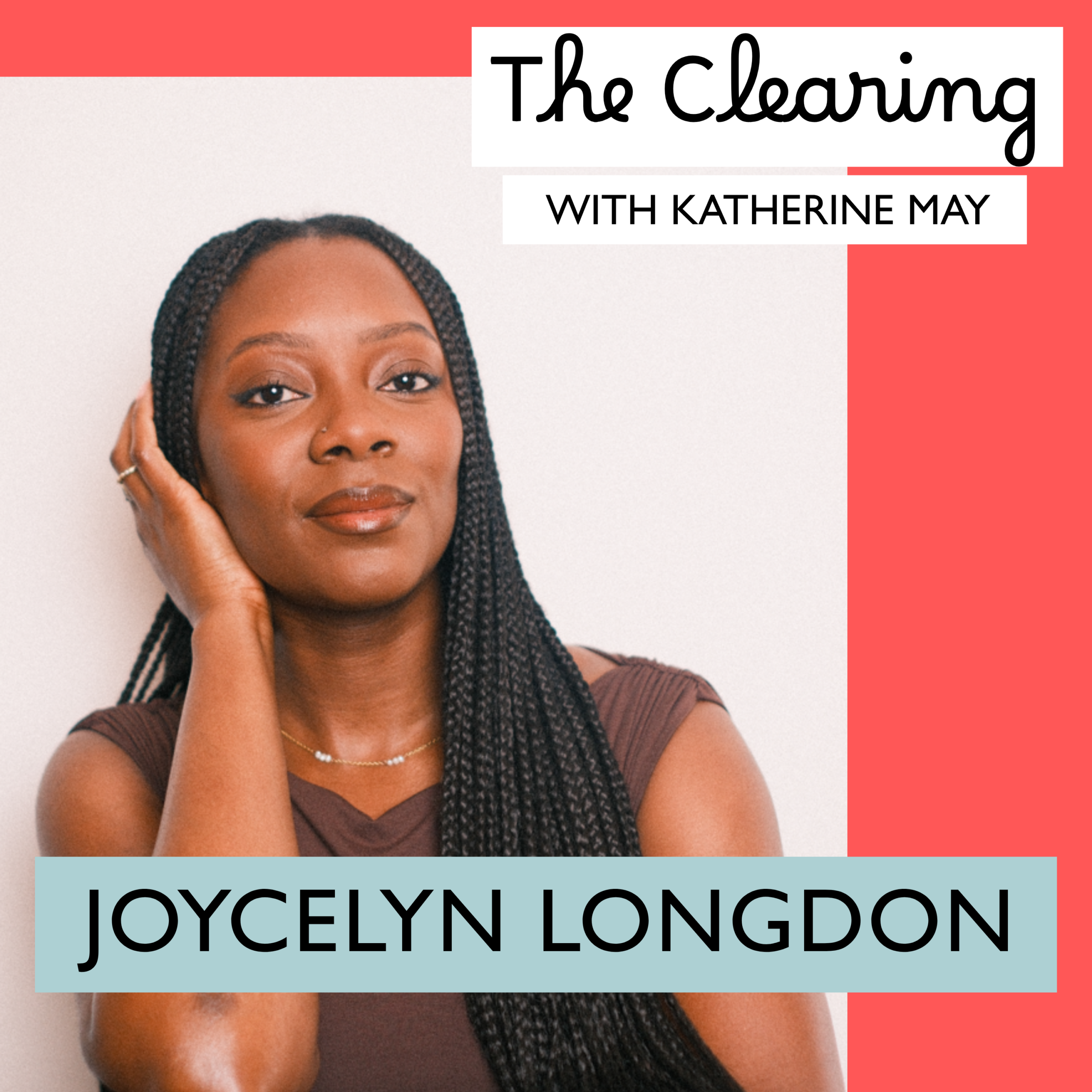
Trees as ancestors, blurring the boundary between our bodies and the living world, and constructing your sense of ‘self’ through art; these are just some of the beautiful areas of discussion between our guest Joycelyn Longdon and Katherine this week.
Joycelyn is a researcher and writer, currently finishing her PhD at the University of Cambridge, who bridges the worlds of ecology, technology and environmental justice.
Resisting the urge to pick a far-flung place, she goes extremely local for her small idyll, choosing a tiny patch of woodland by the river near her home, under her favourite willow tree, connecting to culture and mother earth.
Wonderfully dreamy and deeply grounding.
Transcript
Please note this is an automated transcript and as a result it may contain errors
Katherine May: [00:00:00] Hello? Here. I don’t know if you’ll be able to hear the birdsong while I’m recording, but I am in Wonder Meadow Nature Park in southwest London. It’s basically in Wimbledon, where the world-famous tennis tournament so beloved of my family will be taking place in a couple of weeks’ time But I’m here for different reasons I am staying up here at the moment because my mother is in hospital, in the cardiac unit, [00:01:00] having been taken very suddenly ill a couple of weeks ago, and I have been up in London ever since.
It’s a strange turn of events to suddenly drop everything and live someone else’s life
But there you go, that’s what we do sometimes, isn’t it? Things happen, and we get on with solving them. So I currently have a weird little Air- Airbnb flat where nothing works that’s extremely noisy, and I text the owner every day to complain about things. He hates me. It’s fine. It’s fine. My shoulders are broad.[00:02:00]
And I spend my days visiting my mum and making sure she’s being taken good care of and bringing her anything she needs, keeping her company. And in between I do bits of work and then I go to sleep. That’s where we are right now. I’m crossing a lovely little stream here with wild carrot growing from it. So anyway, every morning I walk to the hospital.
It’s about 15 minutes. It’s good for the soul. And normally, I must admit, I take the quicker route along the main road where everything is incredibly loud. [00:03:00] But today I’m taking a slightly slower route through the absolutely lush surroundings of late May. White flowers everywhere I read once that the colors of flowers come in shifts.
The first ones are blue ’cause the bees can see them the easiest, and then come the white ones. And my goodness, the white ones are here. They’re glorious. Everything feels lush and green, moist, everyone hates that word, it’s appropriate today, and alive. And I’m just walking past a giant willow tree that is sheltering a little clear stream that runs through this park [00:04:00] And that is perfect because you might recognize that motif in today’s interview. It’s with the social activist, writer, and current PhD candidate or in fact she’s just finishing up, Joycelyn Longdon, who is a wonderful young powerhouse of a woman and her book, Natural Connection, is all about the ways that we can restore community through connecting to nature.
She is [00:05:00] a wonderful presence to be in. I first met her when she interviewed me for her book, and I was desperate to get her on the podcast, but she’s been extremely busy getting her doctorate, so I’ve had to wait a little while. But now I get to share her with all of you. Her book has just come out in the States.
It’s been out in the UK a little while, so do get your hands on a copy. But we had a delightful chat about how to take, I think, probably mini retreats in the natural world Or maybe the better thing to say is retreats that can last any amount of time if you find your right spot And there’s also a lot in there about making friends with trees, which I’m sure you’ll know is one of my [00:06:00] favorite topics.
I’ll leave you with Jocelyn now for a while, but I’ll be back in a
Joycelyn Longdon: moment
Katherine May: Joycelyn, welcome to The Clearing. It’s lovely to have you here.
Joycelyn Longdon: Thank you so much for having me. This is- Yeah … it’s really wonderful to be on Zoom again with you.
Katherine May: Yeah, that’s right.
Joycelyn Longdon: It’s been a couple of years now.
Katherine May: Yeah, how long ago was it that we… ‘Cause you interviewed me for your book, uh- Yeah … Natural Collection.
Joycelyn Longdon: It was about, it must’ve been in 2021
Katherine May: Something
Joycelyn Longdon: Ooh, three something.
Katherine May: Time really flies Yeah. It’s, I mean, you- you’re just coming to the end of a doctoral study, aren’t you? Yeah So you have been in this incredible process after the, over the last few years. I… How are you feeling? Are you exhausted, or are you just bursting with energy for the next phase?
Joycelyn Longdon: I think I’m very exhausted. I think over the last, um, sort of four or five years I’ve been balancing quite a lot of things at the [00:07:00] same time. Yeah. Doing a PhD, kind of with field work, and also doing an interdisciplinary research program. Yeah. So, you know, drawing from a lot of different places, and a lot of things intersecting in that program in itself.
And then writing a book, and then working as a consultant and an advisor. And working with, you know, conservation organizations- Mm … environmental groups, and on creative projects. It’s been, I mean, amazing, like the most amazing experience, and I feel really grateful to be able to call all of this work. Um, but I’m definitely, yeah, realizing my body got me, has got me to sort of the finish line, and I’m, like, ready to- maybe enter a different sort of register. Um, yeah. I
Katherine May: mean,
Joycelyn Longdon: you’re
Katherine May: in the right place, ’cause this is a podcast all about rest. So, and I, what I love to think is that it’s just a sort of little hour’s rest while we’re recording as well. Yeah,
Joycelyn Longdon: yeah. Yeah.
Katherine May: I’m curious, are you, are you someone who gets away from it all, or, or takes [00:08:00] breaks, or do you tend to just k- are you, are you a Duracell bunny?
Joycelyn Longdon: I think probably from the outside, because of the amount of things I end up doing, it might seem like I never sleep and I’m constantly working. But, uh- We do
Katherine May: worry, yeah, for you.
Joycelyn Longdon: But I think it’s a little bit more nuanced than that in terms of what rest looks like for me. It doesn’t look like, or it hasn’t looked like over the last few years, like having big chunks of time-
Katherine May: Mm
Joycelyn Longdon: off or having like a, a predictable sort of schedule that has built-in rest. Yeah. But it does mean prioritizing movement and walks and being outside, and these sort of like, a, a building rest into- Yeah … and around everything.
Katherine May: Yeah.
Joycelyn Longdon: So it’s n- it’s not like I’m just working around the clock.
Katherine May: Mm.
Joycelyn Longdon: Um, but I think, you know, I’ve seen this stuff about different types of rest.
You know, it’s not, rest isn’t just this one [00:09:00] thing. Yeah. You
Katherine May: have,
Joycelyn Longdon: um, you know, rest can be active in ways, like creative rest- Mm, mm … which
Katherine May: is
Joycelyn Longdon: not just like lying down in bed and, and- Yeah … that kind of restorative rest. It’s a different kind of rest. And I think I’ve, I’ve not really had that really restorative kind of- Mm
of rest. And I think as I look to the future, I’m trying to figure out what it looks like to move every day in a slower register.
Katherine May: Yeah
Joycelyn Longdon: Which from today you can see that’s not happening that well.
Katherine May: Yeah. We are both- It’s very strange … for, for listeners out there, we are both recording in weird places today.
I had to book a hotel room ’cause things got so complicated. Yeah. So I’m in Premier Inn in Wimbledon- … um, home of tennis and the Wombles, and you are somewhere in a restaurant.
Joycelyn Longdon: I’m, I am in a restaurant, exactly, in Central London. Um, that’s just how today is going. But I, but I do think, you know, finding … The challenge for me [00:10:00] is fi- is that I don’t work, I, I don’t feel like I
I work because I’m passionate about the things that I do. Yeah. And I love being creative. And even in this period of time where I feel really exhausted, it, without trying, I’m having these creative ideas, and those things- Mm … give me energy. And so it’s, it’s like how do I balance needing that creative fulfillment- Yeah
which is what has made me juggle so many things at once, but also doing that in a way that feels, you know, kind of luxurious in a time sense. Yeah, yeah. Um, that things can happen slowly. And I think that’s something I’m still trying to figure out. Yeah.
Katherine May: But also there’s, there’s real kind of, there’s passion behind that drive towards environmental justice as well- Yeah, yeah
which makes everything feel really important that you do. Yeah. And that drives you forward. I, but, but it’s interesting, isn’t it? Because I think when we think about climate justice, when we think about, um, the inequalities that people are [00:11:00] experiencing due to various forms of environmental destruction- Mm-hmm
one of the things that does come up a lot is the subject of rest, actually. Yeah, yeah. And, and part of that, the justice that I think many of us are seeking is the ability for people to stop sometimes.
Joycelyn Longdon: Mm-hmm.
Katherine May: But- And, and I, you know, I always, I always think about that kind of deep ancestral past where we tend to think that people worked all the time to survive.
But actually when you look at the research- Yeah … the opposite was true. When we- Yeah … when we look at small scale societies, there’s a lot of leisure going on, and people only work when they have to, to, to get food. Mm-hmm.
Joycelyn Longdon: It, w-
Katherine May: that’s a, that’s an understanding we’ve really lost.
Joycelyn Longdon: I know. I mean, there’s this incredible, I’m probably gonna get it wrong, but there’s this incredible fact about medieval peasants having 150 days off during the
Katherine May: year.
Joycelyn Longdon: Yes. Like, that seems impossible for us now. 100%,
Katherine May: yeah.
Joycelyn Longdon: And I also think that often in the environmental space [00:12:00] there is this- Um, kind of maladaptive sense o- of relating, even though we’re trying to fight against, you know, capitalist systems and, and oppressive systems. Actually, there’s an ingrained capitalist idea around productivity-
Katherine May: Mm
Joycelyn Longdon: and about what you are doing, and how much you’re doing, and how much- Yeah … sacrifice you’re making as a direct correlation of how much you care.
Katherine May: Yeah.
Joycelyn Longdon: And so burnout and this very, like, structured and rigid idea around productivity is ingrained in our own approaches to environmentalism. Yeah. And for me, I always internally try to think about environmentalism as a project of futuring.
Mm-hmm. And I, when I think about what I want the world to look like if we are successful and are able to create more abundant futures-
Katherine May: Yeah …
Joycelyn Longdon: I wanna be chill. I want everyone to be happy- Yes. I want it to be nice … and to have abundance- Yeah … and to be rested, and to have freedom. Mm-hmm. And I think it’s [00:13:00] important that we use the
that we act as if the future already exists, and we- Yes … like practice our work in the way that we want it to exist, because- Mm-hmm … I think it’s unrealistic to think that you’re gonna get to this place through this, like, aggressive, you know, cap- you know, capitalist product- productivity centric, um, kind of approach.
And then get to the point and be like, “Oh, okay. Now we can all just be”
Katherine May: Yeah.
Joycelyn Longdon: You know? Uh,
Katherine May: it’s actually the trap that a lot of revolutions have fallen into in the past, in fact. Yeah. That if, if we can only get through this phase, then we can have the utopia. And it’s like, no, actually, at some point you have to start living the utopia.
Exactly. You have to start making the utopia.
Joycelyn Longdon: Oops, I dropped my notebook.
Katherine May: Um, I’m, I am working off a bar stool here, so just so you can picture it, with my laptop on a pillow.
We’re flexible.
Joycelyn Longdon: It’s- We, we, we are being really flexible today. [00:14:00]
Katherine May: Well, let us, let us go into your vision of rest. Mm.
Joycelyn Longdon: And
Katherine May: I’m gonna take you into my lovely clearing- Mm … which is any clearing you want it to be. Tell me where we find ourselves, where you would take your dream retreat.
Joycelyn Longdon: You know, there are so many places that I think I could imagine.
Mm. And often I think with these kinds of questions, you can be tempted to be like Scottish Highlands or like- … you know, somewhere really far away. But actually, my local woodland is such a beautiful place, and it’s a place that has brought me a huge amount of respite over the years. Um, it’s tiny. I mean, you can walk through it in, like, five minutes.
It’s not this sort of big, expansive place, but it is this hub in Cambridge that is just full of biodiversity-
Katherine May: Mm …
Joycelyn Longdon: and has the River Cam flowing through it. Um, there’s this really, really magical willow tree that [00:15:00] I have sort of built a relationship with there, and she sort of just arches over this huge space, and you can go inside her and be completely covered- Beautiful
by her branches. And so I think under that willow tree would just probably be- Mm. … my place. And it’s very realistic, so, um, as a way of keeping myself- Yeah … accountable. I mean, it’s, like, a five-minute walk from me and, and, and it has been a place of rest and respite for me in the past- Mm … um, and continues to be.
Katherine May: Tell me about this relationship with, with the tree, because I have relationships with certain trees. Um- Mm … I think some people would be like, “What? A relationship with a tree?” What, what does it mean to have a relationship with a tree?
Joycelyn Longdon: I think it’s about breaking down the barrier-
Katherine May: Mm …
Joycelyn Longdon: between yourself and that organism, not as [00:16:00] something external to you, but as-
Katherine May: Yeah
Joycelyn Longdon: not to anthropomorphize as a person, but, but as, as something else, not just an object. Yeah. Yeah. And I remember in our conversation years ago, you- Whatever it was. … said this thing, whatever it was. You said this thing that really, um, connected with me, which was about, like, the goal being to blur as much as possible the boundaries between our bodies and the living world.
And I think some trees enable, or, you know, whether it’s trees for some people, it might be the ocean for other people- Yeah … it might be rivers. Yeah. There are, there are beings in the living world that make it easier or make it more accessible to, to do that.
Katherine May: Yeah.
Joycelyn Longdon: Um, and I think it’s something that, that if you’re kind of starting a practice of noticing and attunement, you find yourself drawn to- Mm
a particular tree or a particular [00:17:00] river. And then it’s through effort, right? It’s like- Yeah … oh, I felt something there. But maybe I don’t make it. So in 2021 especially, I went and visited that tree, like, every day.
Katherine May: Right.
Joycelyn Longdon: And just went and sat by her or in-
Katherine May: Mm …
Joycelyn Longdon: in the sort of un- under the canopy, and then that gets normalized.
But then I think something else can happen after a year of going to the same tree almost every day- Yeah … um, and being d- a different person under that tree over a long period of time. Yeah. I, I think it’s, it’s an internal feeling that’s built up, and it definitely might feel weird or strange at the beginning, but I think provides a huge amount of solace.
Absolutely. I always think, I always think about trees, um, especially because they’re our ancestors, and- Mm.
Katherine May: Mm …
Joycelyn Longdon: especially old trees have seen so much. So
Katherine May: much, yeah.
Joycelyn Longdon: They have seen so much. Yeah. And I always kind of [00:18:00] feel the sense of safety in thinking about the trees that I walk past- Yeah … or visit on a regular basis, and like, you know, they’ve been watching me just this whole time- Yeah
and witnessing my life.
Katherine May: I mean, absolutely. And, uh, there’s obviously the Richard Powers novel, The Overstory- Mm … which is about the kind of, a- about life told from the perspective of a tree, and how small human life looks from that, that length of time, really. Mm.
Joycelyn Longdon: Yeah. Um,
Katherine May: but I, I think there’s a- There’s an aspect of shame that comes up for a lot of people when they think about the idea of having a relationship with a tree.
Like, what will I look like? How mad will I sound? How– what will people think of me? Will I, will I have lost my marbles finally? Like, it’s… You have to put a bit, a bit aside- Yeah … don’t you? And what– maybe this is not an answerable question, but it feels like some people are able to find that permission- Yeah
to give themselves that permission and, and some people aren’t, and I just wondered if there’s anything in your life or your past that’s given you permission to have that [00:19:00] kind of relationship?
Joycelyn Longdon: You know, I think for one, relationships between humans and humans and humans and non-humans equally need practice sometimes, and they don’t always have to be shown or, like, um, performed.
Katherine May: Yeah.
Joycelyn Longdon: Uh, you can have a relationship with a tree, but internally in your head, even when you’re with a group of mates, like you don’t bring any attention to it, but you’re just internally like, “Hello.” Just like, “Hello.” You know? “
Katherine May: Hi.” Little salute on the way past. Yeah. Yeah,
Joycelyn Longdon: absolutely. And that, and that, and that is being in a relationship.
I mean, I definitely didn’t grow up in any environment that makes any sense for the, even the work I do now. Um, I, yeah, I grew up in a very, uh, traditional West African immigrant, um, household and, and in a very low income household. And so these kind of things, although I know that my parents growing up have their own experiences with the natural world in Ghana specifically, and, [00:20:00] and I’ve come to build that over the years with my research and visiting, um, that wasn’t really something that we were brought up with.
And, and although, you know, we did go to natural spaces, it, it, it wasn’t, it wasn’t like I grew up in a household of, of naturalists- Environmentalists, yeah … or environmentalists. And, and-
Katherine May: Or people, I think there’s often, um, like I, I think I, it, I think we have a similarity in that we lack that sense of ownership over- Yeah
like a, an environmental, or like a, what would be considered a nice environmental space. Yeah. You know, like, “Oh, these are my hills” Exactly. “These are, that my ancestors handed me.”
Joycelyn Longdon: Exactly.
Katherine May: Um, and some of us just have to make our own relationship.
Joycelyn Longdon: Yeah. And I think- That’s what we
Katherine May: did …
Joycelyn Longdon: I think actually as well, struggling with very poor mental health when I was younger, I left home at 17, I think that quickly having that much responsibility over [00:21:00] yourself-
Katherine May: Yeah, huge
Joycelyn Longdon: and needing to figure out quite quickly what works and what doesn’t work for you.
Katherine May: Mm-hmm.
Joycelyn Longdon: A huge amount of the time that I was struggling through my A levels, I would drive with my friends to these like National Trust like- Yeah,
Katherine May: yeah …
Joycelyn Longdon: places, or we’d drive to the Chilterns, or we’d drive to these random places where I should have probably been in school doing my A levels.
But like- It
Katherine May: doesn’t seem to have held you back. Don’t worry about it. You’ve
Joycelyn Longdon: been all right. It, it has, it has, it has turned out all right. But I think, I think, I think there’s always this idea that a love, a love for the environment or being in environment comes from like, um, anger and rage-
Katherine May: Mm …
Joycelyn Longdon: or like this, like awe and reverie.
And whilst I have had those experiences in my life, I think a lot of the times it’s been out of like necessity. It’s like- Yeah,
Katherine May: yeah
Joycelyn Longdon: I, I, [00:22:00] I haven’t thought, oh, there’s a relationship here. It’s been like, no, there is a relationship here and I just need to like surrender to it.
Katherine May: Yeah. It’s forged in fire. Mm.
So I’m really curious to know, in your dream day under this beautiful mother tree- What, what’s the weather like? Like, are you- Mm. When, when is the… Are you a warm weather person, are you a chilly person? Oh. Like, what’s your dream day in this space?
Joycelyn Longdon: I’m an autumn baby, and like- Ooh. … apart from, apart from spring, my favorite, favorite, favorite time of the year is coming out of late summer- Mm
into autumn. That is just, like, my favorite time of year. And in Cambridge, where I live, it is, like, the most beautiful place at that time of year. The light is really beautiful. The golden hour is really stunning.
Katherine May: Mm.
Joycelyn Longdon: It’s, it’s warm, but it’s, it’s not hot. You know? It’s not- Yeah … it’s not, it’s not a summer day.
So I can imagine the kind of, the leaves, you know, sort of- Mm … blowing and, and, and those kind of [00:23:00] long evenings. You know- Oh, yeah … they are getting shorter, but, but an evening by the river under that tree, dry.
Katherine May: Lovely.
Joycelyn Longdon: Yeah. Perfect. Gorgeous. Perfect.
Katherine May: Gorgeous. I love this. Okay. So I always ask my guests a couple of, to bring a couple of things with them.
Mm. Um, the first is a, a sort of personal item that you’d bring with you that would help you to feel at home or to make you more comfortable. Mm. What would, what would make that space feel extra, extra mm?
Joycelyn Longdon: I think probably a stick of incense. Mm.
Katherine May: Like,
Joycelyn Longdon: especially with the wind blowing, I, I really respond in terms of relaxation to smells, incense.
And-
Katherine May: Mm …
Joycelyn Longdon: I practice a lot of yoga. I’ve practiced yoga for maybe, like, near 10 years now.
Katherine May: Okay.
Joycelyn Longdon: And that always starts with lighting some incense. And so I think that would, it would make me feel [00:24:00] that, like, spiritual and physical connection to the space. Um, yeah. Do you, do you
Katherine May: kind of burn incense a lot at home?
Is that something
Joycelyn Longdon: that-
Katherine May: Yeah. Yeah.
Joycelyn Longdon: Yeah, exactly. Mostly around practicing yoga, but-
Katherine May: Mm …
Joycelyn Longdon: even outside of that, in the place that I work, uh, at home, I just, yeah, often just put a bit of incense on and- That’s nice … that just takes me to another place.
Katherine May: What’s your favorite flavor? Mm.
Joycelyn Longdon: You know what? Right now my favorite, I don’t know what it’s called, but it’s by this, um, really amazing, uh, Australian clothing brand.
They, um, create sort of nontoxic natural yoga wear. Mm. And they sell an incense, and I, I, I’ve just, like, been obsessed with it. I’m now- … wanting to know exactly what, um… Oh, yeah, it’s, uh, the blend is [00:25:00] frangipani, kananga, tuberoses, gardenia, and champaca.
Katherine May: Oh, wow. That sounds very kind of, I feel like in Caribbean, is it, with the frangipani?
Joycelyn Longdon: Yes. It’s like
Katherine May: a kind
Joycelyn Longdon: of- It’s like a tropical-
Katherine May: Yeah.
Joycelyn Longdon: Yeah. It’s, it’s a bit of a mix. Um- So it’s not one of those, like, traditional, um-
Katherine May: Yeah …
Joycelyn Longdon: uh, like, uh, flavors or scents. It’s, I think, a bit of a bespoke one for them. But that one’s been really beautiful.
Katherine May: That sounds lovely. Mm-hmm. I remember being a teenager and kind of feeling like I’d discovered incense, you know, and, and walking through Camden Market where they used to sell the-
Joycelyn Longdon: Yeah.
Oh, my
Katherine May: gosh … like, piles and piles- Yeah … of the ones with, that are wrapped in tinfoil, you know?
Joycelyn Longdon: Yeah, yeah, yeah, yeah, exactly. Exactly.
Katherine May: Just coming home and trying to be really spiritual by l- lighting an incense stick. Oh, we’ve
Joycelyn Longdon: all been there.
Katherine May: But as I get older, I’m a little more restrained, but I do- Mm-hmm … I think it’s so beautiful to watch the smoke, you know- Yeah
the way that it moves. It’s such a- Yeah … there’s that Buddhist belief that, um, that it, it kind of [00:26:00] symbolizes interconnectedness, uh, incense. That, that it’s used- Mm … as kind of meditation focus because of the way that the smoke, first of all, is very coherent, but then you almost can’t tell the moment that it’s blended with the air.
Joycelyn Longdon: Mm-hmm.
Katherine May: And that that’s a symbol of the way that all things are connected, which is such a beautiful, simple thing that, you know, that gives you that moment of, of just reflection. It’s lovely.
Joycelyn Longdon: Yeah. It is beautiful. And, I mean, one of the things that I love, which I probably wouldn’t have under a willow tree, but I could just stare at a fire-
Katherine May: Mm
Joycelyn Longdon: for just hours and hours. Yeah. And it’s, it has that similar kind of thing where-
Katherine May: Mm …
Joycelyn Longdon: you, you can’t read, the way fire moves, you can’t distinguish- Yeah … like, what is, like, what is happening here, you know? And, and- Yeah … this tree was in a place before and grew and was connected to the bird that planted that seed, and now it’s turning into this beautiful warmth and heat and light.
Yeah. And yeah. Yeah. Lovely.
Katherine May: Gorgeous. And so [00:27:00] also a cultural artifact of any kind that you can bring with you, what would make that space light your brain on fire?
Joycelyn Longdon: Oh, my gosh. There’s so many that I could choose. Um- I think it could be cool to do some, I mean, if it didn’t, uh, harm the tree.
Katherine May: Yeah.
Joycelyn Longdon: Um, in Ghanaian culture, we have these things called Adinkra symbols-
Katherine May: Okay
Joycelyn Longdon: which are, which represent philosophies and values.
Katherine May: Mm.
Joycelyn Longdon: Um, and, and yeah, they’re, they’re ancestral symbols that kind of guide you through life. I mean, there are many of them. Can you, can you describe
Katherine May: the form it takes for me, so that we can
Joycelyn Longdon: kind of- Yeah. So they’re, like, pictorial, so they all have different images.
Katherine May: Mm, okay.
Joycelyn Longdon: And because, you know, ancestry, Ghanaian culture’s an oral, I mean, it still is, but an oral culture- Yeah, an oral
Katherine May: culture, yeah …
Joycelyn Longdon: the, the philosophy is depicted by the images. So for example, there’s [00:28:00] a philosophy called Sankofa, which, uh, is about, it, it translates specifically to, “It is not taboo to go back and fetch what was in the past.”
Ooh, wow. And it essentially is about coming back to your roots and- Yeah … connecting to your roots. Mm. And that is depicted by a mythical bird that has its feet and body pointing forwards and its head pointing backwards. Right, right. So that’s that, that’s that symbol that encaps- encapsulates that philosophy.
Yeah. And, you know, you, you would use them to tell stories and to guide you. And I have one on my ankle, which is Asase, the Adinkra symbol of Asase, which is actually two love hearts, uh, intertwined, and it represents the land. Asase Ya is the goddess of Earth and, um, and, and the abundance, the land. So that Mother Earth figure.
Katherine May: Mm.
Joycelyn Longdon: Um, and so I think having some of these symbols-
Katherine May: Yeah …
Joycelyn Longdon: engraved or carved into the tree, I think would be- Mm … like a really beautiful [00:29:00] reminder of, um, my connection to my culture and- Yeah … and to the land as well. Um-
Katherine May: That sounds beautiful.
Joycelyn Longdon: But, yeah, I definitely think I would need books, lots of them.
Katherine May: Yeah.
Joycelyn Longdon: Lots of them.
Katherine May: So what kind of a reader are you? I mean, presumably, you’ve been, you’ve been undertaking PhD research.
Joycelyn Longdon: Um, um-
Katherine May: I’m guessing that you’ve had to do a lot of quite dry, you know, technical reading for the last few years. Yes, yes. What, what’s that done to your reading, actually? ‘Cause it can be very destructive of desire-based reading, can’t
Joycelyn Longdon: it?
Yes. So it has actually destroyed my desire to read. It has des- destroyed my desire to read nonfiction.
Katherine May: Yeah. Yeah, okay.
Joycelyn Longdon: So I, I’m an avid reader, and I’ve always been an avid reader, and that’s been influenced by my mother. She got us reading so young. Mm. And I sort of read everything so voraciously, and I still have kept that up.
I just read a lot of fiction.
Katherine May: [00:30:00] Mm.
Joycelyn Longdon: A lot, and a lot, and a lot of fiction. Um, I, I read, you know, ecological fiction, but I also read a lot of- Fiction by Black women writers
Katherine May: Mm.
Joycelyn Longdon: Um, I think especially as I’ve been growing up, tho- those stories really helped me find my feet through the world. Of
Katherine May: course, yeah.
Joycelyn Longdon: Um-
Katherine May: Yeah
Joycelyn Longdon: and, and so because my work, and, and not just the PhD but also I do a lot of climate and environmental education work and, and- Mm … education on nature technologies. And so even outside of academia, I’m doing a lot of research- Yeah … um, into, uh, all sort of nonfiction research. And, and I end up reading a lot of nonfiction books, not, you know, cover to cover.
I’m reading them
Katherine May: You’re,
Joycelyn Longdon: you’re- Not for leisure, but to- … filtering
Katherine May: them basically to-
Joycelyn Longdon: Exactly … get
Katherine May: the, the info. Yeah.
Joycelyn Longdon: So I have that kind of different reading where non-fiction books sort of come into, like, my work time. Mm.
Katherine May: And
Joycelyn Longdon: so my leisure time is [00:31:00] mainly fiction books, which I do find a little bit annoying ’cause there’s so many non-fiction books that I’d love to read- Yeah
for leisure. Yeah,
Katherine May: yeah.
Joycelyn Longdon: But I, and maybe that will change once I, you know, finish with the PhD, but I think, you know, when you’re writing 80,000 words and, and, you know, you need, like, five citations for every sentence that you write- Yes. …
Katherine May: basically. Yeah.
Joycelyn Longdon: The non-fiction gets a lot.
Katherine May: Yeah, it really does. So tell me, if you could, if you could bring a fantastic novel with you that you, that is beloved to you-
Joycelyn Longdon: Mm
to
Katherine May: sit under this tree with, what would it be?
Joycelyn Longdon: It would be Zora Neale Hurston’s Their Eyes Were Watching God.
Katherine May: Such a great book.
Joycelyn Longdon: Like-
Katherine May: Yeah …
Joycelyn Longdon: that, I don’t know, it just, that book just did something to me, and I’m such a massive fan of, uh, Toni Morrison. And kind of understanding Zora Neale Hurston’s influence- Yeah
on that, you know, Maya Angelou, and Alice Walker, and [00:32:00] Toni Morrison- Mm … whose books have been so transformative, but then going back that step further and- Yeah … and seeing where that kind of storytelling emerged. I mean, some of the lines- Yeah … in that book-
Katherine May: Ugh, she’s so good.
Joycelyn Longdon: Like- One of the best nature writing I’ve ever read- Yeah, yeah, yeah
in, in some of these lines.
Katherine May: She’s amazing. I mean, I, it’s frustrating, she’s actually quite hard to get a hold of still- Yeah … isn’t she? She’s not- Yeah … particularly in the UK she’s not that well known, but she’s- No … and correct me if I’m wrong here, but she’s a Harlem Renaissance writer- Yes … who, she’s conservative actually, isn’t she?
Interestingly, she, she-
Joycelyn Longdon: Yeah …
Katherine May: you know, politically she was conservative, but she also had a, a real sort of eye for social anthropology and for- Yeah … understanding culture. She wrote about Haitian culture quite extensively- Mm-hmm … about, um, about sort of zombies and, and- … Haitian culture. Um, she was really interested in music and, and sort of ethnomusicology.
Yeah. But she, [00:33:00] ah, she just describes the world in- So-
Joycelyn Longdon: I mean, you, you read these sentences and, and you’re just like- That, that is it. Yeah.
Katherine May: Yeah.
Joycelyn Longdon: And there are so many things in life that feel, as a writer, feel really hard to put into words.
Katherine May: Yeah.
Joycelyn Longdon: And it feels like huge. That, as you say, that eye for social anthropology and that-
Katherine May: Yeah
Joycelyn Longdon: just knowing people. And I always felt that with the work of Toni Morrison, and then seeing it in Zora’s work-
Katherine May: Mm.
Joycelyn Longdon: You, you can just see where that comes from, and it, and it’s- Yeah … it’s like a masterclass. A masterclass. If I could write like that, I’d be just, like, bowled over.
Katherine May: Oh, I know. But just, just lovely.
And I, I mean, the campaign starts here for her to be completely republished in- Yeah … you know, in box set. Um- Yeah … she is… I- it’s… And of course, uh, Zadie Smith named her daughter after her, didn’t she? Yeah. Yeah, yeah. So [00:34:00] she’s, she has… I think that’s probably the way her name is best known now. Yeah. People, like, knowing that Zadie Smith lov- l- loves her.
But, um- Yeah … I… Oh, she would be just such a great choice. Her books aren’t particularly long, are they? No. But
Joycelyn Longdon: they’re,
Katherine May: they’re, like, densely packed- Yeah … with fascinating information. Absolutely amazing.
Joycelyn Longdon: Huge storylines. Yeah. I mean, so much life- Yeah … happens in such a few-
Katherine May: Yeah …
Joycelyn Longdon: short pages. Um, and I, I think what’s incredible is, is…
And I, and I think you get this with a lot of books, but specifically hers for me is not from the place that’s being written about. Yeah. Not from the same context or the same culture specifically. The only link for me is that understanding and experience of Blackness and, and being so witnessed by the words.
It, it feels really, really magical.
Katherine May: Mm.
Joycelyn Longdon: So doing that under- Wow … reading that book again under the, under the willow- … would be pretty [00:35:00] incredible. Pretty incredible.
Katherine May: I can’t think of a better choice. Mm. Sitting under your willow tree surrounded by washes of lovely incense and- Mm … Zora Neale Hurston on your knees.
Mm-hmm. That’s, mm, perfect.
Joycelyn Longdon: I probably just need some music to add, to add to it ‘
Katherine May: cause I need music. Okay. Well, I’m normally very strict about these things, but-
Joycelyn Longdon: Okay, it’s only one thing. But
Katherine May: that’s
Joycelyn Longdon: fine …
Katherine May: tell me. I know, tell me what the music would be. I can’t resist asking.
Joycelyn Longdon: Oh. The music thing.
Katherine May: For the full experience, for the full tree
Joycelyn Longdon: experience.
Katherine May: Okay.
Joycelyn Longdon: So I think I would do Jeff Buckley, um, and Elizabeth Fraser, All Through the Hours and Time Then Towards the Sun. And that’s quite naughty because it isn’t actually a released song, but as a- Ooh. I know.
Katherine May: Me
Joycelyn Longdon: cut. It, it, it is, and I found it when I was really, really young, and it’s just a stunning, stunning song.
And the reason it wasn’t released was because their relationship was sort of- falling apart when they wrote that song, and I don’t think they [00:36:00] actually did want it to be released, but it’s been out for so long Yeah.
Katherine May: Um,
Joycelyn Longdon: uh, but yeah, it’s, it’s a, it’s a really… It, it, I think it encapsulates that end of summer, just playing and frolicking-
Katherine May: Mm
Joycelyn Longdon: but also, like, heartbreak and love and yeah.
Katherine May: We’re pinpointing this really bittersweet kind of moment in the year. Yeah. Is that kind of family music for you? Is that, is that music that reminds you of, of home if, if that’s something you’ve learnt early on? Or, or did you discover it yourself? It sounds like you discovered it- I discovered it
Joycelyn Longdon: myself,
Katherine May: yeah
Joycelyn Longdon: yeah.
Katherine May: You were out there discovering your own things, weren’t you?
Joycelyn Longdon: Yeah. Yeah. I think-
Katherine May: Yeah …
Joycelyn Longdon: because I struggled so much, um, in my childhood at- There’s- I’ve always had this thing, and, and maybe it’s just a character thing, but it doesn’t really matter how anxious or how sort of different it is, the things that I wanna do or the environment I’m in.
I might feel discomfort- Yeah … but there’s, like, something in me that [00:37:00] is just, I just have to do it anyway. And so I’d end up going down all of these different, you know, lines of interest, um, and find so much joy in art and music and-
Katherine May: Mm …
Joycelyn Longdon: literature, and I just have a very curious personality, which- Yeah … has ended up with me doing a lot of different things-
and wearing lots of different hats. But I think from a young age, I definitely, yeah, felt that and, and felt that escape as well, or-
Katherine May: Mm …
Joycelyn Longdon: both an escape and a mirror, you know? Like seeing myself- Yeah …
Katherine May: in art and- Well, and sort of inventing yourself as you discover- Exactly … almost. Like, it- Exactly … it’s a sort of process of construction, isn’t it?
It’s like, oh, here’s an element of me- Yes … and here’s an element of me, and I’m, I’m gonna put those together. That’s exactly it. Yeah. That’s
Joycelyn Longdon: exactly it.
Katherine May: Yeah, that makes sense.
Joycelyn Longdon: Mm-hmm.
Katherine May: So how long are you gonna spend under this tree? I mean, we’re in fantasy land, so it-
Joycelyn Longdon: Yeah …
Katherine May: it can be ridiculous if you like.
Yeah. But is, is this something that you would like a couple of hours in this [00:38:00] environment, or do you dream of longer?
Joycelyn Longdon: I kind of dream of longer. I mean, if we’re living in fantasy land, like- … a whole week.
Katherine May: Mm. That’d
Joycelyn Longdon: be great.
Katherine May: Yeah.
Joycelyn Longdon: I mean, that would be, that’d be wonderful. I think… So I just went walking with my husband on the Cornish coast-
Katherine May: Mm
Joycelyn Longdon: on the coast path, and I’ve done a lot of walking. Sure. And I’ve done a lot of long walks. I’d never done, like, a sort of multi-day walk.
Katherine May: Right.
Joycelyn Longdon: And there is somewhere different that your brain goes-
Katherine May: Yeah,
Joycelyn Longdon: really … when you’re doing the same thing, and you’re immersed in the same kind of landscape day after day after day.
So I think, you know, it’d be lovely if I had it for a few hours, but I think after a week I might be in a complete, like, a really, really altered sort of-
Katherine May: Yeah …
Joycelyn Longdon: state of mind or, or being.
Katherine May: It really changes you. I mean, I’ve walked a lot of the South West Coast Path,
Joycelyn Longdon: and- Mm-hmm …
Katherine May: it’s so different to walk across many days.
And, you know- Yeah … there’s [00:39:00] loads of things about that. I mean, you, you absorb into the environment. There’s a rhythm that your body picks up- Yeah … the kind of walking rhythm. Um- Yeah … but also I think tiredness is really useful. It’s, it- Sure … it really takes you to a different frame of mind that, that maybe we often don’t really get to.
Um- Yeah. Yeah … a, a very different kind of physical tiredness as opposed to the tiredness that comes from, like, thinking too much for too long-
Joycelyn Longdon: Yes …
Katherine May: or doing everything too fast.
Joycelyn Longdon: Yeah, I think, I think really that, that burning of the feet and- Often, you know, when we’re talking about connection to nature, it’s this-
Katherine May: Mm
Joycelyn Longdon: very manicured, you know- Yeah … binary, so it’s just all beautiful and it’s all nice, and-
Katherine May: Mm …
Joycelyn Longdon: I think walking for that long and feeling the power of the ecosystem or the landscape that you’re in, feeling actually how weak you are or might be- Yeah … um, and at the same time, having the best time [00:40:00] and things being beautiful.
I think I love being in the in between, and I love advocating for the in between- Mm … advocating for the messiness. And I think when you have to rely on your body and, and, and also have so much gratitude for your body and the landscape for so many days-
Katherine May: Yeah …
Joycelyn Longdon: it, it does, it does put you in a different register, and it, it, it, I think it does take away from some of th- that romanticization about-
Katherine May: Mm
Joycelyn Longdon: what it means to be in relationship with, with ecosystems- Yeah … and landscapes.
Katherine May: Well, that, that genuine encounter with the sublime- Yes … in all of its meanings, you know. Yes. Not just the sublime as in, “Oh, it’s really pretty,” but the sublime- Yes … as in this kind of awe-generating- Mm-hmm … landscape. And it’s awe-generating because it can take you down, you know?
Mm-hmm. It’s so vast, and you are-
Joycelyn Longdon: Mm-hmm …
Katherine May: so small and feeble. Um-
Joycelyn Longdon: Mm-hmm …
Katherine May: that’s a good encounter to have. Yeah. It’s not an easy encounter to actually have, and we prefer- No … the simpler ones. But yeah, it’s a, it’s life defining, I think- It is … when you, [00:41:00] when you do it.
Joycelyn Longdon: Yeah.
Katherine May: Mm. For
Joycelyn Longdon: sure.
Katherine May: So how do you know when you’ve had enough?
At what point in your time under your beautiful tree, you know, maybe, maybe thinking about other times that you’ve got away from it or when you’ve been on holiday or-
Joycelyn Longdon: Mm …
Katherine May: had some time in solitude. Like, is, is there a point for you when you start to think, “I am, I’m done now”?
Joycelyn Longdon: I think it’s hard because actually even though my work is very extroverted-
Katherine May: Mm.
Joycelyn Longdon: I’m, I’m actually really, I’m just, again, mixed. So I would know when I’m finished because I’d miss people.
Katherine May: Yeah.
Joycelyn Longdon: But equally, I very, like I, I very quickly know that I can’t be around people a lot either.
Katherine May: Yeah.
Joycelyn Longdon: So it, it would be this, it would be a strange thing because I could technically be in that space for like a really, really, really long time.
Katherine May: Yeah. Yeah.
Joycelyn Longdon: But I think something that brings me a huge amount of joy is being able [00:42:00] to share my experiences and my thoughts and my ideas with people. Like, I- Yeah. I get a huge amount of pleasure from sharing thoughts that I’m having, um, which is why I love writing and, uh, and communication because I, I, I also like that exchange where you have an experience, you share that with someone and they go, “Oh, but I’ve had this experience,” or- Yeah.
And, and there’s this exchange and learning and-
Katherine May: Yeah.
Joycelyn Longdon: And so I think that I would have this creative urge to- Mm … communicate in some way. And even not, not, you know, just to a friend or a neighbor or- Yeah … or someone. I like to share
Katherine May: experiences. Basically, you’re gonna have a big idea after 10 minutes there, and you’ll be like, “Oh, I gotta tell someone.
Oh, I’ve gotta do this now, sorry.”
Joycelyn Longdon: Yeah, maybe I’d even come out like with the thing done- Yeah … in my head and yeah, who knows? But-
Katherine May: It’ll be ready.
Joycelyn Longdon: Yeah. ‘
Katherine May: Cause, ’cause the other question I always ask right at the end of the podcast [00:43:00] is what would you bring back with you from your retreat? Mm. Is it the next big thing?
Is it the solution to all of this? I hope it is. Please let it be that. That would,
Joycelyn Longdon: that would be- I mean, no
Katherine May: pressure or
Joycelyn Longdon: something. That would be, that would be huge. That would be
Katherine May: huge.
Joycelyn Longdon: Um- Huge if true. Huge if true, exactly. I don’t know. I think, I think it would be something. I think it would be- It would be a piece of writing or it would be an o- an idea for an offering of, of-
Katherine May: Mm-hmm
Joycelyn Longdon: of some kind. I, I, I really like transforming experiences that I have with people and the living world into, into art or into experiences and, and into shareable experiences. And I definitely think I’d find a lot of inspiration-
Katherine May: Yeah …
Joycelyn Longdon: under that tree. Um, and so hopefully an offering, something that I could offer [00:44:00] as a piece of reflection or connection to others.
Katherine May: Lovely. Something amazing’s gonna come back.
Joycelyn Longdon: Hopefully.
Katherine May: Ah, Jocelyn, thank you so much. It’s been so lovely
Joycelyn Longdon: to talk to you. Ah, it’s been so nice to speak with you.
Katherine May: Well, wasn’t that delicious? I loved it. I even love just picturing that beautiful willow tree. It makes me think, this is a really lame reference, but it makes me think of Groot when he suddenly protects everyone, sorry, spoiler alert, and everything goes all sparkly. I don’t think Jocelyn mentioned the sparkly bits, but I made the sparkly bits.
Groot made the sparkly bits. That’s just how it works sometimes[00:45:00]
It’s so important in times of life that are exhausting and complex find ways to take little breaks
There’s so few of them available
Back by a road crossing into another park. Just gonna get into a meadow again now, so we’re okay. Yeah, there’s so few moments available at times of life like this, and everything feels really urgent, but it also feels really purposeful. You just have to surrender to it and take the next step that’s offered to you Walking’s always a good metaphor for that, right?
And [00:46:00] of course, I’m at the end of quite a long period of hospital in my life. My husband having had a tumor removed last June, and then listeners to the podcast will know I’m still recovering from a hysterectomy. And, uh, here I am again. It’s beginning to feel like territory I know well somehow And that’s okay because it’s a skill set we all develop at some point in our lives.
Taking care of others, being present, dropping everything, that’s the skill. Anyway, I’m very glad to take the long way round, and I hope that you’ll be able to take the long way round too today [00:47:00] at some point. I just wanted to say as well, thank you for your lovely feedback on the mini break episodes, which are the bonus episodes I’m recording for our paid subscribers, whether you’re subscribing on, uh, Substack, in which case you get all of my newsletters as well.
Lucky you, I think. Or whether you’re using Patreon or the facility through Apple, which I think will be working by the time this goes out. It’s been really hard to set up. Thank you to lovely Megan, who has been honestly wrangling with it on a daily basis. But we wanted lots of ways for people to be able to subscribe if they wanted to get the bonus content and obviously to go ad-free.[00:48:00]
I get very annoyed by ads personally, so, you know, I think it’s good to have the opportunity to avoid them. But also thank goodness for them because they pay for this podcast. We are an independent podcast. All of the funding comes from me. So it does need to pay its way, as all of us do eventually, in one way or another.
Okay. I’m gonna leave you now, but take lots of care, and I’ll see you very soon. Bye.
Links from the episode
Richard Powers The Overstory
Explore Adinkra Symbols https://www.adinkrasymbols.org/#gsc.tab=0
Their Eyes Were Watching God by Zora Neale Hurston
Jeff Buckley and Elizabeth Fraser All Flowers Bend Towards the Sun
About Joycelyn
Joycelyn Longdon is an award-winning environmental justice researcher and educator. Her PhD research at the University of Cambridge centres on the design of justice-led conservation technologies for monitoring biodiversity with local forest communities in Ghana.
Her work makes more accessible topics of climate justice, climate colonialism, activism, creativity and systems change across a variety of forums on and offline and for platforms including Meta, The United Nations Geneva Dialogues, Channel 4, Cheltenham Science Festival, Oxford University, The National Lottery, The Design Council and The Wellcome Collection.
Joycelyn was 2022’s winner of the Emerging Designer London Design Medal, was featured in British Vogue’s December 2023 ‘Forces for Change’ Issue and is a and is a TEDx Alumni. Most recently, she has been listed as one of Pique Action and Harvard Chan C-CHANGE’s 2024 Climate Creators to Watch and as one of Country and Town House’s Future Icons Power People 2024.
9 responses