The Clearing with Katherine May
Jeffrey Boakye’s city path to peace
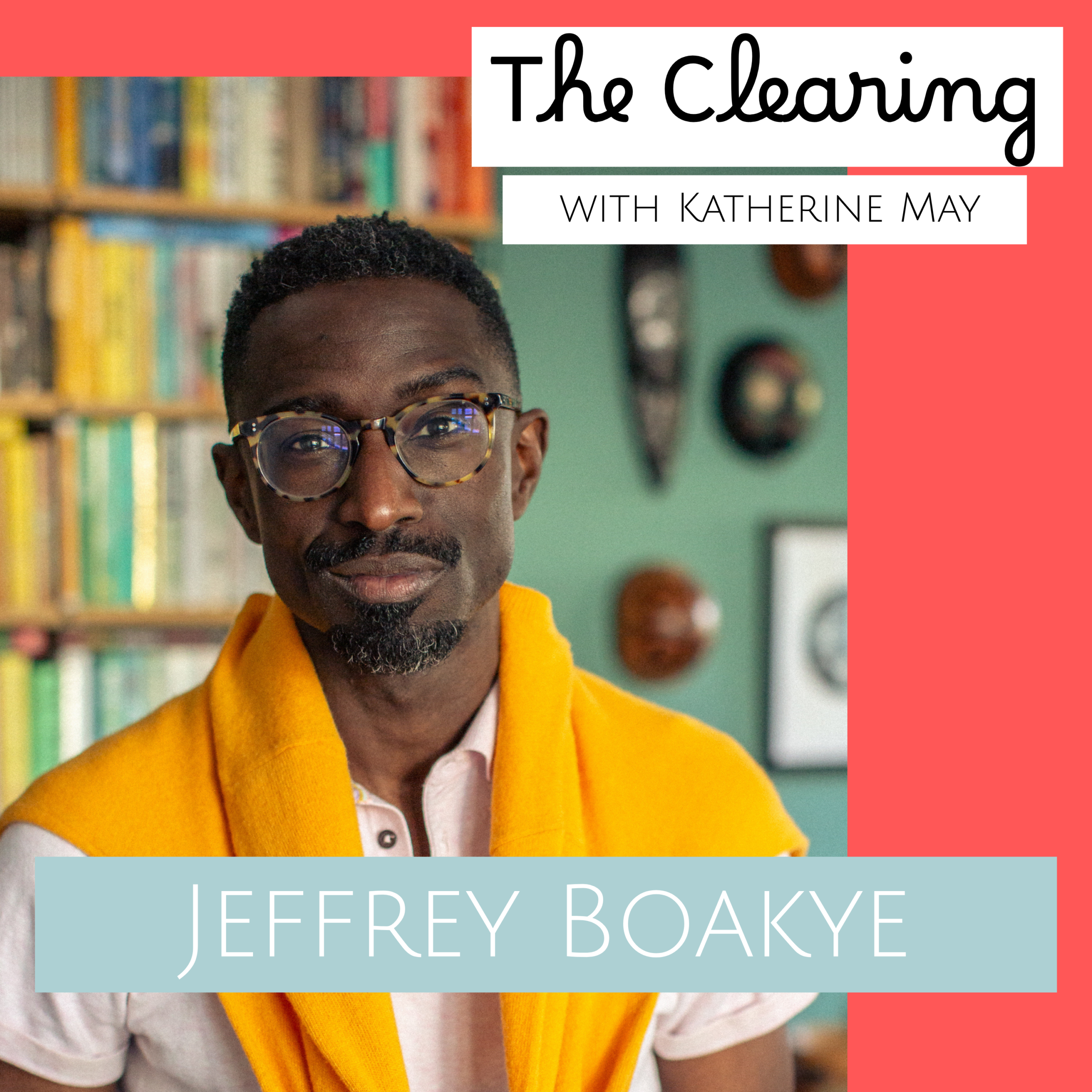
Our first guest to choose a city for his dreamscape, the brilliant writer, BBC broadcaster and educator Jeffrey Boakye reveals he’s most at peace when walking for walking’s sake through the ever-changing textures of London’s streets. The very essence of a ‘flâneur’, as we discover.
A gorgeous and meandering conversation, Jeffrey and Katherine explore a wonderful array of topics: from skateboarding as a life lesson in failure to finding joy in packed tube trains, why we need to foster more pointless hobbies to what the movie Groundhog Day teaches us about the mundane and the sublime. Often philosophical, frequently laughter-filled and as always, deeply thought-provoking.
Transcript
Please note this is an automated transcript and as a result it may contain errors
Katherine May: [00:00:00] Hello. Katherine here. I love the way I say that at the beginning of every podcast, like I’m answering the phone, or you’re answering the phone to me, and it’s a surprise somehow that I’m here rather than the fact that you have just tuned into my podcast. It’s a bit like people who text you and say, “Hello, Rachel here,” as if you don’t fully know that it’s Rachel because they have texted you and their name has flashed up.
I need to stop doing it, don’t I? But hello, it’s really nice to say hello to you all. I am on chair, as my good friend Emma Gannon often says. Uh, this is her phrase for being ensconced in the reading armchair that she has, and we have the same armchair, um, which is a very co- cool thing, except [00:01:00] for mine folds out into a bed and I have to sleep in it when people stay at my house ’cause we don’t have enough space, so mine I think is probably a bit less squidgy.
But I, you know, I quite like a hard chair. I’m a very hard bed, hard chair kind of a girl. I don’t know what that says about me. Anyway, I’m still, um, trying to recuperate from my operation a bit, but life has really caught up with me. Um, and so we’ll be back on our walk soon. Um, it’s terrible to resent feeling better, isn’t it?
I am feeling, you know, pretty good for someone four weeks out from a hysterectomy. I really think it’s really unusual for me. Like, I’m normally the person who has complications, and I have not had complications. This, uh, this has gone well. So I’m still not recording while I’m walking, ’cause it’s probably a bit too [00:02:00] heavy on the brain.
That’s the only thing that I am experiencing, is tiredness, and, um, that leads to a kind of befuddlement because I can’t get the amount done that I feel like I would normally be getting done and there’s a sort of dissonance there for me. Like, I’ve been at my desk the same amount of time, but I’ve done many fewer things.
How? But there we go. It’s all, uh, part of life, isn’t it, and how we learn to get over frustration. Frustration’s such a guiding emotion for me. It has been since I was a child, and I’m experiencing a bit of frustration now, but also I’m kind of raring to go. Sitting still for a long time does not give you some ideas and as usual, I just haven’t got enough time to think them through.
But I have- While I’ve been taking my rest, been really enjoying quite a few [00:03:00] novels recently, um, which is unusual for me. I am, I am a true nonfiction reader quite a lot of the time. I spent my 20s reading novels, and then I didn’t really do… I don’t know. I don’t think I had a preference in my 30s. Maybe I was kind of half and half.
But my 40s have definitely really been devoted to nonfiction reading, and I am just coming out of that phase, and it’s really enjoyable. Maybe this is ’cause I’ve got more leisure in my mind at the moment. I think I’m letting myself read books that aren’t research, you know? There’s a bit of me that’s always tracking down ideas that I want to write about, and lately I’ve just been reading on chair, and it’s been glorious.
Some of my edited highlights, um, have been Katherine Newman’s Sandwich, uh, [00:04:00] which is such a lovely, kind of funny but also deep and very moving family novel. I think probably loads of you have read it already. I’ve come to that one really late. I read the new Ben Lerner novel, uh, which is called Transmission.
Um, it’s a slim literary novel that really, I found it quite mind-bending the way he dealt with truth and memory and the conversations we have. It, it’s a novel that takes you in a kind of circle in a really smart way. I admired it so much, and I was completely immersed in it, so I, I recommend that to any of you that like a good kind of brainy literary novel.
Not necessarily a relaxing read, it– but it is, you know, you will have to have your brain switched on, and it will make you think. Um, I thought it was great. And most [00:05:00]
recently, a novel from the early ’80s called The Door by Magda Szabó. I think that might be how you say it, but please howl at me if you know how to pronounce Hungarian.
Um, S-Z-A-B-O. Um, it was a novel that was recommended to me by my brilliant editor at Riverhead, Jin Dillon Martin, who said it was one of the best things she’d ever read. And if Jin says that something’s the best thing she’s ever read, I’m gonna read it, right? Um, and it is a– it’s an extraordinary novel.
It’s about, uh, a woman, a writer, who hires a cleaner/housekeeper called Emerence. And Emerence, I’m sure it’s probably not pronounced Emerence, but that’s how it’s pronounced in my mind. I might be like the kind of person that reads the word Hermione and says Hurmione in their head. Um, again- Hungarian listeners can correct me, and I will do the take back of shame, the pronunciation take back of shame.
Um, but Emerence is this [00:06:00] extraordinary figure. On one hand, she is a workhorse of a woman, uh, capable of undertaking physical tasks that no one else could undertake. She never sleeps. She is a kind of dark Mary Poppins, but she’s also obsessed with her own privacy. And this plays out in a kind of cat and mouse game between the writer and the housekeeper over decades, where one just really wants to know the other and begins to resent the unevenness of the relationship, where the housekeeper knows everything about her and her family, but won’t let her reciprocate in terms of knowledge or care.
It’s, it’s an immense novel. I really recommend it to any of you that can get your hands on it. So there you go. There’s some… We’ve started with some good recommendations. Um, [00:07:00] and we’ll move on to the matter in hand, which is a interview today with the broadcaster and author Jeffrey Boccia, who is just one of the nicest people I’ve come across.
I met him at the end of last year when he interviewed me on stage for a literary festival, um, and just had the best time talking to him. I was fortunate that I’d already read his book Black, Listed, which is… Sorry, I’m saying it, like, in a weird way because it’s got a comma between black and listed, so it’s like rather than blacklisted, it’s like Black, Listed.
Um, which is a really smart book that examines all of the different words that get associated with Blackness from, you know, the offensive terms that are designed to kind of insult and belittle to the terms taken [00:08:00] in by the Black community themselves to describe themselves and everything in between. Um, it was the first encounter I had with his voice, which is just so clever and lively.
Um- It’s really worth a read if you haven’t already. And there’s also another brilliant book called Musical Truth, which links to his abiding interest in music. And another place that I’ve often encountered him is listening to the BBC Radio 4 show, uh, Add To Playlist, which is available as a podcast on the BBC app.
Um, if you’ve not come across that, it’s a really great podcast where, um, Geoff takes, uh, has musical guests in the studio sitting in front of their instruments. And as they talk about music, they play, you know, excerpts from it or, you know, deconstruct how it’s put together. I’m not a musician. I’ve sung a lot, but I don’t play an instrument, and I don’t have that kind of [00:09:00] understanding of how music’s put together, and so I’m always completely entranced and fascinated by it.
Anyway, that’s probably enough from me. We had a fantastic conversation, and I think it’s a … Geoff’s is a really original take on what it means to rest. He’s really thought through his particular way of resting and his landscape, which is an urban one. Although he does, he lives in the countryside now, but his, uh, his rest takes us through the streets of London.
Um, it’s such a lovely vision of a day of rest, and one that I can well see myself undertaking. Before I give too much away, I will step back and let you have a listen. See you after the pod. Jeffrey, welcome to The Clearing. It’s so lovely to have you here. Thank you for the invitation. I’m really looking forward to this.
Oh, no, I’m thrilled because we did an event [00:10:00] last November, I, I think November. Yeah. And, um, had such a great time, so I was really desperate to get you on the podcast. No, the, uh, you know what, it’s like we started a conversation that I thought, “Yeah, this is to be continued,” kind of. Yeah. So I was really looking forward to just having a chat.
Jeffrey Boakye: Yeah. How have you been? All those big questions. Oh, it’s been busy. It’s been busy. I mean, I feel like li- life just skips forward now in the most- Yeah … absurd pace. It’s, I don’t know- Definitely … if this is how being old feels or if it’s how being busy feels. But, like, life is incredibly lifey these days. How about for you?
Yeah. No, definitely. I mean- The year’s weird because you kind of think, “Oh, it’s dragging,” when you get to mid-January, and then, boom- Mm … suddenly February’s gone, March is happening. All those things in the calendar that w- felt like months away just arrive- Yeah … and you realize- Yeah … that you’re looking at the future suddenly.
So yeah, it just moves quickly and all- I know … you know, it’s like kids, stuff happening, events, just, yeah. Life is lifing, [00:11:00] but- Life is lifing … but yeah, yeah. Keeping busy in a good way, so that’s good. I’m r- I’m… One of the reasons I’m curious to ask you the questions that we ask on this podcast is I wonder if you are someone that takes much of a break.
Katherine May: You seem incredibly energetic. Yeah. Do you ever take a rest? You know what? I’m not sure if I do. I- I, I sort of realized the other day that maybe, maybe I do struggle to stop and unwind ’cause I had a weird, slightly fallow… It wasn’t even long. It was maybe, like, three days where I was- … in between deliveries of different things.
Jeffrey Boakye: I love that that counts as a fallow period for you. Yeah, yeah, yeah. It was like three days, maybe two nights. Oh, in the wilderness. Yeah, yeah, seriously. And I was like, “I don’t, I can’t deliver this thing, so that’s not… And I’ve already done that, and I’ve done that, and there’s nothing coming.” And in the evening, I didn’t know what to do with myself, so I started another two projects, like- Wow
that, that evening. Wow. I started writing whole new projects, whole new ideas, and I think that’s me. I’m, I’m constantly, my mind’s constantly finding something to do, you know? So maybe that’s a thing. I don’t know. Is [00:12:00] that everyone? Is that you? Do you do this? Yeah, I’m quite a lot like that. I mean, I- Okay
Katherine May: I’ve had to learn to take a rest because I do get really burnt out, and I have- Yeah … to be careful with it, but, um, I can’t stop. I can’t stop my brain. My brain is- Like, if, if my brain perceives a gap in proceedings, it’s like, “I’ve got an idea.” I know exactly what you’re saying. It’s weird ’cause my son’s like that, my eldest son.
Jeffrey Boakye: You know when- Right … sometimes you have kids and they just become this kind of like house of mirrors reflection of you- Yeah … and you see yourself. Yeah. I’m like, “Oh, I’m a lot like Finley.” So he cannot sit still. He cannot stop. Super creative, and when he falls asleep, it’s like the battery has run out completely and he- Yeah
just falls asleep. Yeah. There’s no wind down, and I think I’m a bit like that. Sleeps the sleep of the just because he’s done so much. He’s done- Yeah … he’s really achieved something every day, yeah. Yeah, yeah. I think that’s kinda like me. I’m, I’m done by, like, 4:00 in the afternoon. Really? I’m, I’m like a, you know, like a windsock sagging by then.
Katherine May: Just like, “Oh.” Just [00:13:00] flagging. Just that’s it. And then- I’ve got nothing left. Yeah, yeah. You’ve, you’ve actually used it all up. But you burn- Yeah … brightly though, don’t you? I’m a Duracell bunny. Yeah. Yeah, yeah. Mostly, and then I’m not. I do… Well- … I, I, I do, and sometimes I’m just looking at life go by, and I see someone who looks so happy just walking- And they’ve got nothing.
Jeffrey Boakye: You can tell they’ve got nothing on. Like, they’re not doing anything. Yeah. They’re just… And they’re just happy with just being… And I, I can do that, but I wonder what it’s like to just be completely content with no need to do, create, make- Yeah … solve. We’ve had some guests on this podcast who have these visions of, like, complete stillness.
Katherine May: You know, like, to rest they, “I will just sit in a chair.” And I think I have no idea how to do that. I’d be wriggling all over it from the start. Is it a skill, do you reckon? Is it something you can learn? I don’t know. I mean, I think, I think my husband is very good at just existing. He can just, uh, just take it down.
Like, [00:14:00] he’s just like, “Oh, this is fine.” He could just listen to music, for example, for, like, half a day. He’d be really happy- Wow … doing that or something like that. And whereas I’d be like, “Oh, maybe I can dig up the garden.” Yeah. You know, that, that’s, that’s what happens- Yeah … if I’ve got half a day. Yeah, yeah, yeah.
Jeffrey Boakye: I’m definitely on that side of the, of the conversation. Yeah. The let’s see if I can make a hole and mend it type. You know, just to use, use some energy. Yeah. I mean- Or, yeah … let’s take something apart. Yeah, yeah, yeah. Let’s see what it looks like inside. Yeah. I can’t even have a hobby because I get into something, and I then end up exploring it and thinking about what I could do with my new knowledge.
And could it be- Yeah … a project or could it be something I could create? And so I like to enjoy things, but then also to go deeper and learn about them and explore them, and it might become a thing afterwards. Mm. But that’s quite productive to use that very, very, you know, thorny term. Yeah. I mean, that, I, I think all of my hobbies have become [00:15:00] work, you know, jobs- Yeah
Katherine May: almost. That’s… I won- Is that, is that how you got into music? Like, because you broadcast about music on Radio 4. Yeah. Your wonderful podcast. Yeah. It, it actually is because, um, I’m not a trained musician, so I don’t have a musical background in that sense. I’m not classically trained in anything. I’m a self-taught guitarist.
Jeffrey Boakye: Right. I’ve always m- messed about with music. I was a DJ for a while, so I like playing with music and production. But I actually wrote about music, so that was the thing that got me- Yeah … into this weird space of being someone that is seen as a bit of an authority on music even though I’m just a fan- How nice though
’cause I wrote about music. I know. Yeah. This is ’cause I wrote about music a lot, and my first book was about music that I liked and what I could see in it. So that was the first in the run of dominoes that led to me becoming someone that writes about music- Yeah … can do a radio show that is about music and so on.
So, yeah. Well, yeah, ’cause, I mean, Add to Playlist, I, whenever I listen to it, I’m… It’s always a, it’s, it’s always an extraordinary encounter with how [00:16:00] talented musicians are. Like, people that you’ve maybe heard one or two of their records and you think, “Oh yeah, that’s a nice tune.” Yeah. And then they sit in the studio with you, and they just produce music- Yeah
Katherine May: like, as they’re talking. Yeah. It’s astonishing. And it’s always this… I f- I think it’s really magical. It’s like such a magical encounter with what- people can do. Yeah, it is, it is. I mean, I’m just learning that, I knew it already, but it really is a language in- Mm … in various ways. There’s obviously a technical language to music, so if you can read music, if you can understand composition and arrangement, there’s that language.
Jeffrey Boakye: But then there’s just the kind of the communication through music- Yeah … which everyone can take part in, just as a listener. But when you see people that can communicate through music- Yes … and what the show does is it allows them to then do that meta-cognition of unpicking what they’re doing- Yes … and that’s actually quite geeky.
But also- It must be so pleasurable for them, I always think, because they get to- They love it … really turn it inside out. Yeah. Yeah. Yeah, yeah. So yeah, it’s a very, it’s a very human show [00:17:00] on that level- Yeah … ’cause it is about people connecting, and then you get into the context. So the wider cultures, the geography, the history, the cultural contexts, and that’s again, just all about making connections.
So I think that’s where the joy comes from, and you need a bit of joy on Radio 4 every now and again. Goodness. It, it lights up Radio 4 a little bit, doesn’t it? Mm-hmm. Mm-hmm. It’s sort of- Yeah … the anti-Today program. It’s just like- Yeah, yeah, yeah. … “Here’s the joyful bit. It’s okay, guys. The world’s falling apart, but people are great on a piano keyboard, so that’s okay.”
Yeah. Yeah, exactly. Exactly. I love that. I love that. I’ll tell the producers that and they’ll be happy. It’s joyful. It’s lovely. I, I mean, I always think, like, as a writer, it’s quite hard to, like, display your craft in that way. You know, I couldn’t sit in a studio with you and write something and immediately- Yes
Katherine May: I, I know there are writers who can. Yeah. And so when, so I just always think, “Oh, musicians, it must be, it must be so amazing to be in live communication through that medium.” It’s like, [00:18:00] “Ah.” This is it. Yeah, it’s like w- when we talked about, um, wintering, right? It’s like- Mm … there’s a part of me that knows that it’s about the audience’s interaction with your content, with the stories- Yeah
Jeffrey Boakye: the narratives. But another part of me is really interested in your writerliness and the process- … and the, because, because it’s, it’s, it’s really good writing and there are things that you do to make it work. And- Yeah … that’s the stuff that I’m sure me and you could geek out about that, but- Yeah … some people might not be so interested in those t- t- technical things or your processes.
Katherine May: Well, it’s so boring, isn’t it? I mean, like, I, I just always think that writing is the kind of, I mean, for me it feels really alive and important. Mm. I think it must look quite bloodless to other creative artists. You know, like when you think about visual artists who are l- like, in this physical relationship- Yeah
with the thing they’re producing, and it, uh, and it’s so visual and it’s immediately shareable with somebody else. And, or musicians or dancers- Ah … like, it’s so immediate and fully embodied. Whereas [00:19:00] writers sit quietly doing- Yes … the thing that most people hated doing at school- Yes … except for days and years on, on e- on end- Yeah
to produce one thing. Yeah. It’s so- It’s true. Yeah. It’s kind of, it’s not understandable from the outside, I don’t think- Yeah … in the way that other arts maybe are. I think you’re right. And then- I mean, you write, obviously. I do, yeah. And it’s like you’re, you’re absolutely right because th- there is a lot of raging turmoil and joy and euphoria and fear, and all those things are happening in the writing process.
Jeffrey Boakye: But unlike, say, a song or a, you know, visual art or even theater or something, we can see these things. Mm. It’s all kind of, it has to be so contained into the end product that- Yeah … no one will even know that I had these freewheeling moments with joy or these- No … tumultuous moments where I’m, where I’m having to hold the ship together while it’s going through the storm, you know?
Yeah, yeah, yeah. And, but all that is in there when you’re writing. There are some paragraphs that have- Oh, yeah … maybe taken a week off my life, and there’s another paragraph that- … [00:20:00] that added two weeks. Life-shortening paragraphs. Yeah, yeah, life-shortening paragraphs. I’m like, ah. Yeah, yeah. But, you know- Yeah
and the opposite is true, where there might be a chapter or paragraph that, you know, that really gave me life, so yeah. Yeah, those, those ones that come out whole. Yeah. Like, ready-made and whole- Exactly … that you just, you wanna tell the world, like, “I made this.” Yeah. This felt like, this felt like how it was supposed to feel.
Katherine May: Yeah. And the other ones, you know, you’re like, “Oh, this was months- … and my editors kept sending it back going, ‘That sentence doesn’t actually make sense if you think about it.'” Yeah, yeah, yeah. And you’re like- Yeah … “Oh, it was so painful.” Yeah. Yeah. Yeah, exactly. Yeah, writers don’t get a chance to geek out about the writing part so much.
Jeffrey Boakye: No. I’m not sure how, how interesting people find that. Maybe for, like, big novelists and people are like, “Ooh, tell us about this character.” I don’t, I don’t know. I don’t know. Yeah. I don’t know. I mean, I, I just think, yeah, I’ve, I’ve got no access to it anyway. I’m just like, it just happens. Mm-hmm. It just comes out, and it, I’ve got…
Katherine May: Yeah, there’s no, no control. Anyway. Anyway, let’s let’s not think about that because that becomes very unrelaxing for both of us very quickly. Okay. Um, I wanna [00:21:00] invite you into my clearing where you get to create the perfect rest for you. Can you tell me where we find ourselves today? Oh, my goodness. All right.
Jeffrey Boakye: I’ve gotta be honest, okay? I’m go- I’m gonna be honest. My m- my perfect rest scenario location is unfortunately on the move. Um- Don’t apologize for that. Okay, okay. I’m not gonna apologize because, um, I feel as though I genuinely, I find myself relaxing into movement And I spent most of my life living in London.
So I grew up in London, raised in London. So my stomping grounds were essentially South West London. And as I got older, I’d go to Central London and start to explore. Yeah. You get to- So- … explore a bit more. Yeah. And this exploring London, you know, for most people it’s on foot, it’s on public transport. Mm.
But there’s this kind of physical movement through. It’s not like motorways where you’re plowing through the [00:22:00] country, you’re sort of trudging through. And I really, really find peace walking through cities- Yeah … where I can melt away into the city. But the caveat is it has to be with music. Right. I, I really- In your ears.
Yeah. I have to have music, and I find the song, the playlist that kind of m- even meet my mood or soundtrack what’s happening around me or create a scene, and that, I find that incredibly peaceful. If I’m ever at a loss when I’m in a city, I just have to go for a walk and- Mm … go for a long walk, um, and I always find myself kind of resetting and seeing the city in quite a cinematic way and imagining and…
Yeah, so- Mm. Love it … that’s where my head went. Yeah. There you go. I, I think that’s great. I mean, I, I think you’re a flaneur, aren’t you? That makes you a flaneur, a, a sort of great walker of the city. Um- I like that. I know. It’s nice. A flaneur. This is a new one for me. Flaneur. [00:23:00] Yeah. It’s, uh… The French have some really good — Oh, this is cool.
Okay. Yeah. Yeah. So this is a, this is a flaneurship that we’re talking about. I did not know. But I, I agree with you. I love walking cities. I, um, I just think there’s, the texturing is endlessly changing. Yeah. There’s a soundscape that can be far too much, which is why I really get the headphones. But actually it can be really- Yeah
Katherine May: enlivening. You know, you pass these washes of music- Yeah … and things like that- Yeah … that are, are coming through. Yeah. I… Yeah. Give me a few hours and a walk through a city and I’m perf- perfectly happy. No, it’s lovely. And the way that most cities operate, you know, especially if you get to, get to Europe, is that there’s always a stretch of water somewhere- Yeah
Jeffrey Boakye: that you can find yourself gravitating towards or even walking along. Yeah. So we’ve had many a lovely walk going along South Bank, crossing, going back the other way, and just- Mm … tracking the Thames and going all the way into east. [00:24:00] And I just feel like, I don’t know who it was, but someone once said that seeing a stretch of water is really important for humans to reset.
Katherine May: Yes. You know? And, yeah. It’s, it’s about seeing a horizon as well. Right. Right. Um, it’s about, like… You know, there’s a, there’s a sort of ancient defensive de- stance there that y- if you can see a far horizon, you know you’re safe Right Like, there’s no one coming to get you Yeah, yeah, yeah Um- Oh, okay. That’s interesting
the wolves aren’t coming. Yeah. But yeah, and, and of course water really offers that. But, but we’ve always, I think, I think we’ve probably evolved to worry about our water supply. Mm. Yeah, yeah. Like, you just need to know where it is, and is it- Yeah … is it safe? Yeah. ‘Cause that’s another thing that now, I, I don’t live in London now.
Jeffrey Boakye: N- now I live in East Yorkshire. I live- Yeah, that’s quite a change … not far from the coast. Yeah, it is. It is. Um, you saw me. Yeah, yeah. Um- No, it’s… I always knew, though, that after meeting my wife in London and having our kids, I knew that we wouldn’t stay in London- Right … just because the, just the rhythm of life, [00:25:00] you know, you can kind of feel it, and we just knew at some point we’d move away.
Mm-hmm. We weren’t sure where to, but she’s from East Yorkshire, so we kind of… For her, she felt like she’s going backwards, and I was like- Yeah … “It’s not going backwards. It’s not.” But, but for, for me, I, I just love it, ’cause I’m really near to the coast- Mm … and I genuinely feel that pull to get out to the coast, and I can walk to the foreshore from where I live and see the Humber- Mm
which is a, quite a big stretch of water. A big, yeah, a big river. Yeah. And so all these things kind of, maybe I’ve not planned it, but I know that there’s a part of me that, that, that needs that proximity to, and expanse- To water … and to water. Yeah. Yeah. That makes sense. Do you walk in the same way in East Yorkshire as you did in London?
Katherine May: Is it, is it the same kind of walking? When I walk like I’m walking in London in East Yorkshire, people look at me as though, “Where are you going?” “And why are you moving so fast?” Like it’s like there’s this pace that- And where are your wellies? And where, yeah, yeah. Exactly. Exactly. [00:26:00] So no, it’s very, very different now.
Jeffrey Boakye: Um, now that I’m an East, East Yorkshire native, I’ve got all the different footwear for all the different scenarios. Yeah. We go out for long walks, you know, in the Dales and things, and it’s just, yeah. So we, we as a family love getting out and walking, and- Lovely … the kids are great because they say they don’t wanna do it, but they’ll just do six hours when you’re out there, you know?
They, they’ll- Yeah. Yeah, yeah … just do it without any complaints. Once they’re out, they hate the idea of ever leaving the house, kids- Yeah … in my experience. It’s true. All you gotta do is get them over the threshold and everything’s all right. And then they’re fine. Yeah, yeah. But yeah. Exactly. Just, just have a couple of snacks.
Just keep on plying them with breadsticks or whatever and, and they’re happy. They’re happy. Just feed it into them like a wood chipper, like- Yeah, yeah, yeah. Exactly. Just- Get, get all those breadsticks. Yeah, yeah. So I, I just love that. So it’s an interesting one because I’m really a city boy, but I’m also a flaneur I’ve learned.
You are a flaneur. Yes. Yeah, but I [00:27:00] really do appreciate getting out into, into nature, you know? Like- Yeah … it’s, it’s, it’s a big part of my life now, you know, living in the East. The east of the country, East Yorkshire. Beautiful place to live. Yeah. Really beautiful part of the country. But back to London. Back to London.
Let’s go. So when you’re walking- Yes … are you, are you, like, stopping along the way? Are you staying, like, towards the green spaces and the parks? Are you dipping in and out of shops? Like, what’s happening? I- my mind w- I mean, I’ve got quite, quite an imaginative mind, so I’m often creating scenarios, and I see scenes and vignettes, and I feel like often it’s telling that story.
So just, like, s- walking past a cafe and seeing people. Mm. I’m not like being a voyeur or anything, but I just like- No, it’s okay … yeah. I think creative people love staring at other people. I think that’s what we do. Yeah, we’re interesting, aren’t we? People are interesting. We are eavesdroppers. Yes, yes. Yeah.
And I feel like e- everyone’s got a story, and to have- Oh, yeah … that many [00:28:00] stories kicking off is really exciting. Yeah. And to be part of it as well, I think there’s something quite… In cities, you don’t often say it out loud because it makes you a weirdo, but there’s an intimacy to just being with that many people- Mm.
Katherine May: Mm … and cooperating. You just have to live together. I can remember being on my way to Canary Wharf, I was working in the city, and my tube journey was horrendous. It was always packed on the tube in the morning. And I remember being on a packed tube, not being able to move, and thinking, “If I can’t find some- something joyous and stillness in this- Yeah
Jeffrey Boakye: then I’m giving away something of my life to these moments of commuting.” Mm. And I, and I just can’t stand for that. I, I have to find the joy in this. And one way of doing that was to just realize that in this tube carriage, I’m connected to these people. Yeah. And we’re here, and there’s a kind of weird beauty in that.
So when I’m in the city, it’s a similar thing. It’s just being part of, and I like that feeling. And also just the, just the, the lack of urgency is good. Yeah. The idea- Yeah … I’m [00:29:00] usually walking when I haven’t got- anywhere else to be, or there’s no b- like, I’ve got an hour to kill, or I’m waiting for so- and the lack of urgency is nice to just- Yeah
be able to wonder and explore- Yeah … and take a corner that- Some meandering. Yeah. And go and explore a road that I wasn’t planning on going down- Yeah … and s- seeing what I can see. I love all that. I love all that. I think, I mean, we talk a lot about how big cities are unfriendly, but I- Mm … like, my personal challenge is always to find the friendliness in it.
Katherine May: You know? Yeah. There’s always someone that will have a chat with you or- Yeah … there’s always contact to be made. Like, you don’t have to- Yeah … if everyone believes that cities are unfriendly places and behaves accordingly, then- Yes … yeah, of course they are. But I bring my small town behavior- … to cities and I’m like, “Oh, hello.
Yes, how are you today?” Hello. Yeah, yeah. Hi. Have a lot. I just think it’s polite. How’s that working out for you? Like- Yeah, yeah … and, you know, cities are full of immigrants, and- Yes … there’s, they’ve often come from cultures that are not a Londony culture, and so- Yeah … taxi [00:30:00] drivers love a chat, for example. Yeah, that’s true.
Uber drivers- Yeah … are great for a little chat. Yeah. And I, some of my most memorable city moments have been- Yeah … having a really fascinating chat about where someone’s from and, like, how they see the world at the moment. It’s interesting. Yeah. Yeah, yeah, yeah, yeah. No, I, I’m, I’m totally with you on that.
Jeffrey Boakye: And I think that sometimes, um, children are a great, a great kind of entry point to this kind of conversation that you can have- Yeah, yeah … because sometimes adults are a bit like, “I’m on my path doing this thing,” but it can open up a bit. “Are you gonna murder me?” Yeah, exactly. “For making eye contact?” Yeah, yeah.
Yeah. So if I look at you, am I inviting some sort of, like, situation- … I can’t then control. So everyone’s a little bit standoffish, but- Yeah … with kids it can s- kind of soften that. So I’ve had some beautiful conversations on buses where my kids have been talking about, you know, something, something like why are trees kind of, um, why do they grow in a way that doesn’t hit the bus and stuff like that, you know?
Which is a really good question, like- Yeah, yeah … do the trees know what’s going on? We’ll have these conversations, like, maybe they do know, and they’re cleverer than us. And then some man [00:31:00] turned and he turned out he had some kind of specialism in treeology- Oh, really? … or something, and he had a big conversation about the way that- Oh
trees are and how they live and where their roots go. Oh, lovely. And it was just, it was really nice. And I just thought if you asked everyone in this bus to contribute, everyone would have something interesting to say about- Yeah, yeah, yeah … something which- Yeah … which is nice. Which is nice. Yeah. That’s lovely.
Katherine May: So this, this moment of retreat that you take- Yes … are you alone or do you, are you bringing your kids and your wife? Like a, or friends? Like, i- does so- what does solitude mean to you? Is it interesting to you or is it something you’d rather not? No. I’m, I’m a big solo, solo walker. Um, I, I am a, I am an outgoing person in that sense.
Jeffrey Boakye: I’m not sure what the stereotypes are. And I, I’m not sure about the crude kind of introvert- Yeah … extrovert binary. I’m not sure about all that. But I definitely get energy from people. Mm. Um, but at the same time, on my own- I, I’m very happy [00:32:00] on my own for prolonged periods Yeah I know, like, I’ve got no issue with being on my own for an entire day in, you know, eating by myself.
I’ll go to cinema on my own, you know- Yeah. Lovely … stuff like that. Yeah, you know- Nice activity … highly underrated activity, you know? Yeah. Like, why wait until somebody else wants to see what you wanna see? Just- Yeah … just go. You can just get up and do it. Go. It’s great. It’s great. Um, and I, I sort of, I do like my own…
I know it sounds odd, but I do like my own company. I like being on my own, thinking my thoughts- Yeah … pausing when I wanna pause, and not necessarily having to synthesize with someone else. I’m, I’m more than happy to just- Yeah … have my own thoughts, you know? That makes sense. So I’ll be on my own. I’ll be on my own, walking for an indefinite amount of time.
Katherine May: Walking until your legs are tired. Exactly. Yeah. Yeah. And then going to find something to eat when I’m tired is, yeah, I like that. Okay. So normally- Mm … we talk about, like, would you bring a [00:33:00] cherished object on retreat? But you’re in motion. Yeah. What comes with you when you walk? Do you, uh, do you travel light?
Or, or are you like me, have a backpack full of, like, anything you might need just in case ’cause you worry? Okay. Yeah, yeah, yeah, yeah. Yeah. Uh, my… I usually have my backpack with me, but it, it doesn’t, it’s got practical things in it. So if I’m sleeping over, it’s got clothes in it. It’s got, you know, my water bottle and my umbrella.
Jeffrey Boakye: Those are the two things. Okay. Uh, yeah, which is quite poetic in a way. Like, one of them makes you soggy, and the other one- Yeah … keeps the sogginess off you. And you’ve got them- Yeah … you know, like, I’ve, I’ve, I’ve al- always thought it was interesting I need to both intake and repel water at the same time.
Katherine May: Yeah. It’s really important. Yeah. And it, and to me, it’s, like, essential. I never leave for London without an umbrella. I don’t care what time of year, ’cause when it rains, you need an umbrella. So those things are important, but I think the cherished object, I think, the music is really important- Mm … but I won’t include that.
Jeffrey Boakye: That’s a backdrop. Weirdly, it’s… All right, it’s gonna sound so weird, [00:34:00] man. I’ve got a little toy skateboard. Stay with me. Okay. I’ve got a little miniature skateboard. They’re called fingerboards. I- There’s a whole community … there is one in my din- on my dining room table right now. Yes. Yes. Does it belong to you or does it belong to- No
No? Okay. My son has tried to show me how to use it, and I’m like- Yeah. Yeah … “What is this?” “What is this for?” Yeah, exactly. Exactly. That’s g- what is it for? It’s, it’s the one thing that i- if I leave the house and I haven’t got it, I’ll go back and get it. So- Really? Yeah, yeah. So that’s the one thing. So what do you do with it?
You skate around with your fingers. Um, so you- … put your fingers on it like, like that, and you do tricks, and you skate around. Um, I love skateboarding, and again, there’s a link here ’cause that’s a very… If you’re not in California in the swimming pools- … skateboarding’s basically an urban exploration activity.
Right. It’s kind of like creating physical art- Out of the environment, cruising around on concrete. The fingerboard to me, I like to play with it in the same way, but just miniature. So I’ll take it out [00:35:00] when I’m, when I see a ledge that’s cool, and I’ll just do some tricks. And people look at you like you’re insane-
because you’re a grown man literally playing with toys. But I, I, I think that there’s just something about, it’s calming for me, you know? Yeah, yeah. It’s like my wife says that knitting and crocheting really- Yeah … centers her, and, uh, for me it’s a similar thing. The action of moving my skateboard around and practicing tricks is really calming for me.
There’s, there’s a mindset, there’s a philosophy. I don’t wanna get too deep into it, but- Do it … the- Go, go there … the godfather of modern skating, um, he basically, his, his name’s Rodney Mullen, and he, he created all the tricks that we use now. You know- Wow … m- m- making a skateboard jump, he invented that. Wow.
And he did all these things that were basically impossible, but he said he was trying to make the board do things that he know wasn’t possible. And in that process, he learned a lot about [00:36:00] how to create the impossible. Yeah. And it became this thing which is not sport. There’s a reason why skateboarding hasn’t quite made it into the Olympics.
Yeah. It’s not art, and it’s also leisure, but it’s also, like, counterculture because- Mm … you’re doing something you shouldn’t do. And in that space, it’s a community of people that, that basically are knitted by this craft that you- Yeah … really devote yourself to. So in my little skateboard in my finger- … I’m carrying all of that with me at all times- All of that whole-
the philosophy- … distilled history … yes, yes. That I really feel connected to it- … through my fingerboard. Well, there’s, there’s something about skateboarding that looks like wasting time from the outside- Yeah … I think. Like, it, it’s hanging out, isn’t it? Yeah. And so to non-boarders- Mm-hmm … which beli- believe it, I c- I can barely stand up, let alone go on a skateboard.
Katherine May: I mean, imagine. Um, it looks really idle. Yeah, yeah. But it’s actually skill. And the thing that always strikes me when I’ve stood and watched a skateboard is, like, under the [00:37:00] South Bank- Yes … where we’ve got, like, a little, uh, area in- Mm-hmm … the far end of Whitstable- Yeah … is that it’s mostly failure. Yeah, it is.
Like, it’s- It’s almost entirely failure … you’re intimate with failure. Yeah. Fascinated by that. Yeah, it’s, um… That’s probably one of the reasons that I pursue it, because it’s taken me… I used to fingerboard a lot when I was a kid. Mm. And then when I was a teenager, I stopped, and I got back into it as an adult.
Jeffrey Boakye: I dunno why. And it’s taken me about three years to get to a proficient level, right? And I’m nowhere near where I want to be. But it’s every day. My wife can’t stand the sound of it. I’m every tch, tch, tch, tch. But that failure thing, skaters are… They have to fail because- Yeah … it might take- Quite literally hundreds of attempts to land one trick and- And you’re falling over the whole way through that
and you’re falling over. And what you’re getting good at in that failure is you’re getting good at falling over. Yeah. And the best skaters in the world, if you see them, um, they don’t wear pads and stuff, which is not to be recommended, like you [00:38:00] really should, ’cause if it goes wrong, you could really put yourself in hospital.
Rodney Mullen- Yeah … lost all his teeth, and his dad was a dentist. Oh, lucky. Oh, well that’s all right then. There you go. Yeah, yeah. But- Family business Exactly, yeah. Just like, “Get some new ones. Here you go.” But that failing and knowing that you’re gonna fail, they learn how to fall. Yeah. When you don’t know how to skate, you’re n- it’s not the failure that’s dangerous, it’s not knowing how to fall.
Katherine May: Mm-hmm. And if you don’t know how to fall, you’re gonna hurt yourself. So in this sort of like, the psychology is fascinating to me because you’re, you’re not trying to be perfect ’cause you have to get into a flow state, but at the same time, you’re embracing the fact that you’re gonna fail most of the time, and that’s okay.
Jeffrey Boakye: Yeah. And then when you get to the point where you’re not thinking about failure, when you get so good, it’s almost like for those of us who can walk easily, it’s like walking. You don’t think about walking. Yeah. You don’t think about the failure required to get good at walking. But when you’re one year old, you are- Walking is- You are fa- Yeah
walking is- [00:39:00] Yeah, yeah … perilous. And, and actually, I mean, if like me you’re dyspraxic, I, I have to think quite hard about starting walking. Like, once I’ve got going, I’m all right. Yeah, yeah. But actually the first few steps I’m, I’m- Yeah … still conscious of the movement. Yeah. Takes me a- Exactly … takes me a while.
Yeah. Yeah. Yeah. And I feel like that’s, that’s, that’s really important to remember because that’s, that’s incredibly human, first of all. Yeah. And also the, it’s the process that is m- that you’re connecting to. Mm. You know, rather than just being excellent at it. And I think that skaters understand that.
They really get it, and it’s very collegiate. Mm-hmm. I love the fact that skaters understand one another in a way that non-skaters don’t. Like- Yeah … I can look at skaters and I can see what they’re doing. I can name the tricks. I know what they’re working on. I know more or less why they’re doing what they’re doing, and I can appreciate what they’re doing.
Yeah. And I just love that idea that in a niche a- appreciation sense, that I can be connected to that. So [00:40:00] my little- That’s lovely … mini skateboard is, is… Yeah. I’d, I’d have to be honest, I thought, “What’s the one thing I have to go back- … into the house for?” And I was like, “It’s my fingerboard. I have to go back, otherwise I don’t feel like I’ve got everything.”
Katherine May: That’s amazing. And, and you’re never tempted to get onto a skateboard through all of that? Um, I, I have a skateboard, but I- I wanna say, ’cause I have no regrets, but I wish I spent more time skateboarding when I was younger When you were younger, yeah. Yeah. That’s the time, isn’t it? Yeah, because when you’re older, it’s just the stakes are too high.
Jeffrey Boakye: Like the- The fear of falling- The fear- … gets so much higher Yeah. The bones are brittle, you know? We, we actually- I’m not gonna bounce … rate that now, don’t we? Like you, yeah- Yeah … you just bounce when you’re a kid. But yeah. Yeah. Yeah. So I kind of, I did a lot of rollerblading and, like, roller skating, so- Right
I’m a really good skater. I was a big roller skater when I was a kid. Oh, were you? Yeah. Amazing. Amazing. Yeah. You couldn’t get the skates off my feet. I just wanted- Oh, wow … to be on wheels all the time. Yeah, yeah. You know? Yeah. Same here. Oh, yeah. I was never that good at it, again, ’cause I’m so [00:41:00] malcoordinated.
But did you enjoy it? I went to, like… I love, I just loved it. I just loved the feeling of rolling. Like it was- Yeah … so smooth. Like frictionless. Yeah, yeah, yeah, yeah. You know? That was a really nice feeling. Yeah, yeah. I’m, I’m exactly the, the same. Kids always ask you when you do, like, school visits and stuff ’cause- Mm
I’m a kids author, so they always ask you the same questions, “What sport do you like? What team do you support?” And they’re always so disappointed when I say, “I don’t really like football, sorry.” Roller skates. I know, yeah. And then I say roller skating. They’re like, “That’s not a sport.” Like, yeah, it’s what I do.
Like, well, in the ’90s very briefly it was extremely cool. Exactly. And why have you not? Yeah, exactly. It was the, it was the activity actually. Actually. Actually. Particularly if you had blades. Yeah. Too right. Too right. So yeah, so that’s my precious object. What do you make of all that? I mean, gosh- I love it
you’ve spoken to loads of people I, I really get it. I actually really… I mean, I really get the desire to fiddle with something- Yeah … to do something with your hands. But also, like, I just think you can always find that mindset training [00:42:00] in anything. And it’s really- Yeah … important to do it, to do something that’s…
Katherine May: I mean, har- hard’s the wrong word in a way. Yeah. Like, hard is, sounds miserable. Yeah. But that’s, like, difficult to master. Yeah. I think- Yeah … I think we should all always be doing something that’s difficult- I think so … to master. And it’s the exact opposite of my usual setup of do a project, be productive- Yeah
Jeffrey Boakye: make something, write a book, do a project. This is like, there’s no end product to this. I’m not trying- Yeah … to make a video of it or a how-to guide or a book. I’m just doing it. And also, the reason I chose it is ’cause it is probably the one thing I could do for indefinite periods of time with a, a, a, a drop of a hat’s notice.
Like, if right now- The internet turned off and I was like, “Oh, well, I’ll just go and fingerboard and I’ll do it for an hour.” Yeah. Yeah. It makes sense. Anytime. A- anytime I could fingerboard. Anytime. That’s how much I love it. I think, I think it’s lovely you’ve always got that resource, and I bet it’s really calming as well if you’re feeling like- Yeah
Katherine May: anxious or, you know- Oh, yeah. Very much so … [00:43:00] ruminating. Yeah. I should think it’s… Yeah- Yeah … I completely get it. I- Phew … you know, I like to, I try and crochet. I’m, I’m an angry knitter, so I’ve had to give up knitting ’cause it’s just- Oh, no … it’s, I’m not a good person. Oh, when you’re knitting? The, yeah. I’m so angry.
Jeffrey Boakye: Yeah. Oh, no. It just makes me furious. Yeah. But, um, I crochet granny squares, but then I throw them away. Like, I’ve, I’ve realized- Wow … that I’ve got no interest in turning them into a blanket. Yeah. I just, that’s not what I’m doing it for. Like, if I’ve, if I’ve gotta turn it into a blanket, that makes the whole experience miserable and I don’t wanna do it.
Katherine May: I don’t wanna block them into a reg- Yeah … like, no, none of that. I just want to make the little square and that’s it. I- That’s the, that’s it done. I love that you know that about yourself. That is, that is, that is progress. That is, you know- It is ’cause everything else- To, to know that- … I do always- Yeah … you know, even if I have a life experience, I’m like, “I’m blatantly gonna write about this at some point.”
Jeffrey Boakye: Yeah, yeah, yeah. You know? Yeah. You sort of know you’re gonna use it. Yeah. [00:44:00] Yeah. Oh, that is, that is… Yeah. I think that’s, that, that’s really healthy, though, because I think that- Maybe. Well, no, I think it is. The granny square thing is healthy. It- Yeah … be- because, ’cause I feel like we’re… It’s, it’s hard when you’ve been in it for so long.
We’re definitely acclimatized to this world of being productive, and- Mm … we live in a time now where you aren’t even allowed to have a hobby. It’s gotta be your side hustle. Like, there’s a lot of this kind of thing going on. You’ve gotta monetize everything. Yes. You know- And I, like- Like- … no, you shouldn’t monetize everything.
Yeah. You know? Yeah, totally. What happened to just having a hobby, like- Yeah. Doing a thing … that you do for you, and that’s the end, that’s the end result? Yeah. And I feel like, ’cause you do get that a lot, where people will be into photography and stuff, and then there’s pressures to go online and share your photography and- Yeah
and monetize it and sell and make a business, and sometimes that’s not the point, you know? Yeah. So, yeah. I think, I mean, I mean, you know, we’re so burnt out as a, as a nation and as a kind of Western- Ah … [00:45:00] community, and one of the reasons for that is that we’re not allowed to do things that aren’t- productive anymore.
Katherine May: Yeah. We’re not allowed to do pointless things. Yes. And I, I think we should all foster pointless things. Exactly. Did it happen during COVID a bit? I know a lot of people started something- Yeah … during COVID, like they picked up a new thing or tried something. What did I start during COVID? I started a podcast.
You see, I do productive things. Ah, there you go. There y- Yeah … see. Oh, yep. Yeah. Super productive. Yep. Couldn’t handle that wilderness of not- Yeah … being out in the world. Yeah, yeah, okay. Like, what am I? Yeah. Couldn’t walk very f- ’cause I, you know, normally I was, you know, I walk quite a lot every day- Mm-hmm
but we weren’t really allowed to walk. Yeah. It was a strange time, wasn’t it? Couldn’t swim. It was really strange actually. Oh, gosh, couldn’t swim. Yeah. Yeah. ‘Cause was that- Yeah … was that while swimming at the time or was that just going swimming? Yeah, well, I was swimming in the sea, you know, really regularly- Right
until that point. And, um, I mean, it would’ve been fine to swim in the sea really- That’s, yeah … let’s face it. But there was somebody living along the coast who was reporting anyone that went in the sea . No. Yeah . We were so well-behaved as a- Well- … as a nation. Yeah. [00:46:00] I can’t… We- Yeah … all of us, unless your name was Boris, we were so well-behaved.
Jeffrey Boakye: We- Yeah, I was gonna say there was, there was some exceptions, I believe. Yeah. Yeah, yeah. Yeah. The rest of us, we were by the book, weren’t we? Like, we really didn’t go out. Yeah. Like- I think we- … you know, we- … I kind of, normally if like someone gives me a rule, I’ll work out how I can break it. Yeah. That’s, that’s the way my brain works.
Katherine May: But in this instance, I was like, “Right, I’m gonna do what I’m told because I don’t understand this.” Exactly. You know, like, this is the best thing I can do, is just to follow the instructions. Yeah. Yeah. So we didn’t- And so I did … yeah. Gosh. Yeah. Yeah. Strange, strange time . Strange time. Strange time to have lived through.
It still feels very recent, but it’s actually- It does … getting further away. But we are still, I think our life is really inflected by that time. Yeah. I’m, I think ’cause I work on education, as you know, ’cause we talked about it. Yeah, yeah, absolutely. Yeah. And I, I don’t think that the nations had a, had a serious conversation about- Yes
COVID. A reckoning. A reckoning. We need a reckoning. Absolutely. We almost like need like a truth and reconciliation- Yes … kind of- Yes … you know, something big about- Yeah, yeah … [00:47:00] understanding not just went wrong and who did, you know, like who did the bad stuff. Ah. Like that’s important. Ah. But actually there’s a bigger thing about like, what did this psychically do to us?
Yeah, yeah. ‘Cause it, it did change us. Yeah. I think it’s so important, and if we don’t, we’ll, we’re, we might be missing some opportunities to- Mm … create something new or better. I definitely think that in education, like- Yeah … you know, it was, I, I know that this might be anecdotal or not entirely accurate, but there was something about the evacuation moment, Second World War, and understanding that kids had been through something- Yeah
Jeffrey Boakye: traumatic that led- Yeah … to conversations, that led to the birth of the National Health Service. Yeah. Like understanding that we needed to think about what had- Yeah … happened to people, and we just haven’t done that with COVID, you know? So strange. Yeah. And I also, I think that we learnt stuff about community that we haven’t, like we haven’t been able to bring full circle in the aftermath.
Katherine May: Yeah. You know, like- Yeah … we [00:48:00] functioned as- Little communities, little neighbourhood communities- Yeah … during, during lockdown. And then it just drifted, and I feel really- Yeah … sad about that. I really- Yeah. It’s true … I got to know my neighbors in a way that I hadn’t before- Yeah … and I now see them as, like, people that I kind of love- Yeah
Jeffrey Boakye: although they’re like my other people. Yeah. No, no, no. Same here. Yeah. I, I find it a lot harder the idea of moving out of this house now because I- Yes. Yeah … I know these people now. Yeah. And I, and that really matters. No, I’m totally with you. We had a, we, we made really, really close links to our, to our immediate neighbor- Mm
’cause a fence panel had blown down- … and so we had, like, a shared garden whether we liked it or not. And from that moment on, we were sort of- we’ve just been really close as f- families. Yeah. And I think that was it. And, and even a silly thing, well, not silly things actually, but our connection to, like, the seasons.
Yes. ‘Cause you remember that first lockdown when it was, like- Yeah … glorious weather? Blazingly sunny, yeah. And it was like, and life felt like a different kind of priorities. Mm. And it, it, it was, [00:49:00] uh, you know, I, I know that everyone’s got different living scenarios and different situations, but there were moments where that was actually really lovely ’cause we were- Yeah
slowed down and we were- Yeah … enjoying each other and, you know, we were enjoying the weather. And then you sort of realize that we don’t often let that dictate how we’re living- No … a lot. No You know? We don’t let- We’re often fighting against it, actually. Yeah. Yeah. You know? Yeah. Schools are really bad for that sometimes, where, you know, w- when it gets to June and the weather’s like that, down tools and go out.
Stop doing s- I know … stop doing desks when the sun’s out. Like, just go and g- g- go and do the things that your body’s telling you to do. God. You know? So regimented, though. Ah. I mean, when I was a, a, like, little kid, uh, we, I used to go, I would go to a primary school that was way out in the countryside. Yeah.
Katherine May: And in the summer we did all our lessons outside sitting on the lawn. Wow. And it was lovely. You know, we were on the football pitch or under a tree. Yeah, yeah. And that was what y- And, and in the, um, in the break times they’d set up a sprinkler and [00:50:00] we could all run through it. Oh, wow. That, those, those teachers were…
Jeffrey Boakye: You were taught by hippies, weren’t you? You, you, you were taught by full-blown hippies. I think, I think that’s just what education was like in those days. Yeah, yeah. It’s true, yeah. You know? It was just more, it was more chill. Yeah, yeah, yeah. 100%. There was, there was less pressure on the system. Yeah, yeah.
Katherine May: Particularly at primary. Oh my gosh. There was… Yeah, it was nice. Anyway, let’s- Anyway … let us return. Return. Come on, come on. How long does this gorgeous flaneurship last? Oh. Is it, you know, would you go on, would you do this for days on a row if you could? Or is a- an afternoon plenty for you? I, when I’m in that mode, mood, walking around, um, it does start to feel a bit timeless.
Jeffrey Boakye: Yeah. You know when you have a, you know when you have a long afternoon- Mm … and you’ve genuinely got nothing on. Like, there’s no- and- So rare, but yes. Yeah, it’s very rare. But 1:00 PM and 3:00 PM might as well be the same time. Yeah. And then 4:00 PM, 5- e- especially during the summer when you’ve [00:51:00] got all the- And you eat when you’re hungry- And you eat when you’re hun-
and you stop for a drink when you’re thirsty That’s it. Yeah. That’s it. So the kind of the, you know, the kind of the, the regime of time or the demarcations become less meaningful. And I feel like, so time-wise, I’m thinking i- long summer day into those, you know, those bright evenings. Mm. And as late into the evening as possible, but as long as it stays bright.
So- Lovely … you know, like the longest day of the year maybe when it’s still bright at 9:00 o’clock and you’re out and about, and- Lovely Yeah. And then you get the sun starting to set, and people are still out. Yeah. I love all that. I love all that. The streets come alive. I love that. I mean- Yes … living in a seaside town, lo- those long summer evenings are so lovely because- Yeah
Katherine May: people are here on holiday, and they’re, they’re all out in their fancy dresses. You know- Yeah … we’re all there in our, like, T-shirts and shorts. And they’re, they’re all there in their, like, lovely summer holiday clothes that they- Yeah … bought specially, and it feels so delicious, I think. Yeah. Yeah. [00:52:00] Yeah. So that length of time.
Jeffrey Boakye: And then, you know, nightfall, nightfall is a kind of like a different, it’s a different thing. Yeah. You know, like nightlife in the city feels a bit different, so I’m out of it by then. Yeah. It’s gotta be like a daytime activity. Yeah. You’re done then. Yeah. You’re back home. Yeah, yeah. Yeah. Yes, yeah. That’s why I’m back home with my fingerboard.
Katherine May: And is there a p- a cultural artifact that you’d bring with you or that you would see along the way? Wow. I mean… All right. Again- All right. Yeah, I know. Because I- I like that. All right, here we go … b- because I feel like I’m cheating, but I’m just being honest. It’s really, it’s probably, um, the thing in my head, the cultural artifact is the, the film Groundhog Day.
Jeffrey Boakye: It is. The 1993 rom-com Groundhog Day starring Bill Murray and Andie MacDowell. Mm. Which is, um- It’s a stone cold classic … stone cold classic. It’s a film that I, that I’ve been thinking about since I first saw it when I was 10. Mm. And I, 10 or 11 or whatever, and, [00:53:00] um, I- I’ve used that film a lot when talking to new teachers.
You know, we’ve watched it. I’ve taught it to kids as well because it says a lot about how we cope with the mundane. Yeah. Yeah. And I feel like part of the, one of the things I think life is important to, it’s important to do in life is to realize that the mundane and the sublime, they don’t have to be mutually exclusive.
Like- Mm … most of life is just life-ing. It’s just like, wake up. It’s the same. It’s- Yeah … it’s not these peaks of I’m getting married today, I’m going on a cruise today, I’m do- These things happen, but they’re not the, they’re not the norm. They’re not the norm. And Groundhog Day is all about what happens when the norm is all you’ve got- Mm
because he’s stuck, and he’s stuck with a day that isn’t particularly exciting. And that’s most of us Yeah And he’s stuck with himself, and he doesn’t like himself. And on some level that’s most of us too, if we wanna get deep into it. We’re wrestling with ourselves. Um- Mm … [00:54:00] and how he gets through that is, is really simple.
He, after going through deep depression, it’s a rom-com but when you watch it- Yeah, yeah … it’s like- There’s a real- It’s really dark … idea that he reaches. Yeah. Yeah, yeah. Yeah. You know? It gets really grim. It gets- Yeah … really grim. It gets to the worst extents of self-harm and beyond. After he gets through that, ’cause he can’t escape it, ’cause you can’t escape life- Mm
um, he realizes that there are things happening around him that he might be interested in, and he just starts meeting people, and he t- and then he meets everyone in the town. Yeah. And I just think- And becomes beloved- It’s amazing … by everyone in the town. He does. He does. And actually kind of, it, it really relates to your skateboards, your- Yes
Katherine May: your fingerboard. Yeah. Because he fails and fails and fails- Yes … but reaches this point of mastery of just- Yeah … one day in human existence. Yes, exactly. Yeah. Yeah. Yeah. It’s constant failure, and then he realizes that beyond trying to create the perfect day, ’cause he tries that- Yeah … I’m gonna have a perfect day to basically shag Andie MacDowell.
Jeffrey Boakye: That’s the whole point. And then but then- Not only [00:55:00] to do that, but also- Yeah … for her to afterwards wanna stick with him. Exactly. Then he realizes that it’s okay if that doesn’t happen, and that’s, um, that’s magic to me because he’s- He has to let go … he has to let go of that- Mm … perfect product, and that’s when she falls for him.
Yeah. So I’ve got that, those kind of thoughts in my head, and that, the, that text is in my head- Lovely … all the time. Yeah All the time. ‘Cause I think it’s like a real, it’s a real recipe for how to approach, approach life. It’s such, it’s such a deep movie. Like it’s- It is, it is. It is It, it shouldn’t be necessarily.
Katherine May: I mean, Bill Murray doesn’t strike me as someone that I would turn to to like guide me through life- No, no … honestly. As much as I love Ghostbusters. Yeah, yeah. But I mean… But, but no, I mean, it, it, it’s, uh… I know that there’s a number of major religions that have claimed it as this explains us. Oh, really?
Jeffrey Boakye: Yeah. So it’s like- More- … reincarnation, I guess, in some ways. Yeah, yeah. Yeah, yeah. Lots of Buddhist theory, you know. Mm. When it first came out, a lot of [00:56:00] people wrote to the producers like, “You’ve explained us. This is what we believe.” Is that true? Which is- I didn’t know that. Yeah. Yeah. That’s fascinating. Yeah.
It’s, it’s, uh, it’s got a real, uh, spiritualism and philosophy- Wow. Wow … that really speaks to a lot of- Um … religious ideologies, you know? Mm. Yeah. So there’s- Well, there’s a zen to it as well, isn’t there? There is, yeah. Of what he learns is to not control, but to- Yeah … receive essentially. Yeah Receive life as it comes towards him.
Exactly, and, and to get good at stuff, which I really also like. He just- Oh, I wanna watch it again now … want, he’s like, he’s like, I want… He, he realizes I’ve got every day for- forever, why don’t I just learn the piano? So he does his lessons Have you read the book Zen Mind, Beginner’s Mind? No. Oh, I need to write that one down.
Katherine May: Mm. Zen Mind- I can’t remember who wrote it. Yeah. I- Zen Mind, Beginner’s Mind … Zen Mind, Beginner’s Mind. Um- Okay. This is good … it is- ‘Cause I’m reading a lot more now, so I’m gonna write this down. Yeah. Well, I th- I think you’ll really like that. It’s by, and I’m gonna pronounce this wrong, someone called Shunryu, Shunryu Suzuki.
Jeffrey Boakye: Okay. And it is, it’s about [00:57:00] the beauty of learning from the s- from scratch. Like, that actually to be… The ideal state is not to know and to be on top of- Yeah … everything and to, to have completed knowledge somehow, which I think- Yeah … we often think we can. But instead to be in that state of acquiring knowledge is actually the, the most beautiful human state.
Katherine May: Wow. It’s wonderful. I think you’ll love it. Oh, I like that. That’s what I tell to the new teachers. I, I’m, I’m always saying- Mm … you’re not a trainee, you’re an apprentice. But an apprentice- Right … is an amazing place to be. To be the apprentice- Mm … to be wanting knowledge, to be seeking your craft, to be e- discovering your craft and your potential.
Jeffrey Boakye: That’s maybe- Yeah … the best place to be, ’cause I don’t think you ever get to expert. Not to have attained it. Exactly. Yeah. Um, your retreat is coming to an end. Oh, no. How do you know when it’s time to go home? Is it literally that the sun sets, or do you ever get tired? Yeah, yeah. I mean, it’s the, it’s the [00:58:00] transition from one thing to the next.
And in my retreat, in my flaneur, flaneurship- Flaneur. Yeah. Yeah. You’re, you’re the flaneur, so it’s a- As, okay, so as a flaneur, um- Yeah. I’m not sure what, that you’re flaneuring? Yeah. Mine has to be in that activity of the day, and when that starts to transition into the activity of the night, it’s over.
That’s when you’re… Yeah. That’s when it’s over. Okay. And that might be when I actually move on to my next thing, like I go to the place I’m staying, or I meet- Mm … the people I’m meeting, or I decide that it’s time to get on the train and get out of there. So, but- Yeah … yeah, that’s when I know. And you can feel it when, when the nightlife begins- The vibe changes
Katherine May: and the daylight. The vibe changes a bit, yeah. Yeah. And that’s, and that’s a different thing, but I’m happy to leave that. I like the daytime. It’s hard to be, I think in a city at night, it’s hard to be on the outside- Mm … of the action. Like, I think to, to enjoy it, you have to be in the action. Yeah. [00:59:00] But it can feel quite menacing from the outside, I think, especially at night.
Jeffrey Boakye: Yeah, yeah, yeah. And I think nightlife is generally just a bit more, um, maybe a bit more intense. I mean, you can wander- Mm … a city at night, but it looks like you’re about to star in a Scorsese movie or something. Like, walking the city at night. I don’t know, it’s just a bit more edgy. Different soundtrack required.
Different soundtrack required, definitely. Different outfit required, you know. You’ve gotta… Yeah. Yeah. So, so yeah, so th- th- that’s when it’s coming to an end. Yeah. Yeah. You know when you’re leaving. Let’s say when the sun is starting to set, yeah, yeah. That’s good. When the golden, when the golden hour is starting to become- You know, the- Dark
yeah, yeah. Then, then it’s over Then you’re done End credits. And is there something… End credits roll. Is there something you bring back home from
Katherine May: this time of being out of, out of life for a while? Oh, wow Is there a, there something you’ve picked up along the way? Yeah. Always. Um, I’m a big finder of gifts for, like, I always regret, you know when you go somewhere and you see something and [01:00:00] think, “Oh, that person would’ve loved that.”
Jeffrey Boakye: Yeah And then if I don’t get it, I always really regret not getting it. I- Yeah … and then, and then I do the worst thing, which is tell them that I saw this great thing. “Oh, I saw this thing that you’d have loved.” Yeah. And then I, and as I talk I go, “I should’ve just bought it for you.” So I like finding something that- Mm
I know someone would really love. And it c- it, it can be anything. You know, like- Like a little gift … yeah, a little gift. My wife, she loves, um, the pastries from Ole & Steen, um, which is like a Danish kind of, it’s like m- mass produced, but it’s got, like quite good Danish pastries Really nice Danishes, yeah Yeah.
And so, um, I’ll get her one of those You’ve gotta not squash it all day, though. That’s the problem. I know. You’ve gotta carry, yeah, yeah. Or you have to not eat it, which is really hard. Yeah, that’s hard You know? I’d get peckish, for sure. Yeah, yeah. Or a little comic or something for my kids or some- or just, like, yeah.
So just something little for someone. Yeah. You’re gonna bring that gift. As I wander. Yeah. Yeah. Wonderful. Or, yeah, yeah. There you go. That’s, uh- That’s lovely … that’s the thing I bring back. I dunno. Those are my honest answers- Yeah … Katherine. [01:01:00] That’s- Those I, I love it. Thank you so much for taking us on a walk with you today.
Katherine May: It has been a delight. Oh. Thank you for coming, and, and just, uh- And yeah, as I said before, seriously, thank you for reaching out and for inviting me to, to go on this walk with you, ’cause it’s, it’s really great, and I’ve had another great chat with you. So yeah. Aww Two for two. Two for two. Yeah. We need a third.
Jeffrey Boakye: Yes. We’ll book it.
Katherine May: I don’t know if you can hear, coming through my window at the moment, the builders are playing Stevie Wonder. It’s probably best if you can’t, ’cause I’d probably have to pay to license it. Um, but yeah, it’s quite nice, the music drifting in, and it made me think of Jeffrey’s vision of how you encountered kind of different soundscapes as you walk through the streets, which is often such a pleasure to just drift through all these different things that human beings are doing.
There’s [01:02:00] something in there, isn’t there, about the value of wandering, just wandering without purpose and encountering what you encounter. I do it so rarely. It’s something I associate with being younger. You know, particularly in London, I think, going to a city and exploring and seeing what you can find, and particularly in those days when everything feels open to you and possible, and you’re allowed to meet things for the first time.
I love doing that in foreign cities as well. The great cities of Europe are just always so walkable and so delightful to walk. But I do think that sometimes as we get older, we come to believe that we need to already know everything, and maybe we don’t take those walks. Maybe we don’t do that exploring.
I think also I’m a little bit confined to my own house at the moment, so, uh, maybe the appeal of wandering [01:03:00] is very strong in me right now. I would love to go exploring in London today. I’d love to just get on the train and walk and walk and walk. And I’m a little bit away from walking and walking and walking yet, but I am limping slowly towards it.
If, as I’m sure has happened, you were enchanted by the delightfulness that is Jeffrey, um, it’s worth noting that he does have a Substack called Are You Sitting Comfortably? You can find him on Instagram as well. We will link all of this in the show notes so that you can follow along and, and do tune into his radio show.
It’s a joy. Um, and of course, we have got many more brilliant guests to come. And also now, the bonus episodes that I’m recording for, uh, paid subscribers, uh, so anyone that’s on my Substack gets the bonus episodes. But you can also, if you don’t wanna, uh, meddle [01:04:00] with Substack and get all my newsletters, which are great, I put loads of effort into them, but that’s fine.
Um, if you’re, if you’re a podcast-only kind of a person, um, you can also subscribe on Patreon. Um, again, link in show notes. But, um, that’s a little cheaper because you don’t get the full package, uh, but it might just help anyone who either wants to hear more from me or just who wants to support the podcast, uh, or who wants to get rid of ads.
All of those things are relevant motivations um, because as you know, my motto is the podcast has to pay for itself, and so any help that you can offer is gratefully received, including listening to ads on the free version. I will see you next week
Links from the episode
Jeffrey’s website where you can find his books https://www.jeffreyboakye.com/
Jeffrey’s Substack
Jeffrey’s Instagram
Jeffrey’s BBC Radio 4 music show Add to Playlist
Sandwich by Catherine Newman
Transcription by Ben Lerner
The Door by Magda Szabo
- Danish Bakery
- Zen Mind, Beginner’s Mind by Shunryu Suzuki
About Jeffrey
Jeffrey Boakye is an ex-teacher turned writer, speaker, broadcaster and educator, with expertise
in issues surrounding race, masculinity, education and popular culture.
Jeffrey taught English in London and Yorkshire for 15 years and now provides training for
educational establishments on race, identity, masculinity, oracy and education. He is also Senior
Teaching Fellow at the University of Manchester’s Institute for Education, has nine published
books and hosts BBC Radio 4’s Add to Playlist. He received the Honorary Degree of Doctor of
Letters from the University of Leicester in January 2023. Jeffrey was a member of the Oracy
Education Commission in 2024. He is a primary school Governor and is proud to be a Patron of
The National Association for Teaching of English (NATE) and an Ambassador of The PTI.
13 responses