The Clearing with Katherine May
Carissa Jackie Morris & Robert Macfarlane ‘dream of nest’
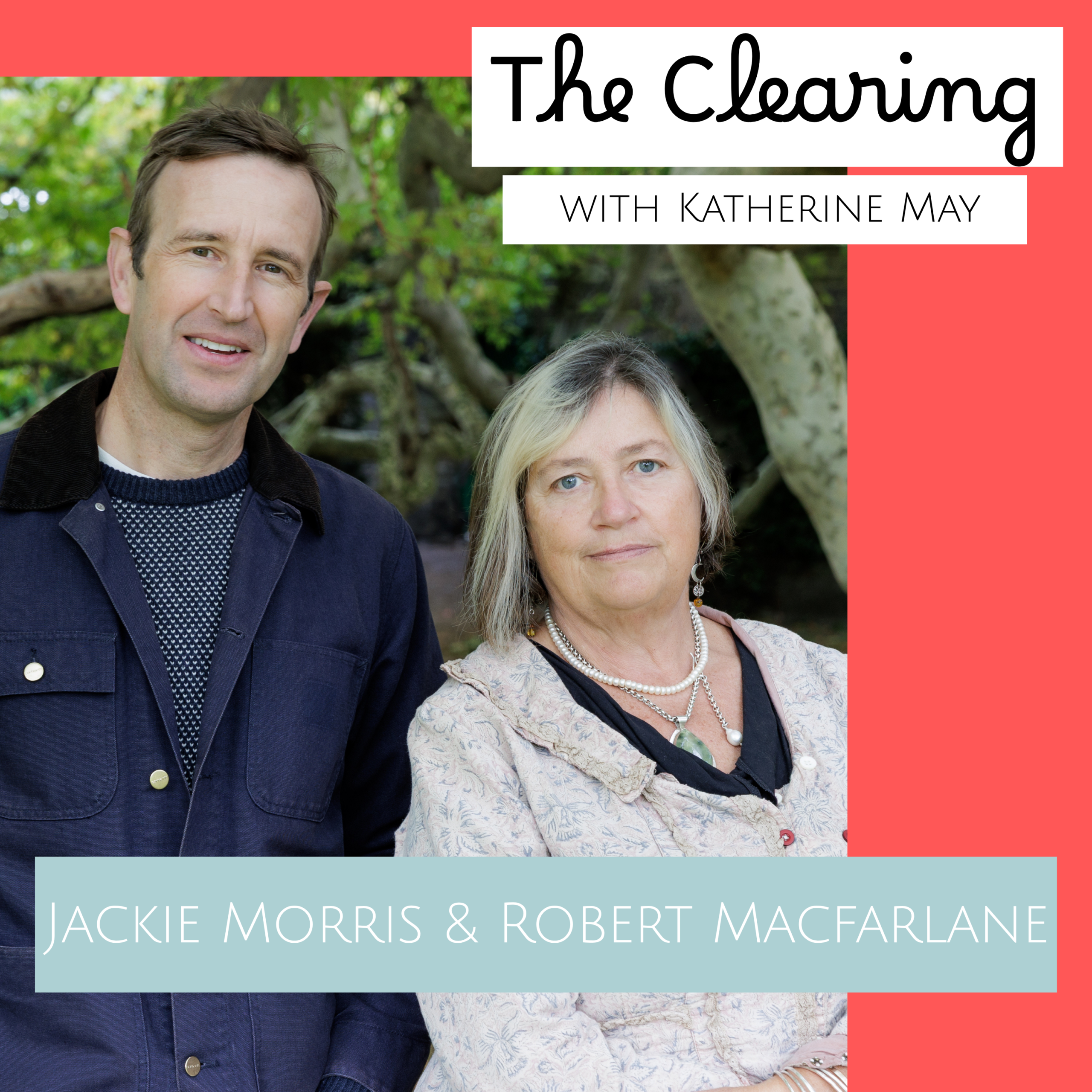
A beautiful, bird-filled episode from the wonderful collaborative duo of writer Robert Macfarlane and illustrator Jackie Morris. Together they have created some of the best-loved books on the natural world in recent years, including The Lost Words.
In this transcendent episode they share their quite different visions of what rest looks like for them. Robert conjures a wild, bird-filled landscape in the Scottish Cairngorms while Jackie imagines taking a sentient ship to a melding of the Rain Wilds and Earthsea. Full of wonder, wild knitting, ‘glacial erratics’, laughter and of course plenty of nature chat, this episode is a true salve for the soul.
Transcript
Please note this is an automated transcript and as a result it may contain errors
Katherine May: [00:00:00] Hello. Hello. Welcome back to The Clearing. We are here with you again for season two. After a little break in which we restored ourselves, reflected, put our feet up, and in my case, had major abdominal surgery. That wasn’t entirely the attention when we. Went on our break. Uh, but I’m very glad to have had it done and I’m now recovering at home thinking funnily enough, a lot about what it means to rest.
I feel like I’ve learned a lot in the last few weeks. You are supposed to, after having a hysterectomy, as I have, you’re supposed to stay off work for six weeks, uh, which is an unthinkably long time for a writer. Um, but I [00:01:00] have been taking my rest very seriously. You have to, of course. Um, every little thing makes me very tired.
I’m not allowed to lift anything heavier than a kettle. Um, and when I’ve stretched that accidentally, I’ve felt it. So your body has a way of teaching you things. Um, but mostly I’ve been spending time. Watching lots of movies, reading lots of books, binging 30 rock all over again. Nice to watch that from start to finish and you recognize more people in it every time.
I have to say it hasn’t been that unpleasant. I’m not normally someone that’s all that good at stopping, but this hasn’t frustrated me as much as I thought it would. In fact, it’s been a time of dreaminess and thinking about who I am now in this new phase of my life. I’ve really appreciated the time. [00:02:00] It feels luxurious, and of course it shouldn’t.
We should all get exactly the time we need to recover from surgical procedures, but I’m mindful that so many people don’t and I just have felt very grateful for this time, for all the people that have looked after me. All the kindness I’ve received, all the gifts. You get really good gifts when you have a hysterectomy.
It’s great. Honestly, I’m awash with kind of uterus themed knickknacks and that’s not a bad thing in any way. As well as lots of flowers and chocolates and stuff. It’s been great. It’s been like uterus Christmas. I dunno what to tell you. I just really recommend it. Anyway, it’s a bit more of a. Uterine start to the podcast that you’re probably expecting.
Um, but we do have an excellent pair of first guests this season. There are many more to come. You’re gonna be delighted, [00:03:00] uh, but I think you’ll be really pleased to hear that we have this week, Jackie Morris and Robert McFarland, the duo of author and illustrator, who have produced such beautiful children’s books as the lost Words and have just produced a brilliant new book called The Book of Birds, which is a song, a bird song, if you will, um, to both of their love of all of the birds of the air.
As you can imagine, the pictures are absolutely divine. Jackie Morris, just. Brings it home every time in, in the illustration world. So, so beautiful. Accompanied with really poetic meditations on each bird. But I wanted to talk to both of them together about how they rest. I think I had a fairly strong sense [00:04:00] of how Robert might rest, although the food he takes with him surprised me.
But I really wanted to know more about Jackie and what feeds that amazing imagination and that sense of deep beauty. They are such an interesting pairing, and it was just brilliant to talk to them. A real pleasure and a real highlight of, uh, of my year so far. So I really commend it to you and I hope you enjoy it.
And I hope that some of you’ll be listening in the same attitude as I am recording this intro, which is on the sofa with my feet up and a blanket over my knees.
Jackie Morris: It’s a good way to be. I’ll see you in a little while.
Katherine May: Robert and Jackie, welcome to The Clearing. It’s so lovely to have you here.
Robert Macfarlane: Thank you, Katherine.
Jackie Morris: Thank
Katherine May: you. I, um, of course, have known your books for such a long time, that, particularly the ones you do together, having a 13-year-old who’s sort of grown up with them. So I’m [00:05:00] so thrilled to see that you’ve just done a new one about birds this time.
Robert Macfarlane: Yes. New, uh, uh, begun seven years ago, so new and old, um, and, and very, yes, very long.
Jackie has painted the most extraordinary body of work. Has really, it’s
Katherine May: beautiful.
Robert Macfarlane: Summoned the birds from the skies to the page. It’s beautiful to see.
Katherine May: I’m so curious, before we start, really, I, I’m so curious about how that process works. Do you agree on a topic and go off in different directions, or do the words come first, or how do, how does that happen
Robert Macfarlane: Every which way?
What, what, how do you tell it Jackie?
Jackie Morris: Um. It’s, uh, a strange kind of, uh, uh, movement through time and space. I think, um, we work around the concept of how we want to shape the book. Um, people try and help me by making my work [00:06:00] less and I love painting, so I try to paint more. Um, sometimes we work together with words.
Yeah. So I will be responding to, to Rob’s words With the Book of Birds, it was very different because when we began it, we began in the pandemic. Rob, you were a little bit busy, weren’t you? Um, with um, having a proper job. You had stuff
Katherine May: on Rob, did you?
Jackie Morris: Uh, yeah, little bit stuff on
Robert Macfarlane: 600 students and three children.
Jackie Morris: Yeah. Yeah. So difficult,
Robert Macfarlane: difficult. Yeah. But the birds rolled around us and they were um, they were singing it up as it were. So yeah, slowly. I think sometimes Jackie’s art leads, leads my words and, um, that was often the case in this book. And sometimes I’ll write and, and I mean, that’s what I think true collaboration is rather than a kind of, you know, Jackie is the illustrator or me as the caption to [00:07:00] Jackie’s paintings.
It’s, yeah, you know, good, good collaboration is alchemical it. It’s a proper combination that lights up both forms and moves in both directions.
Katherine May: Mm, lovely. And of course, I mean, if you started during the pandemic, that’s a, that’s a time when lots of people really noticed birds for the first time, isn’t it?
That, you know, that actually engaged with them and began to be able to name them. I, I imagine, you know, there was a huge wave of, of interest then that, that you can ride on now. People like, oh, I remember those from the pandemic,
Robert Macfarlane: what birds. Yes, exactly. They find them. Yeah. The birds I episodes for a
Katherine May: while,
Robert Macfarlane: miraculously in 2020.
Where were
Katherine May: they before? Yeah, yeah.
No,
Katherine May: you’re right. And that’s true though. Is that the people? Yeah,
Jackie Morris: for some people I think there was, um, because people had to stop rushing around and doing things, there were less distractions, so they would take time. To listen a bit more maybe. [00:08:00] I mean, it did begin before then.
We had like a false start, didn’t we? Um, with the work where, um, when we were working on curlew and Lapwing, um, and then, and that was before, um, the pandemic, but then once we were in the pandemic, it was very much, um, having to respond ev the birds were center really. And that, and it’s very different. Yeah.
And it was both of our responses to each bird, but also conversations between us almost daily. Poor Rob gets so many emails from me sometimes.
Katherine May: Mm. Like sharing, sharing birds.
Jackie Morris: Yeah.
Katherine May: Yeah. That’s lovely. I mean, it’s such a beautiful book and, and that. That melding of the words illustration. I often wonder why we as adults can’t have more illustrations in books.
Honestly, I just think it’s such a pleasure to have that interplay of the, of the two bits of information. I, [00:09:00] I just think grownups should be allowed. Picture books too.
Jackie Morris: No, I, I said this one on stage, um, with a writer there, and he said that pic, if, if the writing was good enough, pictures were irrelevant and I almost cried on stage.
I know, I know. Um, this is a, I won’t name names. He wrote picture books later. No, he did. He wrote, he wrote books. But his, his, uh, argument was that, um, older children didn’t need the pictures and adults certainly didn’t need them, and it nearly broke my heart. You know, I would love to illustrate Angela Carter’s books.
Don’t need illustrations.
Katherine May: No, but, but it would enhance the right illustrations would. Yeah.
Jackie Morris: Yeah, yeah. Yeah. Why should we be deprived? The joy of the visual?
Katherine May: Absolutely. Absolutely. [00:10:00] Maybe someone will take that as a pitch, Jackie and, uh, see your illustrated Angela Carter in a couple of years time. I’d love to see your feathers.
I think that would be great.
Robert Macfarlane: Oh yeah. Knight at the circus by, with Jackie Morris would be amazing. Lovely.
Katherine May: I, that was, uh, that was done for a level at my school. Uh, but not, not the class that I was in the other A level class and I just remember the all coming out really scandalized the other day. ’cause it had the C bird in it.
I think they’re all so excited.
Robert Macfarlane: Yeah. Course rule breaker, the, the bird, I mean. We, we imagine this as a field guide, uh, as a kind of di we, we grew up reading field guides, think about books with pictures in, and of course they’re, in a way, they’re the books that are allowed to have pictures. Yeah. Because
Katherine May: Yeah, of course.
Robert Macfarlane: Yeah.
Katherine May: Uh,
Robert Macfarlane: and, and we still all, I think many of us who love birds still live with field guide. Some of them we, we had as children and some, some we’ve acquired as, as grownups. So. [00:11:00] We wanted to, to create an homage to the field guide of the Bird book. And, um, and so, but, but really to use where, where photographs and data come in, um, in that very objectifying and, and brilliantly rigorous scientific way.
Think about how we can, how we can celebrate and honor birds in language and, and art. But, but Katherine did. You did. I mean, I, I’ve, I’ve heard you, I identify bird song very well. Um, you
Katherine May: weren’t that good actually. No.
Robert Macfarlane: Did you grow up, I mean, you, you’re obviously a bird person. Did you grow up with, with bird books, with field guides?
Were the ones that you remember from ’cause we’re, I think we’re of an age more or less. And no,
Katherine May: I actually had very few books as a child. I didn’t, didn’t really grow up in a very bookish house. Um, but I did grow up with my grandparents’ garden where they fed the birds every day. So I, I recognize those ones, you know, and my grandma had a tame, um, thrush.
Tam song thrush that she Oh, wow. Who came and sat on the arm of her chair every morning when she sat [00:12:00] on the veranda. Oh. And she fed it sultanas. So yeah, I aspire to that one day.
Robert Macfarlane: Wow. So your grandma was your bird book basically.
Katherine May: Yeah, she was. Yeah. Yeah, yeah. That’s right. Yeah. And, and also they were great gardeners and so, you know, that naming of things I got from, got passed down from them.
It’s an oral tradition for me rather than a book tradition. Yeah. But, um, didn’t, didn’t really come down it through a family that was very, um, kind of. Yeah, nature oriented really. Um, in fact, my family generally hate leaving the house. That is the, that’s the sort, the dominant mode in my, in my lineage. Like they prefer not to straight outside the front door.
They can possibly help it long line of kind of arra, not arachnophobes, agro phobes. And, and, and, um, its
Robert Macfarlane: probably Arachnophobes too
Katherine May: actually. Yes. I, I also, I’ve just, I’ve literally just written a book about the, the inheritance of arachnophobia that I got from my family, so, yeah.
Robert Macfarlane: Oh wow. Okay. So it was on your mind.
Yeah. Your mind.
Katherine May: It was a, yeah. Freudian [00:13:00] slip. That one. So, yeah. Anyway, um, as you know, this podcast is talking about rest and, and often how we dream of rest, um, rather than the rest we take in real life. ’cause I think that’s often a very imperfect relationship. Um, I’m really curious to know if you are the kind of people that take yourself off on retreat or take yourself away from it all, or, or is life just too busy for that?
Robert Macfarlane: Jackie,
Jackie Morris: well, I live, um, in retreat, but have to keep going out to promote books. Um, and my year a shame is terrifying. Um, I, years ago, um, I came on holiday and um, for a weekend and I just fell in love with a place and moved here. [00:14:00] Um, and it’s, it’s been a wonderful place to kind feel like I’m retreating from the world going home really.
So there is, there’s, there’s that kind of thing for me, but, um, once a year I’ve taken to, uh, trying to organize being away with a group of like-minded people. Um. So, um, we, we rent a big house on X more uk I’ve heard,
Katherine May: I’ve heard the heard rumors about this Jackie.
Jackie Morris: Yes.
Robert Macfarlane: Oh, words getting around
Jackie Morris: and then everybody gets on with their own creativity in the day and in the evening.
We all get together and share food and ideas are born there. I think sometimes you have to get away from home to, uh, drop all the noise that goes on at home so that you can have a clear thought. I think, um, and I don’t mind what time of [00:15:00] year that is really. I
Katherine May: really get that.
Jackie Morris: Um, but I, I do look forward to it.
But I think my problem this year is that I’m just out and about far too much, um, talking about work and not actually making it.
Katherine May: It’s really hard, isn’t it? Confronting those years when you have to promote a book. I mean, on one hand it’s a joy ’cause you get to meet readers and you get to meet other writers.
But I look at those years in prospect and think, okay, when this is done, I will go very quiet for a while and, and not talk to another human being for six months.
Jackie Morris: Mm-hmm.
Katherine May: That’s definitely, are you more sociable Rob, though? Are you, are you the sociable, one of the pair?
Robert Macfarlane: Well, I, by, by my job. As a, as a writer, I suppose as, as a talker and a communicator.
And I love ideas. I’m very passionate about taking ideas into the world and, and watching them, um, change and metamorphos and gain their own new lives when they meet readers and hearts and [00:16:00] minds. And I, I am a teacher as well, so I that, uh, that brings me into a lot of contact with, uh, brilliant young people who keep my music taste fresh.
Uh, I, I think, I think I have forgotten what rest is. I, I think I have almost no memory of it left. And I think that if I were to try to rest, I would have to unlearn. A, a number of powerful instincts, and I would have to learn almost from, from fresh what rest means. Mm-hmm. It, it rhymes. It rhymes with, with nest, of course.
And of
Jackie Morris: course it does. Yeah.
Robert Macfarlane: Yeah. It’s the very first of the entries is a, is about this, uh, it was one of the first things I, I wrote and I was just put in mind of it. And I Would you mind if I just read, just ’cause it speaks to what we’re talking about. Oh,
Katherine May: please do.
Robert Macfarlane: It says, to nest is to trust. To trust the earth, to nourish the root that bears the trunk, that grows the branch, that makes the [00:17:00] crook, that holds the weave of moss and twig that forms the nest.
That cups pressed beneath a warm and beating chest. The egg nest is secrecy, nest is rest. And I think, uh. When I dream of rest, I dream of nest. Yeah, I dream of climbing, miniaturizing and climbing into a little re cocoon through that tiny opening, and it’s stitched together by spider’s. Silk and lichen is woven with feather.
And of course it’s teaming with parasites, but we, we forget that in this dream.
Katherine May: Yeah. We, we’ll try not to think about the parasites. So is that where you would like to take us to an a nest today?
Robert Macfarlane: I’m a very north minded person. I, I, yes, I flourish at, um, high altitudes and high alts.
Katherine May: I have a feeling we might find ourselves in Scotland.
Robert Macfarlane: You are right. Um, uh, you are right there is a little, it’s called a refuge. Um, [00:18:00] it would might also be called a bothy, uh, the Scot’s word for a simple shelter in open country. Um, but, but this is technically a refuge. So, but it, it lives in a, in a, in a very remote, um, corry in the Kang goms called, uh, AV Kry, which sits under bra and, uh, the river D is born, uh, about a thousand feet above this corry, uh, at the wells of d the springs at 4,000 feet.
And they crash over the. Cory wall and, and, and begin to grow into the, into the d And there’s this little refuge, which is really, looks like a heap of stones. You would mistake it for a natural feature in the boulder field from a distance. It’s the home of togan and golden eagles and, and whitetailed, eagles and ravens and occasionally humans.
So that, that is, that is where, that is where my mind goes, I suppose, and where occasionally my body goes to.
Katherine May: So this is a place you’ve actually been to?
Robert Macfarlane: Oh yes. Yes. This is
Katherine May: a real, real place, not a, not a composite of many. Well, all,
Robert Macfarlane: all, all [00:19:00] places are made of dream as well as, um, I mean the, all places as they live in our minds are made of dream as well as metaphor, as well as matter, we could say.
But it it, you could put a pin in this place. Yes. A very hard place to reach, but a very, and I think there’s something about the cocooning of shelter in a place of great ality and, and, and magnitude scales of time and space and force that, that, that enhance that sense of, of protection.
Katherine May: How lovely. Well, it sounds a little bit like a nest actually, in many ways.
Yeah,
Robert Macfarlane: yeah.
Katherine May: Jackie Stoniness, what about you? Um, if you could take us to a restful landscape for you, where would that be? Is it further south? I wonder?
Jackie Morris: Um, I, I’m taking myself, I’m not taking anyone else with me. Um, apart from a cat, a dog, quite right. Yeah, probably. But, um, I, I need to have two places really, because.
As I was saying, I was fortunate enough to choose my home, [00:20:00] which is, it is a cocoon, it is a nest, um, a bit like a bowerbird. So it’s, my studio is absolutely full of strange and curious things, from feathers to skulls, to wings, to nests, and to be here. That is where I would wish to be, but I want an empty head.
And that is so hard to get because so much of the time you’re so busy, there’s so much coming in all the time, and I really need to learn that ability to just empty the head. Um. But it’s, it’s not just a house. Yeah. You know, I, I chose the house because of the landscape. I live right on the edge of the land.
It’s a bit like living on a map. So the best thing to do to move towards this emptiness is, um, I walk up to the top of the [00:21:00] hill, which is rocky crags above my house, take my knitting. Um, and I like to do this thing called wild, lovely, wild knitting. It’s like wild swimming, but it’s not so wet. Um, and you just, you know, but
Katherine May: it’s, yeah, it’s warmer.
Yeah.
Jackie Morris: Keep your fingers busy and let your mind wonder until you get that peace. Um, which is what I’m searching for more and more these days. The, but the problem is I’m searching for it so that ideas can come in and I need to stop doing that because, just peace for the sake of it is what I should be chasing.
Katherine May: But then, I mean, creative people never stop. Yeah. We never ever stop. We are always, always working in a, you know, in one way or another, in the back of our, our minds, I think.
Jackie Morris: But I’m tired, Katherine. I’m so tired. I’ve been working for 45 years now and, um, I’ve done a lot of paintings.
Katherine May: Mm-hmm. [00:22:00]
Jackie Morris: Um, and I’m slowing down, um, in some ways speeding up in others.
Um, because I can feel time running out now.
Katherine May: You’re too successful. Everyone loves you too much.
Jackie Morris: I did, I did threaten to resign, uh, resign, retire after I’d finished the bird book. Um, but I did say that, you know, I’d do what people do in retirement and do some painting and write a book. Um, but nobody seemed to get the joke, which was irritating.
Um. Yeah.
Katherine May: I, I mean, I think that’s the problem though, isn’t it? That, you know, we do these things because we love them. Hmm. And the, I had a very awkward conversation with a pensions advisor recently who was trying to encourage me to think of a time to give up writing. And, and, and I was like, well, that’s horrible.
I don’t like that idea. That just, that seems dystopian to me. I don’t, I don’t actually wanna plan for this.
Robert Macfarlane: Jackie, you’re, you’re most unhappy. You become most unhappy when, when you are [00:23:00] not painting. It’s very clear. You become tremendously grumpy and, and very sad. And don’t, don’t think you’re ever gonna escape the, you’re not ever gonna escape the loop because you are a creator.
You paint, paint, pause from, from your brush, and you, you, it’s a, it’s a compulsion in you. Um,
Jackie Morris: although I would say
Robert Macfarlane: the world.
Jackie Morris: I’m most unhappy when I’m not in conversation with paper in some way. So this is painting writing, but it’s also reading. And this is the other I want to cheat. I want two places because I want a fictional place as well.
Katherine May: Oh, please. Please.
Jackie Morris: And there’s a place that if, if I could go to a place for a holiday. I would go to, um, the Rain Wilds, which are in Robin Hobbs books. And this is a land that she created, [00:24:00] which, um, her, her world building is so beautiful to, in my head, it looks like Venice in the middle of a forest, and it is a place of dragons of the best kind.
Um, and I think it’s not far from Earth Sea, so I cheat a bit more because, you know, if you’re gonna,
Katherine May: oh wow. You could, yeah,
Jackie Morris: yeah. Couldn’t you? I
Katherine May: would happily meld with the world of Ursula Le Guin. Any, any given moment.
Jackie Morris: It’s, and, and this, um. You arrive there by ship and the ships are sentient beings. Um, so sailing on a sentient boat is, you know, just astonishing at the wind’s hand and then sailing up river to these amazing cities which are empty.
And they all contain whispers and ghosts and secrets. Um, and you know, I can go there because [00:25:00] I can read the books, and that’s the beauty of writing.
Katherine May: That’s the joy of Yeah. Of fantastical worlds, isn’t it? The, the kind of the, the writers that do really amazing world building offer us an opportunity to sort of travel.
I mean, I always think about Susanna Clark’s Fairy.
Jackie Morris: Well,
Katherine May: yeah. And
Robert Macfarlane: mm-hmm.
Katherine May: I mean, it does, it sounds quite scary in many ways, but it’s full of, you know, colors that you’ve, that have never been perceived by human eye and, and, you know, or. Tastes that bring about emotions and, and that, that kind of very synesthetic world that she builds.
Mm-hmm. I just think I would love to just roam around in it in a while without being held captive by the fairies for the next millennium.
So
what do you, don’t let me, don’t get me started on my theories about Piran and what that’s all about anyway. Um, I have, I could do like a podcast on that. I would.
Robert Macfarlane: Please do, please do. The world wants to hear it go then.
Katherine May: Yeah. The world in [00:26:00] Piranesi is abandoned fairy. I’m just gonna, I’m just gonna like stare at you now and like, so
Jackie Morris: Nancy, have you read the Starless the as well by, um, Erin Morganstein.
Katherine May: I haven’t, and I have it,
it
Jackie Morris: came out
Katherine May: on
Jackie Morris: a million, kind of, it came out at the same time
Katherine May: list. Is it really wonderful?
Jackie Morris: Both of those, um,
Katherine May: right.
Jackie Morris: Both of Susanna and Erin’s books, they have these weird kind of parallels. So Knight at the, not Knight at the Circus, um
Katherine May: mm-hmm.
Jackie Morris: Uh, the first one and
Katherine May: the Night circus.
Jackie Morris: The night circus. Is
Katherine May: it The night Circus I think
Jackie Morris: has real parallels with, um, yeah. Susanna Clarks, um. Noelle and Jonathan Strange. And then PII came out. Yeah. And the stylist C came out and you’re like, whoa. How? There must be some kind of connection between these two women.
It’s just astonishing. [00:27:00]
Katherine May: That’s interesting. Perhaps they’re the same person.
Jackie Morris: No, Banksy.
Katherine May: I’m gonna, I’m gonna just start a kind of literary conspiracy podcast instead, like, let’s just abandon this, just like wildly speculate about all sorts of things. Um, so, so to get back on track and to ignore some of my wilder ideas about literature, um, what, what is it that you like to do at these retreats?
So, Jackie, you’ve talked about knitting.
Jackie Morris: Yeah.
Katherine May: You know, is it. Do you need to stay in motion to rest, or is there any stillness that you find, or, or is there stuff that you want to do?
Jackie Morris: I think, uh, usually when I’m doing something like this, I’m also doodling. Um, this is the first time in ages I haven’t, and my hands are kind of all over the place.
Um, I find
Katherine May: do it, do it. Don’t, don’t, don’t not do doodle on our account
Jackie Morris: for you. I, I find walking is good for walking and thinking, especially for writing. I think the rhythm of walking [00:28:00] helps me to find the words that I want. Mm-hmm. Also, being away from the house so you’re not distracted by all the clutter.
Um, but yes, knitting, stitching as well. Um, and I love working with old tools that have a haunting about them. Um. Ooh, uh, that other people have that used. Um, well, you know, if you’ve got an old sewing set that somebody else has been using at some point, and there are so many stories and even a needle, um, and, um, other people’s knitting tools and there’s Oh, oh, just beautiful.
I, I write on a typewriter as well. I’ve got some really old typewriters and, uh, I love thinking about what they’ve seen and where they’ve been. But, you know, the same is with trees,
Katherine May: things with lineage.
Jackie Morris: Yeah. Yeah. When you stand next to a tree and listen, listen to the bark, [00:29:00] um, and think about what they’ve seen.
Katherine May: It’s something communicative, so it must be wherever you go in this retreat, it must have lineage and age and continuous usage. I think. Yes, the kind of softness of the world that has been used
Jackie Morris: and trees and owls.
Katherine May: Oh, it must have owls. I mean, everywhere has to have, I mean, that is, that’s a basic standard, right?
The owls have to be there.
Love that.
Robert Macfarlane: Well, maybe I can request a snowy owl, uh, which I, I’ve never seen a snow owl. I think there’s probably no bird I’d rather set eyes on in the wild these days than a snow al. So maybe I can, I can especially dial one in, um, to the
Katherine May: Yes, we can. We can That,
Robert Macfarlane: that’s,
Katherine May: yeah,
Robert Macfarlane: that would be great. Thank you so much.
And Alice
Katherine May: is, Alice, the producer is really good at, you know, sourcing out. She’s just
Robert Macfarlane: writing that down
Katherine May: because that’s, yeah, just sort that out for you right now. Yeah.
Robert Macfarlane: That’s fantastic. My, my places are haunted as well and weathered, but [00:30:00] they’re weathered not on the whole by the human though, though. I mean, the, the, the can goms are.
A former eroded stubs of a, of a vast magma chamber from a Devonian era vol volcanic chain. So they’ve had some weathering, they’ve had some haunting. Um, and we have left, you know, we humans have left our, our traces in the forms of refuges and footprints and, and, and thin tracks. Um, but of course, time and creatures and, um, lichen this beautiful collaborative being that’s, uh, plant and alga and, um, uh, the, these are all present.
I think I have to keep, keep moving really. I, again, I don’t really know what it means to sit still any longer. So I run and walk and would follow the water and, and I would love to, I think what I would love to do is take the digital out. That’s un not, not unusual these days, of course, and but to have pen and.
[00:31:00] Pen and notebook, uh, to, to, to be working on a song or a, a poem. Uh, do noodling as, uh, songwriters say, as I like to say, noodling on a, on a, in a notebook, uh, on a song or a poem that would be restful to me.
Katherine May: Yeah, I think, um, I always find that I end up, I never, I never work on my live project when I go away, but I do always end up kind of having an affair with a different project almost.
I sort of cheat on my main work for a while and, and dream up something really crazy. And I love that. I love that feeling. And, and it’s almost as if, as soon as I get back it. Recedes back again. Like it was, it was just a dalliance that I had. Um, I love
Robert Macfarlane: that too. Oh dear. I think I’m permanently polyamorous then when it comes to projects.
’cause I, I’m running, running 10 at a time and, uh, I’m not sure how faithful I am to, to one of them. You’re
Katherine May: promised writer.
Robert Macfarlane: Yeah. But, but they, um, they, they cross pollinate to change, to change our metaphor. They [00:32:00] cross. I learned so much about, I learned in part how to write this bird book from, uh, working with Jackie on the Lost words, but from writing songs and Libre and, and, and, and scripts and Coral works.
So you learn something different in each case about how language moves and plays and, um, yeah. The best writing advice I think I’ve ever had was, was, was from Jackie when we began the lost words. And she said, well, this is not a, it’s not a book for children, it’s a book for people. And basically go and play.
And, uh, that was, these were wise, wise words from a, a wise woman.
Katherine May: And it’s, I mean, I’ve, I’ve written about this a lot, I guess, but I think we have such a narrow idea of what play actually is. Yeah. And play for people like us. Three is often on a page or is often, you know, it is that doodling It is that, that kind of scribbling down lines.
It’s not, it’s not this kind of received idea of play, which is boisterous and noisy. I [00:33:00] mean, it might also be, but, but we are, we are so narrow in what we. Are prepared to accept as play. And I think that reflects on the way we treat children who like to play in, in this kind of way, but also adults too, that we don’t invite that continued play and it is play.
Jackie Morris: Mm-hmm.
Robert Macfarlane: Well this is, I mean, sweet singer in Homo Ludens is sort of this great early study of play from the thirties and, and it stayed, I guess as one of the principles of play. That True play is, is purposeless. It, it, its outcomes are not predetermined. Indeed. It doesn’t, it doesn’t work with deliverables.
And so, and yet. The, the, the world of, of, of hustle and, and bustle and capital tells us that even when we’re playing, we have to be delivering. And that, that’s, that’s when play actually sort of defaults into leisure. Because leisure is sort of managed play. It’s the thing that we do and it’s deliverable is to make us better able to return to our work.
Um, and, [00:34:00] and true play, I think is really hard to find birds play. I watch them and they play Ravens play and rivers play. And I, yeah, I need to remember from ravens and rivers how to play, I think
Katherine May: rather than the way that humans have, have been outta shape.
Jackie Morris: I used to work on many projects at the same time when I was younger.
Katherine May: Mm-hmm.
Jackie Morris: Um, and then I found that I could only, not only concentrate on one because while I’ve been doing birds, I’ve done other things, but mostly that was writing. Um. For other people to illustrate. Um, what I find now with my work is that I need to really be much fiercer with my focus and it feels less like play and more like prayer.
Um, maybe this is just me trying to hang onto the shreds of sanity in the crazy world. I’m not sure, [00:35:00] but um,
Katherine May: well, good luck to you, honestly.
Jackie Morris: I know.
Robert Macfarlane: Tell us how to do it
Jackie Morris: well. Yeah. If I knew I’d be, well, I would say if I knew I’d be wealthy, but I feel really wealthy. Um, just not, it’s got nothing to do with money.
It’s got more to do with the amount of time you can spend doing either what you really want to or nothing at all. Um, and that I think has its core in what you value most. My value is put on time. Yeah. More than anything.
Katherine May: And just, just that freedom to, to do as you want to do and not to, I mean, I, I just, I feel like a lot of what we’re saying is drawing the distinction between the work that we have to do and ought to do and the work that we want to do, and they often look exactly the same to the outside world, but there’s something about that, that freedom to roam and to meander rather than to work in a straight line and, [00:36:00] and be productive.
Yeah.
Jackie Morris: Mm-hmm.
Katherine May: I always invite my guests to bring something with them to their retreat, like a, an object that’s got sentimental value or a practical object that will help you to, to be in that space. What would you bring with you?
Robert Macfarlane: I would, I. Spring. Uh, sometimes I, I carry back little bags of red, red hot birds eye fresh chilies with me because they pick me up like nothing else.
And, um,
Katherine May: do you eat them
Robert Macfarlane: raw? And I just, yes. I love eating raw chilies. Several a day and they just kind of, they, they, they, they set everything fizzing brain body, um, best, best hangover cure, I know. Best insomnia, best fatigue, cure, I know, um, great mountain food. So they would keep me warm at night. Then I’d probably, I’d probably have my favorite little notebooks as well to scribble it.
I know I’m not really meant to have more than one thing and then I have, I we’re
Katherine May: not just [00:37:00] either discs, we are fine.
Robert Macfarlane: Okay. I have it here. I’ll just show you. ’cause there is a story attached to it. This, um, this little object, which is, looks a bit like a,
Katherine May: Ooh. Stone.
Robert Macfarlane: Stone is that
Katherine May: panic.
Robert Macfarlane: It’s not. It’s uh, it’s the fossilized, um, ear bone.
The mpa buller of a whale. Oh
Katherine May: wow.
Robert Macfarlane: Who swam the oceans of this earth about 10 million years ago? Uh, and
Katherine May: for people listening, can we just describe it? ’cause it’s, it’s black and it’s kind of like, ha it looks like half a black egg. Really? With a thick shell.
Robert Macfarlane: Yeah. Half a Exactly. Or, um, or a little kind of con shell with a yes.
With an opening. Um, dark gray, heavy in the hand. Curved. Um, so yeah, that, that, that, that is what a, a a, an ancient whale, um, navigated with, heard with, um, at some level sang with. Attuned its song with, and wow, it reminds me of all, all the ways [00:38:00] in which the world listens, hears, sings, speaks in ways that we cannot understand and will never understand.
So I think that as humans, we presume a supremacy and a totality of knowledge too easily. And actually, we are only ever holding up a tiny flickering candle in one square inch of the cave wall, um, and mistaking that for the light of the sun, so that that ear, fossilized ear keeps me humble and partial, I hope.
Katherine May: Oh, wonderful. Did you, did you find it somewhere or did you, or did you find it in a shop?
Robert Macfarlane: No, I, no, I was given it by a Rita. Uh, it was the most amazing gift, and I’ve kept it on my writing desk ever since.
Katherine May: What a lovely gift. How gorgeous Jackie, you’ve gotta beat, beat the whale, the fossilized whale bone.
Now I’m so sorry. No pressure.
Jackie Morris: I think once upon a time there were people who understood the language of whales, [00:39:00] but we’ve lost in the same way that I think people understood more the voices of birds when we paid attention more, when survival depended on it, which it still does. If only we could realize that.
Um, not like as in words, but um, you hear about communities who worked with dolphins hunting. Um, so there must have been some kind of two-way communication. But anyway, um, inevitably it is a brush. Um, and I am in love with this brush.
Katherine May: Ah, lovely.
Jackie Morris: Um, this brush is,
Katherine May: um, do you, do you have a, a specific like brand or type of brush that you, that you favor?
Jackie Morris: I used to have one, which was, um, a Windsor and Newton one, but this one’s come along and this one is, uh, synthetic and [00:40:00] absolutely stunning. So it folds away so you can put it in your pocket. Um, so it comes in half and then when you put it together, it’s just the right length, just the right balance. And it has a tip on it, like a sword.
You can write with it, you can paint with it, you can do smooth washes and fine detail. And it is the most exquisite thing. Um, and it comes from a company called Deep, deep Light in, uh, Lavia. Who also make paints and they make the most exquisite paint, so it would have to bring some of its paint friends with it.
Um, so, uh
Katherine May: oh, of course you can’t just have the brush.
Jackie Morris: Yeah. And then they’re kind of made from, um, they’re made from natural pigments and they’re mixed with honey. And, um, there’s a scent to them as well, which I think is something like, um, geranium, um, or uh, lemon balm. That’s it. [00:41:00] It’s lemon balm. So they’re beautiful.
You wake ’em up by kissing them with water. Um, so yeah, it’s just, uh, the most exquisite thing and as a tool, it’s gorgeous. And I hope that one day, maybe kind of 50 or a hundred years from now, somebody finds it and, uh, uses it and wonders about why on earth it’s haunted. Because it’s mine and I’m staying with it
Katherine May: wonders who’s held it.
Jackie Morris: Yeah.
Katherine May: You’ll, you’ll still be there, you’ll still have your presence on that brush by then
Jackie Morris: inside it like a genie.
Katherine May: That sounds absolutely lovely. Do you, um, do you often kind of paint in the field? Do you, are you, you someone that goes out and sketches out in the real world? Or, or is it something that tends to happen at your, at your desk or,
Jackie Morris: I haven’t been until recently.
I’ve been carrying a sketchbook around with me and trying to get back to that kind of practice. And, um, [00:42:00] and this year I’ve had, um, two very sound pieces of advice that I’ve read. Uh, one was in a book by David Gentleman and he, the, the, um, quote was, just get on with it. Um, and the other was from a podcast, uh, called the Illustration Department.
And, uh, one of the guests on that said, make art not excuses. And I thought, oh, yes,
Katherine May: oh yes,
Jackie Morris: yes.
Katherine May: Yeah.
Jackie Morris: It works with painting. Doesn’t work with housework. Oh,
Katherine May: yeah. Well, that’s not so interesting to get on with.
Jackie Morris: Yeah,
Katherine May: I used to have that as my screensaver in the early days of computers. It used to, it used to pop up after two minutes and say, get on with it.
Yeah. And bounce about the screen at me. And I was like, oh, okay. Then yeah, that was before other things were there to distract us so that it was, it was even easier in those days to actually write something. But, um, apparently not, not so much. And I also always invite a [00:43:00] guest to bring a cultural item of some sort, a record piece of art writers always bring books.
Uh, but I’m gonna kind of ban books because I think, I think there are more like, let’s make a leap today. We’ve talked about books already. What would you bring with you to, I don’t know, to speak to your soul while you’re there? Is there something that you might bring?
Robert Macfarlane: Jack, you’ll need to go first. ’cause I had a book, so, oh.
But I mean,
Katherine May: I don’t wanna throw you down Crisis, but I, I’m gonna push you with that. I’m sure you could find a song.
Jackie Morris: I wanna know what the book was though as well, but, um,
Robert Macfarlane: oh, well it was, it was Nan, shes in the, uh, the Living Mountain, which is set setting, set those, you know, setting those
Katherine May: magazine, I think, I think we take it as red that you have that in your pocket.
Anyway, I think we just, we just know that you’ve got that with you.
Robert Macfarlane: Thank you. I did actually once leave a copy of it in that refuge. So there is a, there is a copy of it there if it’s still there. Five years on. So if anyone [00:44:00] Oh, cracks open the door of that refuge and finds a copy of Nan. She, it’ll, it’ll, yeah, I was involved in it.
Katherine May: Yeah, it’s already there. Then it’s
there.
Robert Macfarlane: Yeah, that’s true. So I don’t need to um,
Katherine May: you don’t need to bring it.
Robert Macfarlane: Um, yeah, there’s a, I will just give you one line from it that I, ’cause I think I’d like to be there in September. She says in September, dawns I hardly breathe. I’m an image in a ball of glass. The world is suspended there and I in it.
And I was thinking about that line and, and, and your, your work, Katherine of, of the idea of suspension in the, the best senses and the, and the, the, the ball of glass. Um, uh, that’s lovely. Yeah. So it’s a beautiful line about, it’s such
Katherine May: a
Robert Macfarlane: beautiful book and suspension. Yep. So beautiful.
Katherine May: It’s an incredible book.
And also I share her love of September.
Robert Macfarlane: Yes. Yes.
Katherine May: Best one. The
Robert Macfarlane: blessed Month.
Katherine May: Yeah. The best month for walking for All Things September. And it’s my birthday, so [00:45:00] that’s, that’s important.
Jackie Morris: And
Katherine May: mine. And mine objectively. Is it, are you a September girl as well?
Jackie Morris: I’m the 8th of September. Um, and this year I’m going to be in Usher Hall with spell songs.
So for my birthday I’ve got a massive hall and a band, which would be nice. Except I’ll beyond safe sounds
Katherine May: or is that terrifying? It’s
Jackie Morris: terrifying, really, but it’s okay. Yeah, as well. It’s all right when it’s over.
Katherine May: I refuse to do anything on my birthday. I’m still a massive child, and if someone tries to invite me to something, I’m like, no, it’s my birthday.
You can’t expect me to be anywhere. So,
Jackie Morris: brilliant.
Katherine May: So Jackie, what cultural item would you bring with you?
Jackie Morris: I’m gonna steal juror’s hair from a museum, and I’m gonna tuck it in my pocket and I’m gonna take it everywhere with me, because I think of all the paintings in the, I mean,
Katherine May: that’s legal, I’m sure.
Jackie Morris: Yeah, of course.
It’s, yeah. [00:46:00] Yeah. I will. I’ll love it and look after it. So it’s that
Katherine May: beautiful. What is, is it an etching?
Jackie Morris: It’s a painting.
Katherine May: It’s a painting. Okay. That beautiful. Really present hair.
Jackie Morris: Yeah. And there are stories. Inside that painting. Um, maybe that’s why I wanna take it actually. Um, she’s a beautiful hair and I’d like to write about her life.
Really? Mm-hmm.
Katherine May: She’s gorgeous.
Jackie Morris: Um, but she’s also, uh, the, it’s just the most exquisite piece of work. Um, so I guess to have that always to look at. It’s a bit selfish. Nobody else can say it. I think
Katherine May: it’s fine to kidnap major works of art and just take them, take them on retreat with you. It’s, it’s perfectly reasonable.
It’s
Jackie Morris: well,
Katherine May: yeah.
Jackie Morris: Yeah.
Katherine May: Everyone’s actually Kettle’s Yard used to let you do that in the, in the olden days, didn’t it? In Cambridge.
Robert Macfarlane: I think it still happens. The, the art loan scheme. I think [00:47:00] students still have remarkable works of art on their, on their walls for a term or, uh, or two terms. It’s a, it’s a beautiful, beautiful notion.
Katherine May: Okay, so we have jurors hair and we have, um. We have Nan Shepherd, but is there something else you bring Rob?
Robert Macfarlane: Well, I, the, the thing is, it’s so the thought of a film or a song other than those I carry, you know, carry in the skull cinema and the skull, um, playlist are, I don’t really want them there. I don’t, I don’t, you know, that’s such a, it’s such a cinematic place.
It’s such a musical place. Water is singing, what is it saying? And, um, and the snow buntings are there glittering in with their, with their, uh, companionable cries. So I think it would have to be a silent work of art. So probably, probably a painting too. And I think maybe Rothko, maybe a big Rothko to hang on.
The, the walls of the refuge are, they’re like, it’s an Ved, [00:48:00] it’s a bit like Jackie’s, um, Jackie’s studio. So it’s quite hard to sort of hang a painting. But I imagine something about that, that, that the ways that Rothko’s colors. They kind of, they merge the, the absence of hard, hard lines and that Yeah. And something about and losing, and they change across
Katherine May: the course of the day, as well as the light changes,
Robert Macfarlane: as the light moves in.
And if being in a place like that is about recalibrating one sense of time so that it’s not fine sliced into micro units, which is how I live my life at the moment. Yeah. Uh, then, then the blur feels very attractive to me.
Katherine May: Mm. That sounds gorgeous. So it’s time for you to go home now from your gorgeous retreat.
Robert Macfarlane: Oh,
Katherine May: is there? I know, I’m sorry. I, you can stay there in your, your mic. I’m so sorry you have to go back to work now, but is there a moment when you get time to yourself that you feel ready to come home? How do you know [00:49:00] when you are ready to go back to, to real life?
Jackie Morris: I find that when I’m away, I almost get scared of going home sometimes.
Um, but the minute I stepped across the door. Step into the chaos of my house. Um, it does welcome me. Um, when I bought my house, I knew that I was buying a home, not an investment. And, um, that kind of, that’s really held me. Um, I do wish that, um, the people who are trying to develop AI would concentrate on, um, AI to actually tidy up your house for you so that you can do more writing rather than stealing writer’s work so that they can use it.
Um, that would be much more interesting. Much more useful.
Katherine May: I’m here for train squirrels personally.
Jackie Morris: Yeah. Train
Robert Macfarlane: squirrels.
Katherine May: Train squirrels. Yeah. Yeah, yeah. It would be whimsical as well, which would be really nice. I’d, I’d like a little bit of whimsy. That would
Jackie Morris: be [00:50:00] winged monkeys as well. Yeah,
Katherine May: we could set that on the ai.
We could actually, you know, fly my pretties fly.
Jackie Morris: Yeah.
Katherine May: Until the ai
Jackie Morris: I think this is dangerous,
Katherine May: but it’s interesting you say about that. Yeah. It’s probably dangerous that, that dread of coming back home. Like, I, I really get that. I really, I, I will get to the point where I miss my pets and I want to be back with the cat. And if I’ve left the dog, I’m definitely feeling very guilty about the dog by then.
’cause I know she’s probably sitting by the front door looking tragic. Yeah. Um. But I, I do always have that big speed bump to get over to go home if I’m somewhere really lovely. And if it’s quiet and if nobody’s bothering me, like I’m just really happy if no one’s bothering me, honestly.
Jackie Morris: Yeah. Yeah.
Robert Macfarlane: I feel we should apologize for bothering you, Katherine, right now.
Katherine May: I think, I think technically speaking I bothered you, so I think this is okay.
Robert Macfarlane: It’s alright.
Jackie Morris: I even [00:51:00] find this when I, when I go out for a walk and, um, so I’ll, I’ll, I’ll drag myself out the house to go for a walk and then once I’m out there, I don’t wanna come back. Um,
Katherine May: yeah.
Jackie Morris: Which is, you know,
Katherine May: yeah. I never wanna go home.
Jackie Morris: Yeah,
Katherine May: but then take me on a night out and at eight o’clock I’m like, oh, has it done?
Jackie Morris: Oh, yeah,
Katherine May: there you go.
Jackie Morris: Where’s the
Robert Macfarlane: pillow? Yeah,
Jackie Morris: you make
Katherine May: a bed fairly. That was the polite version. But would, but Rob, would you stay in the mountains forever? I mean, it, it always strikes me that you are extremely happy on your own, out in the, out in the landscape.
Robert Macfarlane: Well, I actually don’t, don’t feel that, um, in fact I, I’m quite suspicious of, uh, of, as it were, the urge to solitary transcendence. Um,
Katherine May: there’s
Robert Macfarlane: an, there’s another word, uh, that we is less familiar to us than transcendence, and its Inc. Descendants, and it was coined by Thomas Berry. The, um, sort of theologian and [00:52:00] Mystic and Inc.
Ence is instead of trying to kind of leave behind the troubles and the cares of, of the world and, and retreat into a splendid isolation. Through ascension, I suppose, in sentence, is staying with the trouble climbing into the complex core of the world. In, in all its wonder and all its difficulty. And I, I think, um, when I’m away from, from family, from friends, but also from the trouble and the wonder, I, I begin to feel guilty.
I begin to feel itchy, scratchy. I begin to feel I should be there working for change, working for good, be it driving hope in some way. However, however, tiny Yeah. And local that might be. So, yeah, I, I, I’m s. Personally find that the hermit impulse difficult to live with for any length of time, that’s not a criticism at all of those [00:53:00] To who for whom it is strong.
Yeah. And
Katherine May: yeah, and, and
Robert Macfarlane: I think
Katherine May: part, there’s there be a temperament, isn’t there? There’s a hermit temperament for sure. Yeah. And there’s a, but most people would. I mean, people talk a big game when it comes to hermitude, but most people don’t honestly have the stomach for it. I would say
Robert Macfarlane: so, yeah. Put me in a shell lined grotto and I’ll last a day at the end, at the end of the garden.
Katherine May: We have one of those in Margate. That’s very good. If you’re fancy.
Robert Macfarlane: Okay. Um, so I, I realize that sounds sanctifying as well. I think it, it’s not that it’s not, it’s not that the hermits are the irresponsible ones and the, and those in the, in the stuck and the mire of it all are the, uh, I mean, we, we need, we live in the dialectic between those two poles and, and it’s impossible to stay in one, I think, I think forever.
And, and we, yeah, we live on an infinity loop between them. I think that’s what we’re talking
Katherine May: about here. But he think that. Everybody has their, their locus where they communicate with the world. And, and for some of us, I [00:54:00] actually, I communicate better with the world when I’m away from it. Like I, I can see it from a distance.
Whereas when I’m in the Mele, I’m mostly just overwhelmed by it. And I, I can’t think straight and I, you know, have many thoughts about it when I’ve left it by. Yeah. Whereas for other people, that, that kind of reactivity is, is really part of it. And that, and convers, you know, real time conversation is really important for others.
And I, I just think we all just have our, I’m, I’m much more effective staying out of it to, to an extent. To an extent, you know?
Robert Macfarlane: Yeah.
Katherine May: Yeah. So, one last thing. What do you bring home with you from your retreat? Oh,
Robert Macfarlane: oh, a stone. A stone. Just one stone. Yeah, yeah. Uh, their archives, memory storage devices better than any thumb drive, um, better than any photograph.
Um, they have a texture to them await a pulp and a heft in the hand. Their geology speaks of their place, although they might be [00:55:00] zeniths and, uh, have been carried over time from one, from where they’re made to where they’ve ended. And, and I’m, and I’m just part, you know, I’m a, I’m a small glassier carrying, carrying a stone on another journey, and it will, it will leave me the transporter behind.
But for you,
Katherine May: a glacial or regular.
Robert Macfarlane: I’m Exactly, I’m a glacial, erratic. Yeah. So for brief moment, there’s,
Katherine May: I’m on Sherlock Holmes, aren’t I? I’m on the Baker Street Irregulars instead, like little
Robert Macfarlane: glac stoves. I the glacial irregular. That sounds great. I’ll take that. I’ll take that on a t-shirt.
Katherine May: I used to have glacial erratic written above my computer, and I used to look up at it every day and aspire to it, you know?
Robert Macfarlane: Oh, that’s so funny. Why was it there?
Katherine May: I, I think I wanted to learn to be a bit more glacial at the time and a little less available to the world, you know,
Robert Macfarlane: glacial erratics. Let’s, let’s found a club.
Katherine May: I know. It could be a really good tattoo. Okay, so a stone. I’m, I always bring a stone home too, Jackie. Are, are you bringing a stone or a skull?
[00:56:00] Maybe, if you find one.
Jackie Morris: I, I do. I’m, I’m a stone woman. Really? You know, I, I live yeah. By the sea and, um, the, the sea sculpted stones. Especially the smooth ones have a, a heft in the hand that does help to carry memories, I think. But I tend to, I take them home, um, pattern gold leaf onto them and then take them back to the sea and leave them.
Um, it’s a, a habit that I have. Maybe that’s a hobby. I’m not sure. Um, sometimes they’re found by people. Sometimes they’re, I put them in places where I know the seal just take them. Um, sometimes they’re hidden in trees and in the landscape. [00:57:00] Um, and I don’t, you know, sometimes I find out who’s found them and taken them, and other times I don’t.
Katherine May: Lovely. So you just let go of them and free them into the world. Well, thank you so much. That’s a dreamy end for us. Um, thank you both for a lovely conversation. I’ve so enjoyed it.
Robert Macfarlane: And you, Katherine, thank you so much.
Jackie Morris: Wasn’t that lovely? It was such a pleasure to do.
Katherine May: And one of the things I should tell you, which I hope will make you giggle is that all the while we are interviewing Jackie, the, she has very rural wifi and the video feed that she was, uh, coming through.
Was just a blur. And we really wondered, um, whether the magic of the software we use, which actually records everything on people’s local computer and then uploads it to us afterwards was gonna work or whether we were gonna get any footage at all. [00:58:00] But actually it’s come out crystal clear, and I don’t mention this often on this podcast, but we do always upload a full video version to our YouTube channel.
If you, um, search the Clearing podcast, you should find it. And that lets us add, uh, subtitles. For those of you who I know find it much, much easier to concentrate if you’re watching the subtitles. So that’s absolutely there if you need it. Um. We have been busy a littler with this podcast on hiatus because we’ve also now set up a series of extra episodes for anyone who would like to just be more involved.
So they’re available for paid subscribers to my Substack. But you can also, uh, just subscribe for the podcast only on Patreon if you’d prefer. Um, there are links in the show notes to do all of that, and that will mean that you get, um, an extra little bonus episode [00:59:00] every week where I’m gonna be talking about my mini breaks, which are the ideas I have for little breaks in your day.
Not big breaks, like having your uterus removed, but just small breaks that are nice and relaxing. Nothing too dramatic, but I’ll also be asking listeners. To feed in their dream retreat. So to answer the same questions that all of our guests answer and to expand our vision of all the different ways we can rest.
I can’t wait to start broadcasting these episodes. We’ve had some really great submissions already. Um, again, have a look in the show notes if you’d like to submit yours. Um, we’ll do our best to pick the most interesting ones. We won’t be able to cover all of them, but please give us something original, which will make us much more likely to choose it.
That’s the best guidance I can give you. Anyway, there’s one coming very soon, so I hope you’ll enjoy that and do [01:00:00] subscribe ’cause it really supports the podcast and it also means that you’ll be going ad free too. So, uh, that can be an enormous joy. I know. It all has to be paid for somehow. So loads of us tolerate the ads anyway, but either way, it means that the podcast pays for itself, which is really, really important.
Anyway, that conversation has made me want to go for a long walk, which I really can’t do at the moment. I can, uh, just about manage a little stroll around the block, followed by a little snooze, but I’m fantasizing about the day when I can get out and, and really explore again. My dear husband who has been looking after me lots, did drive me to see the bluebells recently in our local woods, uh, which is a, it’s a piece of ancient woodland where it just gets this beautiful host of bluebells every spring.
So I have got to see them, which was really nice and I [01:01:00] might go back again this week. But yeah, feeling maybe a little constrained at the moment. But all is well. Um, thank you for coming back. Thank you for being here, and I hope to see you very soon with another great guest next week. In the meantime, take lots of care.
Bye.
Links from the episode
The Book of Birds by Jackie Morris and Robert Macfarlane
The Lost Words by Jackie Morris and Robert Macfarlane
The Lost Spells by Jackie Morris and Robert MacFarlane
Jackie’s Instagram
Jackie’s website
Robert’s Instagram
Deep Deep Light paint brushes and paints
A Wizard of Earthsea by Ursula K. Le Guin
The Rain Wild Chronicles by Robin Hobb
Artist David Gentleman
Read about Albrecht Dürer’s painting Young Hare here
The Living Mountain by Nan Shepherd
Read about artist Mark Rothko on the Moma website
About Jackie
Jackie Morris has written or illustrated over seventy books, including the beloved children’s classics Tell Me a Dragon and East of the Sun, West of the Moon and a volume of modern folklore for readers of all ages, Wild Folk, co-created with Tamsin Abbott, as well as introducing and illustrating Barbara Newhall Follett’s gem of wild literature, The House Without Windows. She is the internationally bestselling and award-winning co-creator of The Lost Words and The Lost Spells, two books which have captured the hearts of hundreds of thousands of readers of all ages. In 2018 she won the Kate Greenaway Medal and the British Book Awards Children’s Book of the Year for The Lost Words.
Her artwork is held by public art collections in the UK and USA and has been published in the New Statesman, Independent and Guardian among other venues. She tours and performs with the Spell Songs ensemble around the UK, and is a Fellow of Herefordshire Art College.
About Robert
Robert Macfarlane’s Sunday Times– and New York Times-bestselling books include Is a River Alive?, Underland, Landmarks, The Old Ways, The Wild Places and Mountains of the Mind, as well as a book-length prose-poem, Ness. His work has been translated into more than thirty languages, won prizes around the world, and been widely adapted for film, music, theatre, radio and dance. He has also written operas, plays, albums, choral works, and films including River and Mountain, both narrated by Willem Dafoe.
Macfarlane has collaborated closely with artists including Olafur Eliasson, and with the artist Jackie Morris he co-created the internationally bestselling books of nature-poetry and art, The Lost Words and The Lost Spells. In 2017, the American Academy of Arts and Letters awarded him the E.M. Forster Prize for Literature, and in 2023 in Toronto he was the inaugural winner of the Weston International Award for a body of work in the field of non-fiction. He is a Fellow of Emmanuel College, Cambridge, and is presently working on a graphic novel retelling of the Epic of Gilgamesh.
11 responses