The Clearing with Katherine May
Barbara Carrellas’ enchanted theatre
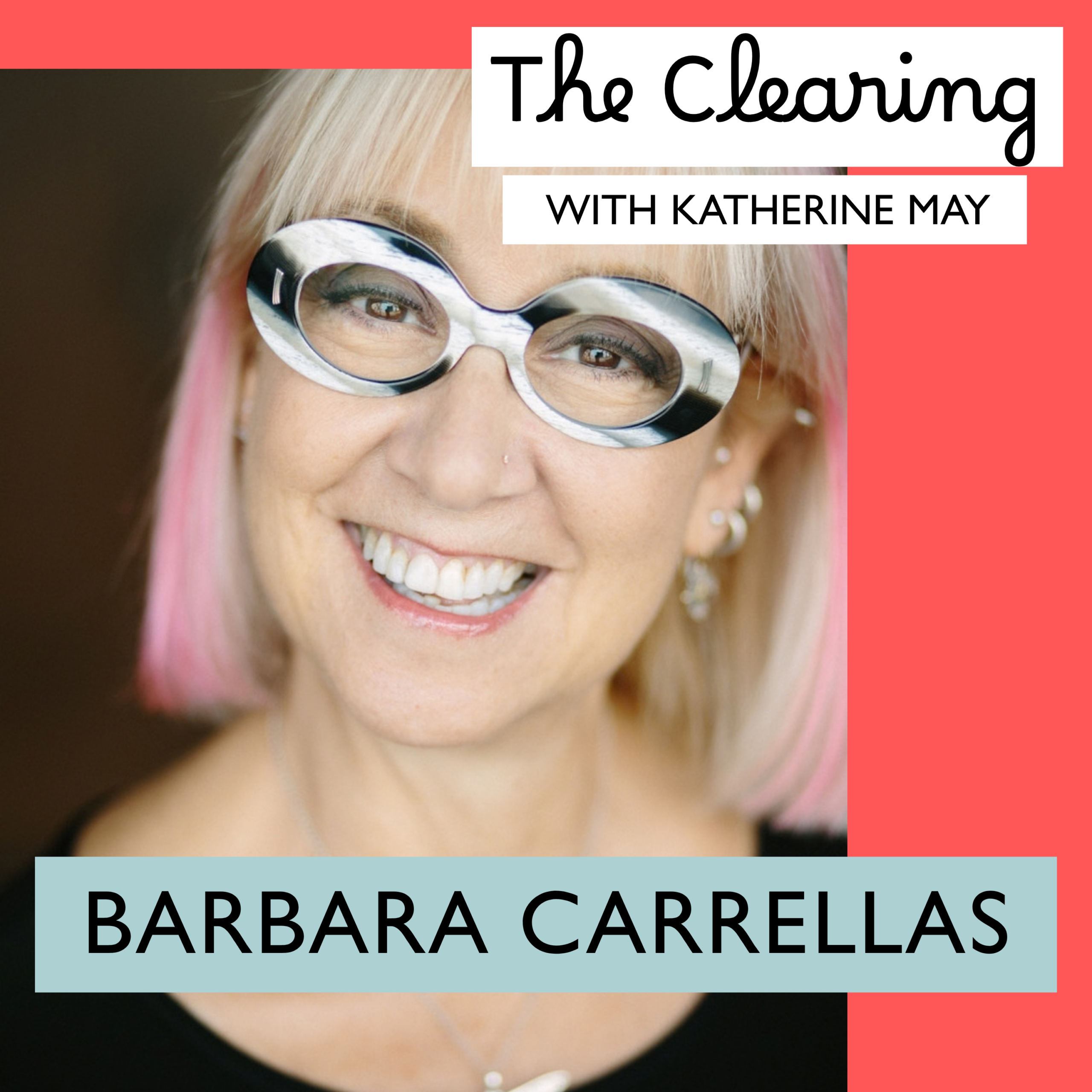
Barbara Carrellas believes we can find the truest rest in moments of awe. The author of ‘The Book of Ecstasy’ says even in life’s darkest moments, ecstasy is possible. It’s something seeded in her practice of ‘Urban Tantra’ – a non-touch sexual practice rooted in her experience of working with the people and communities affected by New York’s AIDS crisis in the 1980s.
Transcript
Katherine May: [00:00:00] Hello, Katherine here. I am on my way to the train station to go to that London town to seek my fortune, as ever carrying heavy bags today, so there’s gonna be some huffing and puffing. Hope you’re all very well indeed. I am here to introduce today’s guest. But first of all, I just wanted to flag up this week’s mini break, the extra episode for subscribers, um, which every week I normally share, like, a something that I find restful to do, something that’s like a little break in your day.
Um, but this week it is an audio diary of the thing I’m doing this week, uh, which is [00:01:00] attending a stand-up comedy performance course to hone my stage skills. So, yeah, if you’re interested in hearing my progress through that, do consider a little subscribe. Um, those of you that are subscribed, hopefully you’ll enjoy it.
It’s a bit different to normal, but, um, I thought I’d really share the process. Um, it’s probably mostly gonna be me being tired and overwhelmed, but that’s okay, you’re used to that. Ooh, going through the echoey tunnel on the way to the station. Woo-hoo. Did you get that? It’s cool. Um, so this week’s guest is the absolutely delightful Barbara Carrellas.
She is a teacher of tantra, um, which she will define for us in the podcast in the broadest possible way. We only [00:02:00] associate it with tantric sex, and therefore with Sting in the UK. Um, Barbara does connect tantra with sexual ecstasy for sure, um, but she also has a really vibrant and fascinating and inclusive take on what tantra can offer us, and the kind of tantric awareness that transforms our attention.
All of which makes it sound like it’s gonna be a very woo and kind of wafty conversation, but Barbara is not like that at all. Um, I have known her for a long time, and I was delighted when she sent me her recent book, The Book of Ecstasy, um, which is a really joyful look at different ways of finding ecstasy, which is really thoughtful, I think in particular about how neurodivergent people can think about these kind of [00:03:00] matters, particularly if like touch is difficult, et cetera, et cetera.
Um, but the thing is, Barbara is a, a sort of bubbling fountain of joy, enthusiasm and delight, and she’s also a deep, deep lover of theater. And that’s what we’re gonna explore today in her dream of rest. I was so thrilled when she chose it as a topic, um, and I was more and more thrilled as we went through because what we’re treated to here is just a romp, a romp, I’m gonna say, through somebody’s deep, deep love and deep knowledge, you know, the kind of knowledge that you cannot fake, that you cannot shortcut, the knowledge that comes from [00:04:00] decades and decades of return to something that is a personal passion.
Yeah. I urge you to have a listen to this one. I came away from the conversation feeling so uplifted, and I think you will too. So whether or not you are a fan of going to the theater, I think Barbara’s contagious here. So do take a listen Barbara, welcome to The Clearing.
Barbara Carrellas: Thank you so much. I’m so looking forward to this.
Katherine May: Yeah, it’s a long t- we have known each other for a long time, but it’s been a while, so I’ve been really looking forward to this conversation. I know you’re gonna think up really great ways to take a rest, ’cause you are an expert in this.
Barbara Carrellas: Yes. With a lot of practice. It doesn’t come naturally.
Katherine May: No. I mean, I think that has become the kind of governing theme [00:05:00] of this podcast, which is that creative people find it absolutely impossible to rest because we’re big balls of enthusiasm, we’re really driven, we can’t stop, but that maybe rest looks a bit different to, you know, that, that kind of picture of rest that we’re fed, which is just having a little lie down.
I can’t have a little lie down. I’m hopeless at it.
Barbara Carrellas: Most creative people I know have trouble napping. I’m, I’m blessed with the fact that I, I can, uh, refresh and restore with a nap. It, it turns- Oh, you’re good like that … my brain off enough. It’s what… Other people, like, meditate.
Katherine May: Mm.
Barbara Carrellas: My brain’s too busy, but if I can- Yeah
conk out for 20 minutes, it, like, wipes the slate clean and I can start again.
Katherine May: I really envy nappers. I wish I could do it. I’ve just… It takes me so long to get there, and then, like, I, I haven’t got… You know, there’s never any time to… I mean, I always want either three hours or nothing, [00:06:00] basically. Yeah. I can’t do it.
Have you always been able to nap?
Barbara Carrellas: Yes.
Katherine May: Mm.
Barbara Carrellas: I remember when I was working, uh, on Broadway as a general manager, and my, uh, office mate and I were similar that way. We had a little rollout mat. And because we would usually work from 10 o’clock in the morning till 10 o’clock at night when the show came down-
Katherine May: Yeah
Barbara Carrellas: um, we had a little mat, and we would take naps on the floor.
Katherine May: Wow. Wow, that’s amazing.
Barbara Carrellas: Yeah.
Katherine May: That’s a skill.
Barbara Carrellas: It is. I, I, I think it is, actually. I’m not sure when I realized I could do it or taught myself to do it. I think it was simply just h- how to, how to get through this career shining. Because otherwise- … by the time I got to the theater at night, having been working since 10:00 in the morning, I’d be so knackered I’d be useless.
So it- Yeah … was a coping mechanism. Yeah.
Katherine May: You have to do it. [00:07:00] And I, I think because, uh, this won’t be going out on the 11th of September, but it is, uh, September 11th as we’re speaking. You’re a native New Yorker. I would love to ask your thoughts about today. How’s it feeling? It’s the 25th anniversary, right?
Barbara Carrellas: I know, and oh, everybody’s got a 9/11 story, uh, or several. Yeah.
Katherine May: Yeah.
Barbara Carrellas: It’s, um, th- that day I was supposed to go to the theater. I was working on Bro- in a Broadway- Mm … I was managing a Broadway theater. We were going to open the box office for the show Noises Off. Now, you theater people- Right … will know Noises Off.
It’s the Michael Frayn farce.
Katherine May: Yes.
Barbara Carrellas: Now, we did not know when Noises Off was in production how much we were going to need a farce- Right … in the months that followed.
Katherine May: Right.
Barbara Carrellas: Um, you know, I like to think some higher power programmed that particular show [00:08:00] for our particular- Mm … theater. But, um- I was about to walk out the door and my partner Kate said, “Oh, wait a minute.
You’re not going anywhere.” Obviously, planes were hitting buildings. It was hideous. It was terrifying. Yeah. But what I remember most was that the phone rang, and I went, right about, uh, at 10:00 AM our time, and I’m like, “How did anybody get a call through? Who is that?” I picked up the phone, and it was one of my best mates, Hailey, calling from Sydney, Australia.
Katherine May: Oh, wow. Worrying about you.
Barbara Carrellas: And she got through. It was midnight her time. That’s amazing. Somehow, miraculously, that call got through.
Katherine May: Mm.
Barbara Carrellas: She was watching CNN International. I had it on, obviously, locally. Yeah. And we watched the tower [00:09:00] fall together. Gosh, yeah.
Katherine May: Yeah.
Barbara Carrellas: And I, the feeling of being held by someone halfway around the world- Mm.
Katherine May: Mm …
Barbara Carrellas: is what I remember.
Katherine May: That’s a, that’s an incredible memory to have, actually, of it, isn’t it? That, that there are people there that are waiting to, to kind of take care of you. Yeah.
Barbara Carrellas: Yeah. And it, it, and then I saw the subtitle of your new book, How Care Binds the World, and I went, “Yes, it does.”
Katherine May: Yeah, the whole world.
Yeah.
Barbara Carrellas: And the whole world. My situation was not unique, whether, whether I had a phone connection or not. The whole world was holding what was going on in New York. And New York is such an international city. I don’t think of it as being- Yeah … an American city. Yeah. And it’s, it’s, it’s- It
Katherine May: belongs to all of us, I think
Barbara Carrellas: it does. It does. Yeah. And I- that is my memory of New York which, on that [00:10:00] day, is not the horror. It’s that moment, exquisite moment of being held. And in my new book, which we can talk about later, but-
Katherine May: Yeah …
Barbara Carrellas: I’m trying to explain to people the ecstatic moments that can be found even in tragedy.
Katherine May: Yeah. It’s so you.
Which I think- Yeah …
Barbara Carrellas: I practiced over and over again during the AIDS crisis, but-
Katherine May: Yeah, I was, I was about to ask you that because it, it seems to me that you are, you know, so intimately connected with that other great New York tragedy, which was the AIDS crisis, right? Like, that’s- Exactly … a time that, you know, you were taking care of a, an awful lot of people.
Barbara Carrellas: That’s where all of Urban Tantra came from. Mm-hmm. It was, how do we have a spiritual practice that embraces our sexuality, our eroticism, that, um- Also has a radical political intention to it, which [00:11:00] original tantra apparently did- Yeah … all those many hundreds of years ago. But, but yeah, learning to hold community and learning to laugh and learning that the saddest, most tragic moments will have elements of pure ecstasy.
Because ecstasy is not-
Katherine May: Mm-hmm …
Barbara Carrellas: feels good pleasur- pleasure, all joy. Yeah. Ecstasy is a moment of such awe and such truth that everything, speaking of quiet, everything goes quiet.
Katherine May: Mm-hmm. Mm. Yeah, absolutely.
Barbara Carrellas: And it’s just you and the awe.
Katherine May: Mm-hmm.
Barbara Carrellas: Which is nameless and hard to describe, and that is the ultimate, um, rest-
Katherine May: Yeah
Barbara Carrellas: is to be able to relax into that moment of awe. Mm-hmm. And often we’re moving [00:12:00] too fast-
Katherine May: Oh,
Barbara Carrellas: yeah … to- Yeah … notice that there’s a moment of awe right over there. Yeah. But things are too loud and too quick, and there’s the next thing we have to do. And unless we’re in a situation like sitting on my back stoop on the phone with Haley, unable to go anywhere because we don’t know where the next bomb is falling-
Katherine May: Yeah
Barbara Carrellas: that you’re open to that kind of awe, I think. Yeah. I mean, it doesn’t have to be a tragedy.
Katherine May: They come, they come packaged together, don’t they? Like, the kind of tragedy and the immense connection. And the way I always try to think of it, ’cause I, you know, I had a really rough day on 9/11. My dad used to work in the Twin Towers.
Oh. And, yeah.
Barbara Carrellas: Really?
Katherine May: Yeah. Yeah. So I didn’t know. We were, we were not in contact at that point, but I knew that he regularly worked, uh, in the World Trade Center, and he was living in New York at the time. And I- Oh
Barbara Carrellas: my God …
Katherine May: [00:13:00] didn’t know for two days whether or not he’d been there at the time. As it happened, he was on a business trip to Canada and was very unruffled, and, like, didn’t know why everyone was making so much fuss.
Thank God, though, you know, because, yeah, that was … It, it felt very close to home to me. So I- It was
Barbara Carrellas: very
Katherine May: close to home. Yeah. Yeah. Yeah.
Barbara Carrellas: Wow.
Katherine May: We were very lucky, um, that he was, he happened to be… But no one could get a hold of him, um, because-
’cause all the phone lines were down. Um, so yeah That’s what I mean.
Barbara Carrellas: I really, I just kind of went, “This is a miracle.” And she and I both knew it. It’s like, “We can’t hang up ’cause we can’t get back on the line.”
Katherine May: Yeah. Yeah, yeah. There
Barbara Carrellas: we go. You need to pee, just put the phone down and come
Katherine May: back. Yeah. Yeah, absolutely.
Yeah. Well, let us, let us turn ourselves to more pleasant things, but- Yes … but actually, you know, as, uh, the point you’ve made is so important that care always outweighs the terrible things in this world, and, and [00:14:00] you have to go looking for it. It’s so important to stay, uh, connected to that idea, I think, because for every- To that web
yeah. ‘Cause for every Elon Musk, there’s several billion people taking care of other people. Um-
Barbara Carrellas: That’s so true …
Katherine May: taking care of their children and not abandoning them-
Barbara Carrellas: Thank
Katherine May: you … because they don’t do things that they want to, them to do.
Barbara Carrellas: Thank you so much, and go Vivian Jenna Wilson.
Katherine May: Mm.
Barbara Carrellas: One of, one of my sheroes, Vivian.
Yeah.
Katherine May: Absolutely, yeah. Well, I’m inviting you into my clearing in the woods, and then handing it over to you to ask you where you would take us to get away from it all. I- it could be anything. Tell me, tell me where you’re gonna land us.
Barbara Carrellas: Oh, it’s where I go every time I need to get away from it all. I go to a theater.
Katherine May: [00:15:00] Oh. This is exciting. Uh- Is it a specific theater or, or is this
Barbara Carrellas: a fantasy theater? Oh, well, for, for this question I have- … a very specific theater that is magical. Okay. It changes depending on the show, the performance that’s in it, for example. Um, and- … and it’s more magical still. It’s magical because I can- Dial a performance that I didn’t get to see, maybe I was too young.
Or I can dial a performance that I could watch a million times. Mm, sidebar. I have a T-shirt that says, it really is my, it’s my tagline. It will go on my gravestone if I were going to have one, and it is, “All shows close.”
Katherine May: Mm.
Barbara Carrellas: No [00:16:00] matter how big a hit, no matter how long it seems to have run, one day- Mm-hmm … that show will close.
Katherine May: Yeah.
Barbara Carrellas: It’s one of the saddest facts you have to come to terms with when you work in the theater. It’s not a movie.
Katherine May: This constant process of loss, yeah. Unforgettable.
Barbara Carrellas: It’s not a movie. It’s not going in the cans- Yeah … that you can watch later. Mm. It’s, when it’s gone, it’s gone. Yeah. And that’s true of each individual performance.
Katherine May: Yeah. Yeah. And presumably there are days when it’s incandescent- Yes … and days when it doesn’t hit quite so well.
Barbara Carrellas: Exactly.
Katherine May: Everything is just the moment.
Barbara Carrellas: So in my theater, it, my theater might look like Madison Square Garden if I want to see Tina Turner again.
Katherine May: Oh, yeah.
Barbara Carrellas: Which I do.
Katherine May: Yeah. Yeah.
Barbara Carrellas: Um, it turns into Carnegie Hall when I want to be there for Judy Garland at Carnegie Hall, the album I’ve played till the grooves are worn through.
Katherine May: [00:17:00] Oh, I love it.
Barbara Carrellas: Uh, but I was too young. I was not there.
Katherine May: Yeah.
Barbara Carrellas: Um.
Katherine May: Yeah.
Barbara Carrellas: Le- uh, f- my favorite musical, but I didn’t see the original, I would go see the original of Follies.
Katherine May: Ah, great.
Barbara Carrellas: I would see the last show Sondheim wrote, which I only saw once. It’s only been performed a handful of times.
Katherine May: Mm.
Barbara Carrellas: Um, Here We Are. I would see that again, because seeing it once is not enough.
My show, Nine. Yes. Um, uh, Liliane Montevecchi on the passero in front of the stage doing Folies Bergère. Mm. I would th- so that would be the 46th Street Theater, now the Richard Rodgers. Uh, so that’s, that’s my magic place. That’s wonderful. And for a very good reason. In the theater- Oh, oh, by the way, and the perfect audience would be there.
Because theater isn’t just [00:18:00] for one person. Theater is an energetic event that takes place f- in a group, in a community. Mm-hmm. For that moment, no matter how much, how badly behaved people are before the show starts-
Katherine May: Yeah …
Barbara Carrellas: when the show starts- Which they frequently are. You’ve noticed. When the show starts, everybody goes
Katherine May: into , “Ah.”
Barbara Carrellas: Mm. Or, “Ee,” but it’s all focused, like, “Whoa, what’s gon- how’s it gonna be?”
Katherine May: I love that.
Barbara Carrellas: And it’s a sense of community, and as we were just saying, being held.
Katherine May: Mm.
Barbara Carrellas: You’re like-
Katherine May: Mm …
Barbara Carrellas: you’re like-
Katherine May: Handing yourself over to a greater power for- Yes … a couple of hours. Yeah.
Barbara Carrellas: Which is that- Yeah … communion between w- playwright, actors, crew, musicians- Mm
and you, and you’ve [00:19:00] agreed to be in this tantric, if I may, relationship. So that is, without question, my magic place. If something horrible happens, like somebody dies, I’m thinking of one in particular.
Katherine May: Ugh.
Barbara Carrellas: It’s like, “What’s the answer?”
Katherine May: Mm.
Barbara Carrellas: I need to go to the theater.
Katherine May: Mm. When did your connection to the theater begin?
Was it something that you’ve had from very young? Four. Four, four years
Barbara Carrellas: old. Yeah.
What did you see? On my fourth birthday, um, I was, um, I was- That my parents threw some little party for me, you know, as they do with pe- kids and their parents. Mm. And some dad asked, “So where do you wanna be when you grow up, Barbara?” And I went, “A movie star.” And my father just kind of went pale and went and, like, shoved me out of the camera frame.
Oh, no. It was like, this was not cool. My hero was Marilyn [00:20:00] Monroe because she was just, like, this magical being from- Mm … you know, some magical fairy place. I mean, and she was- Yeah … funny. And that was very, very, very, very bad in my strict- Right … Roman Catholic household.
Katherine May: Right. Okay. Yeah.
Barbara Carrellas: Um.
Katherine May: Cut that out.
Barbara Carrellas: But, um, I remember in seventh grade, this is in America when you’re about 12,
Katherine May: 13.
Barbara Carrellas: Mm, mm, mm. Um, we wrote a, you know, the, the essay on what you wanna do for work- When you grow up … when you grow up. And I said, “Well, I haven’t decided whether I’m going to work in movies or the theater.” Yeah. “One is New York, one is Los Angeles, and I’m debating the two.” And I wrote this whole considered essay on I was going to be in the theater or, or the movies or some entertainment.
I was, but I wasn’t quite sure where yet- Yeah … and [00:21:00] what I’d be doing.
Katherine May: So you were, you were always really clear on it then?
Barbara Carrellas: And the teacher put a thing on my paper. I mean, she gave me a good grade, but then she wrote, “Are you serious?”
Katherine May: Oh, no. Oh, no. Don’t have dreams, kids. No dreams allowed.
Barbara Carrellas: Oh, God. And, um, but I was, like, the most rabid theater kid.
Mm, mm, mm. My parents did everything they could to s- to sway me. Um-
Katherine May: But you,
Barbara Carrellas: yeah … uh, it, uh, I was not persuadable. It was, uh, the only thing I wanted to do, and then it was just a matter of figuring out what. And the older I got, the more I, like, went from actor to stage manager to, wait, I wanna do… I, I like the big picture, which leads you to directing, management, producing.
Right.
Katherine May: Right.
Barbara Carrellas: I like putting, knitting together the [00:22:00] whole. Making
Katherine May: it fit. Yeah. And so you described it as tantric, and I would love for you- Yes … to unpack that for the audience because they might not really understand- Oh, you’re right … yeah, like what you mean by tantric and why- What- … that would apply to theater.
Barbara Carrellas: Well, it’s in… Now, just very briefly, tantra is the size of, let’s say, the ocean. Or if you wanna think smaller, Lake Ontario. Uh, and you go to Lake Ontario, uh, with a teacup, and you take a teacup of water out of the lake, um That’s the sex part. People think that tantra- Yeah … is all sex. ‘Cause we only,
Katherine May: only know that, that link.
Barbara Carrellas: Right. Right. Yeah. And I, and I understand that. I understand that. We live in such a sex-negative culture, especially religions tend to be very sex negative. Yeah. Uh, or have historically. So when you find a [00:23:00] spiritual practice that includes your sexuality, your eroticism- Mm-hmm … uh, you tend to go, “Give me that.”
And then it becomes all about that. So- That
Katherine May: one’s mine. I’ll have that. Yeah.
Barbara Carrellas: I’ll have that one.
Katherine May: Yeah. I’ll have that. Thank you.
Barbara Carrellas: But in reality, tantra includes, uh, is a spiritual practice that includes everything that exists in life. Oh, yeah. And wh- and, and when we talk about tantric sex, we talk about energy more than we talk about sex- Yeah
as sex is commonly defined. And the energy can be when you breathe with someone, when you eye gaze with someone, whe- you, you… The reason I became so focused on tantra and tantric sex during the AIDS crisis is, was a way to create powerful connection, powerful emotional states, powerful transcendental experiences without body fluids, without spreading a virus.
Katherine May: [00:24:00] Mm. Mm.
Barbara Carrellas: But that’s how I came to know the essence of tantric connection was because- Yeah … physical sex was not on the table for a long time there.
Katherine May: Because you’re talking about a time when people hadn’t really figured out how AIDS was being transmitted yet, and so, you know, there had to be kind of radical solutions so that people could make contact with each other, make erotic contact with each other, make emotional contact with each other.
But with the risks removed until things could be figured out. Yes.
Barbara Carrellas: AIDS was 100% fatal. Yeah. And we didn’t know whether condoms were, um, enough. Mm-hmm. We just didn’t know. And, and- Yeah … it was so fatal that the thought of a condom breaking was a death sentence. Yeah. So it was just- Yeah … anyway.
Katherine May: Terrifying.
Barbara Carrellas: Um, s- but the c- the tantric web, uh, which I started experiencing in healing circles-
Katherine May: Mm.
Barbara Carrellas: for gay men. Right. It wasn’t just one-on-one, it was the web of [00:25:00] love and energy and intention that was- Yeah … so powerful, is the same thing I felt in the theater.
Katherine May: Right.
Barbara Carrellas: Whether it was between the cast and themselves. Yeah. Um, and I was lucky enough to, uh, work with Tommy Tune and Michael Stewart, who were very woo.
Mm-hmm. And, uh, we used to have a circle and hand-holding every night before the show started. We were very woo. But it was- It was all part of the same, same gestalt. It was how I did theater- Yeah … it was how I did Healing Circle, and to this day, it’s how I do workshops. Mm-hmm. I, my workshops are all well-made plays, and if they’re not, I keep working on them-
till they are well-made plays.
Katherine May: I, I’ve, I’ve always, I mean, there’s obviously like a very well-known connection between gay men and musical theater or, or the theater in general, a kind of deep love. But it’s only just occurred to me that that’s about kind of queer [00:26:00] people feeling cast out for so long and then finding a space that, that brings about so much connection and so much kind of acceptance.
Connection and
Barbara Carrellas: fabulousness.
Katherine May: Fabulousness. It’s important.
Barbara Carrellas: Fabulousness is celebrated in the theater. Oh, yeah. It’s celebrated especially in the musical theater. The more fabulous, the better. And gay men were not allowed to be fabulous on pain of unemployment, getting beat up, you know? Mm-hmm. It’s very recent.
Stonewall was 1969. Yeah. Historically speaking, that was yesterday.
Katherine May: Yeah. Yeah.
Barbara Carrellas: 20 years before that, they were being sent to gas chambers in Germany. Mm-hmm. 20 years, that’s nothing.
Katherine May: Yeah. Yeah.
Barbara Carrellas: So when we look today at the backlash of everything LGB, but especially T, Q- Mm-hmm We have to remember that in a very short period of time, we took 10 steps forward, and yes, we’ve been shoved [00:27:00] back four-
Katherine May: Right
Barbara Carrellas: steps, say. But we’re still six steps ahead of where we were, let’s keep marching. Yeah. Or in the case of queers, let’s keep dancing.
Katherine May: Yeah, absolutely, yeah. Let’s just, let’s not march. I mean-
Barbara Carrellas: No … it’s
Katherine May: too much Dancing.
Barbara Carrellas: High kicking, high stepping. Yeah.
Katherine May: I love it. Do you dress up? And in this, in this fantasy theater, are you dressed up for the theater?
How, how fabulously do you attend the theater?
Barbara Carrellas: Oh. It depends. If I’m going to go see, if my theater is gonna shrink down to a tiny little black box in the East Village, I would dress appropriately for that. Or if my theater, this is one of my favorites, is gonna shrink down to the tiny little theater where the Coney Island Sideshow happens-
which I love, I’m a graduate of the Coney Island Sideshow School, um, then I would dress for that. So it’s, it, [00:28:00] that’s up for grabs. It depends. Okay. And, and sometimes because, like I said, to me, theater’s like church. I stumble into it also when I need to, and I’m not really concerned about what I look like.
Katherine May: That’s fine. Well, you’re in the dark, it’s okay.
Barbara Carrellas: Yeah, exact- when I’m watching something. Now, you know, if you turn the spotlight on me, then d- diff- that, then, then I might dress differently.
Katherine May: Would you, in this, in this wonderful retreat, would you stop to eat and drink or, like- Probably not … do you ever leave?
Do you take a break?
Barbara Carrellas: It’s just a marathon. That’s such a good question. One of my favorite shows was Peter Brook, my idol, my North Star in the theater. Um, uh, Google Peter Brook, and if you’re English you probably know who he is. Uh, his nine-hour production of the Mahabharata. Nine hours. And this is the best part.
He was such a genius director. [00:29:00] G- directors, um, hopefully have, uh, an intention statement when they start a show. And I’ve heard some relatively lengthy and detailed intention statements, but my favorite is Peter Brooks for the Mahabharata. “I wish to write Dharma on your heart.”
Katherine May: Oh, wow. Wow. I mean, I l- I love unambitious people that, you know, just don’t really care what they, what they do when they turn up to
Barbara Carrellas: work.
And nine hours later, he achieved that.
Katherine May: So wait, nine hours? They took breaks. I
Barbara Carrellas: mean, there- They took
Katherine May: breaks … I was gonna say there are intervals. Please, please tell me there’s intervals, but in one, in one day.
Barbara Carrellas: Oh, yeah. Another one that I loved was Eugene O’Neill’s Strange Interlude. I don’t know what it is if you run it straight through, probably about six hours.
Gosh. Something, something very long. I, I don’t remember the actual length. [00:30:00] And David Greenspan, an American actor, decided to do it as a one-man show. He played all the characters and did it in one day. He started at the matinee, we took a dinner break, he finished in the evening.
Katherine May: Oh, my goodness.
Barbara Carrellas: So I’m very into, into duration theater, and I really don’t give a- Yeah
damn what I eat. I- Yeah … just get me back into the theater.
Katherine May: You’re just totally immersed in the… I love that. Like, I find it really hard to have the attention span for anything very long. I get, I’m a wriggler, I need to move. I’m not, I’m not the ideal audience member, which I think is why I love comedy, because I think you can move much more in comedy.
Barbara Carrellas: That’s true.
Katherine May: Yeah. I think, I think I would find that really hard.
Barbara Carrellas: I have much less of an intention span f- attention span for, for movies as I get older. Mm-hmm.
Katherine May: Mm.
Barbara Carrellas: It’s like, uh, [00:31:00] you know, I see, oh, the movie’s three hours. Really?
Katherine May: Yeah.
Barbara Carrellas: Is it really good?
Katherine May: I’m not sure- Yeah … any movie needs to be three hours.
Barbara Carrellas: Well, my partner loved Lawrence of Arabia as a kid, and it was playing in a festival downtown.
She said, “Would you go with me?” So I’m like, “I have studiously avoided that film for my entire life.” “But let me do some research. Perhaps I’m just being judgmental.” And I’m l- reading it, and I’m going, “Oh, God, it sounds awful.” Yeah. And then I see the running time, and it’s three hours. I went, “I will drive you to the theater, I will buy you the popcorn, I will pick you up when you tell me it’s over, but I will not sit through that.”
Oh, I think that’s- But if you had told me- … that’s all right … that we were going to see Long Day’s Journey into Night, which is also three hours, I’d be like, “Ah.” “I’m up for doing it.” “Let me get dressed.”
Katherine May: I love that. But I think we all, you know, we all have this thing in our life that holds us rapt, and theater is that for you, which is just beautiful.
Barbara Carrellas: Yep, that’s, that’s it. And everything- Yeah … everything in my life worth [00:32:00] learning, I learned in the theater.
Katherine May: Oh, I love that. All right. So I wonder how we’re gonna approach this, ’cause I always ask people what they’ll pack to, to take to this. Do you have, like, a kit that you bring with you to the theater?
Barbara Carrellas: But I’ll, I’ll, I’ll, I’ll just modify your question slightly.
Okay. How would I get to the theater? Try that one.
Katherine May: Oh, okay. How would you get to the theater?
Barbara Carrellas: On my horse.
Katherine May: Oh. Of course you would. Tell me about your horse. The second horse owner of this season, by the way. I
Barbara Carrellas: know. I, I heard Elise’s.
Katherine May: Yeah.
Barbara Carrellas: Um, when I was a kid, let’s go back to 12. Mm-hmm. I had, like many 12-year-old girls do, a passion for theater.
Now, my mother thought this was much healthier, so I got to take horseback riding lessons.
Katherine May: Okay.
Barbara Carrellas: When I got to be about 14, 15, and I had opportunities outside of school- Mm … to do theater, like a community theater- Yeah … and, uh, a summer stock theater that [00:33:00] happened in my hometown. You can, the two things that are highly incompatible are being a professional theater person and being a horsewoman person.
Right. Those two things are ju- both are all-consuming.
Katherine May: Yeah.
Barbara Carrellas: You really have to pick one. So alas, horses went by the wayside except whenever I was in another place, America or around the world, um, I would, uh, you know how surfers, the s- the thing about surfing is you go around the world looking for the perfect wave.
Katherine May: Yeah.
Barbara Carrellas: I go around the world looking for the f- perfect horseback ride. I’ve been- Oh … through, like, Co- Costa Rica rainforests and-
Katherine May: Oh, wow …
Barbara Carrellas: Puerto Rico sw- swimming with horses and Iceland. I’ve gone to Iceland several times just to ride Icelandic ponies. Horses. Oh, wow. Horses. They’re not ponies. Wow. Icelandic horses because they’re- Right
pacers. They have a fifth gait. Okay. And I love that. Okay. And Paso [00:34:00] Finos, and I, to this day, go to Mississippi to ride Paso Finos there. Blah, blah, blah. But during the pandemic, we wound up back in my childhood home. I inherited my parents’ s- my parents’ house when they died. It’s in Newport, Rhode Island.
Rhode Island is the smallest state. Um, it’s about a three and a half hour drive out of New York City to the northeast.
Katherine May: Yep.
Barbara Carrellas: And it’s by the sea s- it’s by the sea. It’s very pretty. And we kind of accidentally wound up here on a mini holiday when the pandemic started and everything closed. Okay. So we said, “Well, this is probably a better place to be than New York City.”
“Um, let’s sneak back in and get an extra bag,” and we did. And we moved all the pets up here. And, um- Other people were knit, learning to knit and crochet and make sourdough. I started horseback riding at a stable nearby. [00:35:00]
Katherine May: Oh, lovely.
Barbara Carrellas: Gateway drug.
Katherine May: Yeah.
Barbara Carrellas: I wound up leasing the horse that I rode on this trail ride, and then that led to leasing another horse, and that led to the stable saying, “We’re gonna have to sell off some of these horses because the vet situation has changed.
We can’t afford to own this many.” Right. Right. “And the horse you’re leasing is for sale,” and he was, he was gonna be the first one that went. He was- Oh … such a good horse. They gave him, me a great price, and Pride and Joy was mine.
Katherine May: Is that his name, Pride and Joy?
Barbara Carrellas: Pride and Joy. He is now 14, and he is, uh, a racehorse.
Remember Elise saying- Oh, wow … “No Thoroughbreds, no racehorses”? Yeah, yeah,
Katherine May: yeah. He
Barbara Carrellas: is a retired racehorse.
Katherine May: Oh,
Barbara Carrellas: goodness. And he’s, he’s, he’s, uh, bay, which the non-horse, for the non-horse people, is a very dark brown with a black [00:36:00] mane, and he’s such a good boy. Horses are great emotional support animals.
Katherine May: Mm.
Barbara Carrellas: If y- so the reason I’m also picking the horse as opposed to my dogs and cats and turtle is when you’re, I’m around the horse, nothing really else exists in an energy- Right
his energy field is so big.
Katherine May: Mm.
Barbara Carrellas: And his heart energy is so big That- Yeah … if I am nervous and crazed and I communicate to him, “I’m really frazzled”-
Katherine May: Mm …
Barbara Carrellas: if I’m unconscious about being frazzled, he’ll pick it up and he’ll start behaving weirdly too. And I’ll wonder- Oh, God … “What’s wrong with him today?” Yeah.
Katherine May: You kind of spread that emotion almost-
Barbara Carrellas: Totally
when
Katherine May: you- He’ll pick it right up … when you’re not in control of it. Yeah.
Barbara Carrellas: But-
Katherine May: Yeah, yeah …
Barbara Carrellas: if I’m like, “I’m really not in a good place,” if I’m conscious about it, he’ll support me out of it.
Katherine May: Aw, that’s
Barbara Carrellas: lovely. It’s, it’s [00:37:00] quite, it’s quite magical. And he’s funny, and I love a funny horse. Uh- How- He
Katherine May: does- Sorry. You’re gonna have to explain to me how a horse is funny.
I’ve not spent much time with horses-
Barbara Carrellas: Okay …
Katherine May: recently unfortunately,
Barbara Carrellas: but- He, um- I’d love to … his favorite toy is a huge, you’d call it a yoga ball. The really, really big ones.
Katherine May: Oh, yeah, yeah. Those, yeah, they’re great big, yeah, the ones you bounce on when you’re having a baby.
Barbara Carrellas: Exactly. When you’re in labor. Well, he kicks it around the, the arena.
And we, we can play get, go get the ball, and he will. Yeah. And he’ll kick it back and forth to me. And if we’re try- if I’m trying to do some work with him, es- especially if we’re on the ground, and, um, he’s gotten a little bored with what I want him to do, he’ll walk over to the ball and just look at it like this.
And it’ll be like, “You want the ball, huh?”
Katherine May: He sounds amazing. He sounds absolutely amazing.
Barbara Carrellas: He’s so funny.
Katherine May: So wait, though. So you’re gonna ride him to the theater?
Barbara Carrellas: Right, [00:38:00] because- He- Yes, exactly. He’ll be good. Uh, there’s a reason. There’s a reason because, you know, if he doesn’t wanna watch the show, I’ll have a stall for him piled with alfalfa hay.
He’ll be very happy. Yeah. But he’s there for a reason. One of the things from a performance viewpoint, one of the things I most love to see in an arena in a performance space are horses at liberty doing a routine. Think circus horses. Okay. Now imagine like you’re standing here and there’s one, two, three, four, five, six horses, say, lined up.
Katherine May: Mm.
Barbara Carrellas: And with some subtle motion, they all start moving. And of course, the outer horse has to go further, and the nearest horse just pivots. And you can ask them to go in like these wonderful shapes, and, and they’re all just moving [00:39:00] Without a bridle, without a rope, without anything. Wow. Yeah. And it’s just magical.
Yeah. And they’re well-trained, but they can only do that if they get off on it. They’re, they- Yeah … if they didn’t want to be doing it, they’d run away.
Katherine May: They wouldn’t do it.
Barbara Carrellas: So there’s so much- Yeah … buy-in in a routine like that.
Katherine May: Mm.
Barbara Carrellas: So that’s where I would, that’s the kind of performance rider I would like to be.
I don’t care about jumping. Last Christmas I dressed Pride up in giant wings. Artist- … from Ukraine makes them. P– They were, they’re huge.
Katherine May: Like a Pegasus. And…
Barbara Carrellas: Yes.
Katherine May: Like a bay
Barbara Carrellas: Pegasus.
Katherine May: Yes.
Barbara Carrellas: Yes, except they were black. And he was the- Oh, wow … Christmas horse, and I put twinkle lights- … on the wings- … and a Santa hat on him.
And h- and he’s, he’s a good boy. And the, the horse people are [00:40:00] like, “You did what with a racehorse? What? A Thoroughbred?” But it took a little while d- he’s… Desensitization is something I’m good at. And
Katherine May: Yeah …
Barbara Carrellas: I wrote a version of ‘Twas the Night Before Christmas- … featuring The Christmas Horse, ’cause that’s who they were waiting for.
Katherine May: Of course.
Barbara Carrellas: And, um- Of course they were. And Pride’s pa- favorite part of the routine was the children had laid out cookies and things, and he got to come and find them and eat them. Uh, that was his favorite part of the routine.
Katherine May: That’s amazing.
Barbara Carrellas: And anyway, um, just being with Pride and his friends is, um, a clearing in itself.
Literally- Mm … it feels like everything else in the world goes away, and- Yeah … we’re just here right now. And sometimes it can be hard- Yeah … to pull myself away from a project and remember to go to the barn. [00:41:00]
Katherine May: Mm. It- it’s so true of all those things we love, that we often forget to do them. You know, I often think, “Oh, I suppose I should have a swim,” you know?
And I go down to the sea, and I’m like, “Why don’t I do this every hour of every day?” It’s, it’s really-
Barbara Carrellas: You’re good at it, though … weird, isn’t it? You, like-
Katherine May: I, I can be.
Barbara Carrellas: Yeah. You know? Like, you go for a walk- Yeah … and record a podcast intro- Yeah … on your walk. But you actually get out there. Yeah. You’re the one who walked the whole South Coast.
You’re very disciplined.
Katherine May: I can be. I can … It’s funny. Yesterday I was in, I was down in Devon, and I, um, and I was with my cousin, staying with my cousin, and I sort of said, “Oh, I think I should go for a swim. I don’t really fancy it yet,” you know? Like I’ve ever not fancied a swim. So I, I walked down there, and I put on my little wetsuit.
Um, and I got in, and I was like going, “This is the best thing ever. I’m having the greatest time. Oh, my God, the ocean’s so amazing.” You know, [00:42:00] like, I- I’m so bad at knowing what’s good for me. It’s really weird. Yes. That disconnect. Yes. I don’t understand it, but yeah.
Barbara Carrellas: Yeah. So do you, you have a- Um, is it one of those wetsuits that’s hard to get into because- Ooh
it is a wetsuit? Let’s talk,
Katherine May: let’s talk wetsuits because I’ve never liked swimming in a wetsuit before. Yeah. And I think people have thought I’m scornful of them because I’m kind of very tough about, you know, cold water swimming. It’s not really that. I just think they’re a nuisance, honestly. Yes. Like, they’re just this extra thing.
That’s
Barbara Carrellas: the- Yeah … that’s why I asked you. I said, I think- Yeah … is it struggling to get into the wetsuit that is the problem? Well,
Katherine May: okay, so what I’ve discovered is that you can now buy a swimming wetsuit, which are much stretchier, and they’re partic- they’re, like, quite thin neoprene. ‘Cause, like, some of them make you a bit floaty, and I don’t want that either- Yeah
but, but, you know. There’s the,
Barbara Carrellas: the surfer ones that are, like, this thick.
Katherine May: Yeah. Well, ’cause you have to stay really warm.
Barbara Carrellas: Yeah.
Katherine May: But they also have, like, extra, um, fabric around the kind of joints so that you can swim properly.
Barbara Carrellas: Oh.
Katherine May: Um, so they’re not kind of snapping you back into shape. [00:43:00] And so I bought this lovely really soft, stretchy wetsuit, and it comes…
It means it comes on and off much easier. I always wear a swimming costume underneath it, too, ’cause that helps it not to cling to you.
Barbara Carrellas: Right,
Katherine May: right. Um, and what I love about it is that, A, I can stay in the water longer. Um, I was swimming with seals last week, so I got to- You know, got to stay in for a while with the seals.
Um, but also I, uh, ’cause I quite often like come out of the sea bleeding, you know, I’ve like crashed into some rocks or, you know, grazed myself, and I just feel a bit more protected if I’m, if I’m swimming in a new beach that I’ve, you know, I don’t know the lan- the layout very well. Like I- the, the wetsuit just helps me to feel a bit more safe.
So yeah, I’ve, I’ve got into it.
Barbara Carrellas: Wow. So it, you can still-
Katherine May: And I look hot in it, obviously. I don’t look hot in it.
Barbara Carrellas: How, how, how warm does it keep you? Because you’re swimming in very cold water, obviously.
Katherine May: Yeah. It c- I mean, it doesn’t, it doesn’t make it feel warm. You can still feel the cold. [00:44:00] But it does, it, it, it sort of tempers that level of coldness.
It
Barbara Carrellas: takes the edge off. Yeah.
Katherine May: Yeah. That’s right. So you just get a bit, a bit longer, you get less of a shock when you get in. Um, yeah. You, you just get a little bit more-
Barbara Carrellas: That’s fascinating … time in
Katherine May: the sea. Yeah. Yeah.
Barbara Carrellas: I didn’t know they made those.
Katherine May: Yes, they do. And so, um, and you can also now get eco neoprene ones that don’t shed plastic too, which is really important.
Yeah, it is. So made from natural rubber. Yeah. I love it.
Barbara Carrellas: Fascinating. Yeah.
Katherine May: Anyway, so we’re, we’re talking about your, your lovely theater, and I would not wear a wetsuit to the theater- … just to be clear.
Barbara Carrellas: Unless it was a water ballet.
Katherine May: I mean, it is, it’s ever so comfy, to say. But, um, I always ask people if they’ll bring like a cultural artifact, but you’re seeing all these plays.
You, you presumably don’t need anything. The plays are the cultural artifact. Yeah. They are. They certainly are.
Barbara Carrellas: Yeah.
Katherine May: It’s, it’s in the choice
Barbara Carrellas: of the, the, of the play, yeah.
Katherine May: So just a whole festival of [00:45:00] theater. How long would you do this for? Like, is there a point when you would get fed up and need to go home?
Barbara Carrellas: Instead of fed up, I would use the word full up. Mm. Like some theatrical experiences for, let me give you an example. In Dreamgirls, the act break, or it feels like there is a break. I’m trying to remember it. What am I making up and what’s true?
Katherine May: Mm.
Barbara Carrellas: I need a break after Effie, originally, um, Jennifer Holliday sings And I’m Telling You I’m Not Going.
It is the sh- one of the showstoppers of all times.
Katherine May: Mm.
Barbara Carrellas: Sung by someone, this genius power singer. And when she takes a breath in to, “And I am-” [00:46:00] Telling you. She takes this in breath that feels like she sucked you into her lungs and then sung you out. Mm. It is so- Wow … huge.
Katherine May: Right.
Barbara Carrellas: And when that song is over, you’re completely spent.
Katherine May: Okay. Yeah. You need, you need a breather-
Barbara Carrellas: You need- … just to kind of recover yourself … a breather. Yeah. And if I were going to see it, not as part of the whole show, but just because I wanted to go completely into that experience-
Katherine May: Mm …
Barbara Carrellas: I would I would need a break after that. I wouldn’t go from that into Follies or Tina Turner- Yeah
or anything else. I see. Yeah. I would take a break.
Katherine May: Yeah.
Barbara Carrellas: But if I curated it to lead up to something- … which I might do. Uh. [00:47:00] There’s a, um, a, for, for the New Yorkers or nearby New Yorkers, there’s a theater company called The Transport, uh, Group, and they have been having for the past few years these tribute concerts, sometimes with, like, lots of different stars doing all the songs of a show.
The most recent one they did was Liza at 80, celebrating- Ah … Liza Minnelli’s 80th birthday. Yeah. And these incredible performers were coming out and singing things from Liza’s career. And her sister Lorna came out. W- and no one knew Lorna was there, she was not on the bill, and sang Gershwin’s Liza like it has never been sung before because she was singing it to her sister.
And when that was over, it’s like, “All right, I need a break.” I need a break. I need a break. I need a break. I so need a break.
Katherine May: Yeah.
Barbara Carrellas: Okay. And the [00:48:00] director, being a very smart man, knew the audience needed a break, and did something theatrical to kinda cover that. To kind of change the energy up. Something comedy or whatever, yeah.
Katherine May: Yeah. Yeah.
Barbara Carrellas: Yeah.
Katherine May: Okay. So you’re gonna, you’re gonna need to pace yourself with the, with the programming.
Barbara Carrellas: To pa- Um. Yes, exactly. Which I do when I create my workshops. It’s like- Yeah … okay, that’s- Yeah … gonna be a big experience. We need something soft and fluffy.
Katherine May: Mm. Any creative endeavor, whether it’s theater or running a workshop or writing a book- Book
like, you have to understand the kind of highs and lows and the need for y- the need for breath in between, and the need for people to be able to digest what they’ve done- Yes … to, and, and to, and actually to make space for people to have their own thoughts, because you’re not actually- Yes … controlling their experience.
They are, and so you really have to leave that space.
Barbara Carrellas: Yes. In the Elise podcast- Oh, yeah … you were talking about the, the person who, [00:49:00] uh, thought your book was about something completely other than –
Katherine May: Divorce. Yeah. Yeah. Yeah, absolutely. Yeah. It
Barbara Carrellas: was like- Yeah … “But I didn’t write about divorce.” I know. But to them, that’s-
Katherine May: Yeah
Barbara Carrellas: how it moved them, and they probably figured
Katherine May: out- They, “Oh, your book about when you were breaking up with your husband.” I was like, “I did not break up with my husband.”
Barbara Carrellas: But that’s how they processed-
Katherine May: Yeah. Yeah …
Barbara Carrellas: the art you- Yeah … made, needed to heal that piece of their experience, and that’s what art does.
That’s
Katherine May: right. Yeah. And I think- I think we should always be generous to our audience and let them co-produce the experience. That-
Barbara Carrellas: Yes …
Katherine May: that’s what we do. Yeah.
Barbara Carrellas: Co-produce. Exactly. You cannot tell people how to feel.
Katherine May: Yes.
Barbara Carrellas: You can- It’s none of
Katherine May: my business how people feel
Barbara Carrellas: Or how they interpret it. And, and one, one of the things that I say in my workshops, which now talking to you I realize [00:50:00] probably came from that, is- Yeah
do it your way. I’m not going- Yeah … to tell you how you’re supposed to feel after we do this breath process.
Katherine May: Yeah. Yeah.
Barbara Carrellas: You’re going to feel how you’re going to feel. If you need support- Mm … raise your hand. Other than that, just go for it. Yeah. And don’t- Yeah … try to have someone else’s experience. I,
Katherine May: I couldn’t agree more, and I, I think that there is a bit of a problem with art trying to control its audiences far too much right now.
Yeah, I agree. And I don’t, I don’t approve. I think- No … everything should have some space around it.
Barbara Carrellas: Yes. Your, your writing is particularly good at that. I honestly can see where that woman found the space- Interesting … to insert- Yeah … her, her divorce, uh, i- into your story. Because-
Katherine May: Or, or my divorce apparently
Barbara Carrellas: Oh, yeah.
That’s true.
You sparked someone else’s imagination.
Katherine May: I was like, “What?” [00:51:00]
Barbara Carrellas: Because, ’cause you write about some very personal and tiny experiences so well. When we give somebody a very specific microcosm- Mm … they get to see how that relates to the whole world. It’s like storytelling.
Katherine May: I agree. I actually think, I always call it the treacle at the bottom of the well.
Like, you you kind of tell a bit of a story and then you get down to the bit that you think is the most kind of dirty and personal of everything you’ve said. Like, the stuff you’re like, “Oh, God. This is my particular gross stuff, and I feel really weird sharing it.”
Barbara Carrellas: Yeah.
Katherine May: And that will always be the bit that everyone relates to.
You think it’s the most specific, but it’s actually the most universal.
Barbara Carrellas: Exactly.
Katherine May: But the, the most important thing is to not stay too long with the treacle, ’cause the treacle is a very strong flavor. You only need to dip briefly into the treacle to understand it. That’s all you need. Well said. A little, little bit of treacle.
Barbara Carrellas: Well said. [00:52:00] Uh, Eugene O’Neill’s Long Day’s Journey into Night, one of my very favorite plays. Um, Mary Tyrone is, has gone back to her addiction to what would be heroin. Mm. Um, uh, and it’s upstairs. And they talk about her doing it, and- Right … she’s such a lovely person with such a huge problem.
Katherine May: Mm-hmm.
Barbara Carrellas: And it’s the fact that they just give you that piece of information- It’s hiding it
and you see what’s happening up there. You don’t need a- Yeah … scrim with an actor behind it. No. Yeah. You just know when she comes downstairs that she is stoned. Yeah. She’s back on it. Yeah. She looks different. And you have filled in all the rest.
Katherine May: Yeah. Yeah.
Barbara Carrellas: And then related it to maybe somebody you know who was coping with [00:53:00] something similar, whatever.
Yeah. But-
Katherine May: Yeah, that’s right. And, and who might be, you know, undertaking a very different addictive behavior, but that’s, that’s why it works. Because actually you can make the equivalence, and you don’t need someone to, to do that for you.
Barbara Carrellas: You don’t need someone to shoot up on stage to, to make the point. And a great playwright knows when to lay off the treacle, yes.
Katherine May: Yeah. Well, it’s time to pull you out of your lovely retreat now and send you home. But I just, I wondered if you could leave us with some final thoughts on ecstasy, really. Your, your book, The Book of Ecstasy, is so… I mean, it’s just such a beautiful kind of wide-ranging invitation to ecstasy. I think it’s probably very different to what people would expect.
You know, I think we, we think very narrowly about these things, and we think they’re rare and impossible. And you kind of invite us to engage with it actively all the time. Not all the time, maybe. I mean, like, sometimes you gotta [00:54:00] buy groceries and- Absolutely … maybe ecstasy isn’t that helpful at that point.
But could you leave us with some thoughts about how, how listeners can engage with ecstasy? Because you’ve given us this ecstatic theatrical experience.
Barbara Carrellas: Okay. Here’s, here’s, here’s a quote that I written across. This summer I was reading a book called, um, The Disco Witches of Fire Island, and, uh, Fire Island being the gay resort off the coast of New York, and there’s a quote in there that says, “Life will surprise you.
Let it.”
Katherine May: Mm.
Barbara Carrellas: And I realized that was sort of the whole summation of how you… Yes, there are ways that you can make yourself more susceptible to ecstasy, and that’s largely what the book’s about.
Katherine May: Yeah. Yeah.
Barbara Carrellas: But it’s not [00:55:00] about making ecstasy happen. It’s about letting it in.
Katherine May: Mm-hmm.
Barbara Carrellas: And- Yeah … that’s, life will surprise you.
Let it.
Katherine May: Yeah. That’s all you gotta do. It’s passive really. It’s actually- Yeah … just not actively fighting it, it’s allowing it.
Barbara Carrellas: Maybe Book of Ecstasy is nothing more complicated than getting out of your own way, and how to get out of your own way. Because we’re in our own way all the time.
Katherine May: So much of life is like learning to get out of your own way.
Barbara Carrellas: And it’s easier, ecsta- ecstatic experiences are much easier to find than you think, and happen in places where you would least expect them. So let life surprise you.
Katherine May: I love it. Barbara, thank you so much. It’s been
Barbara Carrellas: lovely to talk to you. Thank you so much.
Katherine May: Hey, I’m back. Did you enjoy that? [00:56:00] I hope you did. I’m spending a bit of time in theaters myself this week, trying to take in as much work as possible. So it feels really, really relevant to me today to share that with you I just increasingly realize that what I really love is encountering other people’s passion and enthusiasm.
It’s the best thing in the world. You don’t even have to share that. I often find it quite uncomfortable to be in a theater. I feel self-conscious. I know I’m quite wriggly. I kind of often, because of my inability to distinguish between many faces, get quite confused halfway through because I’m not sure who’s who.
But there’s something about catching on to how other people see something. I was having a conversation yesterday [00:57:00] with, uh, a man who was telling me about his love of opera, and my first instinct was to say, “Oh yeah, I’m just not into it.” And then I thought that you don’t have to not be into it. You know, the truth is you’ve never been into it before.
But as this person was describing it to me, he was sort of explaining about the sheer grandeur and scale, the way that theater has maybe paired back and thought in more minimalist terms over the years, but opera has become more and more lavish and grand and kind of the sets operate at such a scale that you can’t help but gasp in wonder at them, and the way that those notes hit when sung live that produces goosebumps on your skin.
And I kind of thought, well, after that description, I could at least give it a go, right? That’s all you have to do is just give [00:58:00] something a little try. No one’s asking you to commit to it for life. So there you go. That’s my next project. I must see some opera. I do not know what opera. Perhaps you can tell me.
Perhaps you can get in touch with the show and recommend something that’s really good. But yeah, those two conversations, the one with Barbara and the one with this guy the other day, both made me really think about how we’re allowed to go back to things at a different point in our life and approach them in a different way.
Maybe we don’t have to be quite as intimidated as we were when we were younger. Maybe we’re allowed to go in as ourselves this time. But yeah, I’m excited. Anyway, my train is gonna arrive in a minute, so, uh, unless you want the full railway soundtrack, which maybe you do, um, I’m off. But please take good care of yourselves, and I will [00:59:00] see you really soon.
Bye.
Links from the episode
Barbara’s book The Book of Ecstasy
Barbara’s website
About Barbara
Barbara Carrellas the bestselling author of Urban Tantra: Sacred Sex for the Twenty-first Century—is celebrating the publication of her new book, The Book of Ecstasy.
Barbara is the founder of Urban Tantra®, an international community, a philosophy, and an inclusive conscious sexuality practice that encourages people of all genders and sexual preferences to expand their capacity for both pleasure and spiritual fulfillment.
Barbara was named Best Tantric Sex Seminar Leader in New York City by Time Out/NY Magazine, and was presented with a Lifetime Achievement Award at the Sexual Freedom Awards in London. Barbara is a proud graduate of the Coney Island Sideshow School with a double major in fire eating and snake handling.