The Clearing with Katherine May
Caitlin Moran’s ‘greatest building humans have ever come up with’
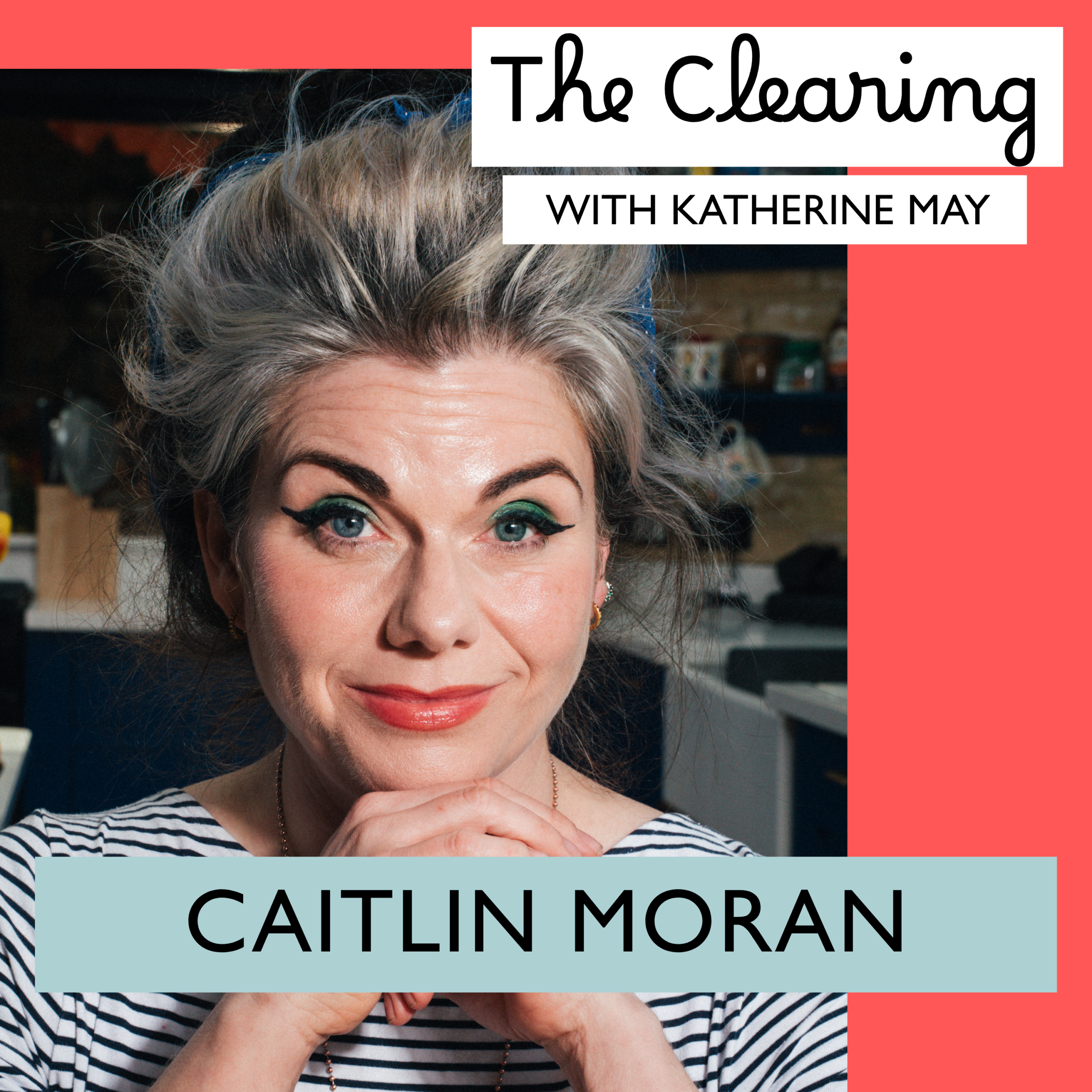
Caitlin Moran is something of an icon in the UK. Growing up as the eldest of eight children in a three-bed council flat, home educated from the age of 11, she became a published author at just 16 and a TV presenter not long after that. A long-time columnist for The Times, she has a well-deserved reputation for being one of the UK’s funniest writers. She is also a massive fan of Wintering – so much so her new book contains an entire chapter devoted to it.
Caitlin joins Katherine for a conversation that was never going to be anything but brilliantly bonkers. They discuss her plan to rid the world of evil billionaires that basically involves being a madam, why she would pay a thousand pounds to hear the sound of a blackbird from Wolverhampton in the 1980s and ask; grottos – the Temu of caves?
Her unique vision of splendour for her escape to the Clearing, involving ‘the greatest building that humans have ever come up with’, provokes a particularly visceral reaction from Katherine.
Just to warn you, this being Caitlin, the episode contains a spot of swearing.
Transcript
Please note this is an automated transcript and as a result it may contain errors
Katherine May: [00:00:00] Hello. It’s Katherine here, back in South West London on one of my meanders to a hospital.
Today I’m in somewhere a little more post-industrial, I’d say. There are some scars of old buildings on the ground
Katherine May: [00:00:00] Hello. It’s Katherine here, and I’m not gonna be moaning about how hot it is this week because it has rained and rained and rained over the last two d- Just outside in the garden in a rare break between rain showers, trying to rescue the dress I put on the washing line three days ago, which has just got rained on repeatedly ever since.
I think it still might start again, but it’s lovely out here today. It’s cooler, and the garden looks really grateful, frankly. There’s that lovely smell of, uh, roses
Katherine May: [00:00:00] Hello. Katherine May here, and I am walking along a clifftop in Devon, which I suspect a lot of you think I do all the time. But sadly not, you know? There are far too few opportunities for me to walk along a clifftop in Devon, and yet today, here I am, and it’s really good. It is a bit windy. It’s rained, but it’s stopped.
I like rain. And there is a fog rolling across the wild blue Atlantic Sea, which is awesome It’s early autumn, so the sort of steep sides coming up from the [00:01:00] sea are all covered in kind of bronzed bracken. So the landscape is green and orange, looking gorgeous with this sort of steely blue below. And although the grass is quite yellow, everywhere is cut by dry stone walls.
So there’s this just gorgeous kind of color palette everywhere. I love it. Now, I am taking you down to visit the local seals who congregate on the beach. Ah-ha-ha, I can see one from above. I’m still at the top of the cliff right now, but ah, there’s a seal in the bay beneath me, and he’s chasing a mackerel.
Ah. We have been visiting these seals every day to say hi to them, and I will not disclose the [00:02:00] location because they’ve got a little private cove here that we’ve happened upon that I think it’s best if the world doesn’t know about. Uh, but they are fantastic. You have to treat them with a lot of respect ’cause they deserve their privacy and their sealy space.
But they do get to know you ’cause they’re really intelligent, curious creatures, and they, um, they come to see you and say hi and pop their little heads up. They look a lot like my dog, Fraggle. They are gray and speckly and have very soulful eyes. And there are two large adults, a male and a female. These are Atlantic seals, and so the male, uh, is darker, and the female is a lovely kind of dappled gray.
Um, and then they have a pup. Not a very young pup, but a definitely a juvenile seal who, um… The, the adults come out first to see you, and, and I think they’ve learnt to trust us because then [00:03:00] they bring their baby out to say hi. So that is, uh, I mean, it’s just so magical. It’s so lovely to be able to watch them from above and feel like you’re having a slight relationship with them.
I get very upset when people drive past on loud boats and with jet skis because it’s not fair on the seals. I’m a- I’ve got a one-woman vendetta against jet skis anyway. But sorry, that’s the background. Right now from above, I am watching the young seal playing on their own. In the bay. There are some other people looking from the cliff above.
And he has caught himself a fish, and there are some people above who I think are very excited to see it too. You can probably hear them. Um, he’s got himself a fish, and he… Uh, I’ve noticed. I’ve, I watched him with a fish yesterday, [00:04:00] um, kind of throwing it around and catching it. They play with it before they eat it.
But he’s, he’s taken it under now. I think lunch is probably happening. Um, and what a beautiful little thing he is. Absolutely lovely. So there we go. That is… Honestly, I think that might be the most exciting podcast introduction I will ever record for you. I’m not sure that there will be many more better than that.
Um, I am introducing you to my podcast while watching a seal. Almost as exciting as that, we have a really great guest today. It’s Caitlin Moran. You will know Caitlin. She has written a series of really kind of thoughtful and sometimes, like, you know, controversial in terms of cr- like, starting up debates, you know, about, uh, how to be a woman, girlhood, masculinity.[00:05:00]
She’s completely unafraid of sparking debate. Um, but she’s just also been a huge presence in the discourse for ages and someone who I think really embodies joy despite being able to talk about really difficult things and being unafraid to tackle them. She’s also someone who just really seems to be able to make the most out of life as it is and for what it is.
And her new book, How to be Hopeful, which I think will be out now by the time this comes out, or at least imminently, I think really outlines how she manages to achieve that, which is not to avoid the difficult topics, but to meet them head-on and to figure out one’s own role. [00:06:00] That sounded really fancy when I said that.
To figure out your own role in what you can do about that, but to understand the limits of it. I thought it was a great read, and I just found myself nodding in agreement at so much of it. But before you read that, take a listen to this conversation, which I massively enjoyed, and I lo- o- o-oved Caitlin’s vision for what might constitute getting away from it all.
I’ll be back in a while so we can talk about that. See you later
Caitlin, hello and welcome to The Clearing
Caitlin Moran: I am so happy to be in The Clearing. Thank you so much
Katherine May: It is so nice to talk to you. I, um, I remember first seeing you on the telly when I was like 16. So-
Caitlin Moran: Oh, God, yeah …
Katherine May: this is like, I don’t know, it feels like it’s been a long time coming. A circle
Caitlin Moran: has been completed.
A circle has been completed. Um, did you [00:07:00] hate me when you saw me? Were you like, were you like, “Why has she got that job?” ‘Cause I was-
Katherine May: I had- … in that position. I had that, like, really toxic teenage mix of, like, thinking you’re incredibly cool and being incredibly envious at the same time. You know, that sort of whole every feeling about it at the same time.
Caitlin Moran: Yeah. Well, I mean, you know- … I mean, we’re not really qualified to drive our brains when we’re teenagers. You know, boys and girls, like, you know, there’s still so much more, uh, brain development to go. So we’re not, we’re not at our most enlightened phase at that point, which is why you would have been jealous of me, which is toxic- Massively
and why I was terrible at being a TV presenter because I am… I still had the brain of a baby. And it turns out if you turn a TV camera on a 17-year-old and go, “Talk for an hour live,” you just talk absolute balls.
Katherine May: God, I cannot imagine… I can’t imagine what that was like. I mean, do you look back on it now and cringe or just feel, like, proud of yourself for surviving it?
Oh,
Caitlin Moran: oh, I mean, I did, I did Adam Buxton’s podcast live last year, and, um, at one point he… there was a big screen behind him, and he put up a clip of me presenting. So [00:08:00] this, this is a TV show called Naked City that was on Channel 4 in 1992- Oh, dear … when I was 17, and it was the replace- it was the summer replacement for The Word, the much cheaper version, and it was the same thing.
It was like outrage on Channel 4 with pop music. And, uh, and I was terrible as a presenter, and he put a clip of it on the screen behind us, and the whole audience kind of went, and when I, as soon as I turned around and saw what it was, I dropped to the floor in the fetal position and all I could do was put my fingers in my ears and go, “Na, na, na, na, na, I can’t hear you,” until it finished.
Like, I can’t, I still can’t watch it. It was, um-
Katherine May: I feel like that about things I’ve done, like, three years ago, let alone, you know.
Caitlin Moran: I feel like that now about this. I feel like things- Constant multiplication … a lot of the things I said. Yeah. Yeah. I mean, don’t worry about that. Yeah.
Katherine May: Yeah, just constantly reviewing and thinking, “No, that shouldn’t have happened,” and yeah.
Caitlin Moran: Which is why we’re writers- Which is why we’re writers … because on the page you, you never have to be stupid forever because you can always go back and delete and rewrite until it is perfect. And this way we, we give the illusion of being fabulous communicators, whereas in real life we’re in a conversation, we’re going, “This is terrible.”
On the page- Yeah … however, we can be perfect. [00:09:00]
Katherine May: We’re just endlessly able to edit as writers. Yes. And I just feel like I would like a little editing button on everyday communication, so every time I say something stupid, I can just be, “Oh, no, no, no, sorry, I didn’t mean it like that. Let me, let me just rephrase that a bit.”
But that would take a long time.
Caitlin Moran: That facility that they have with emails now where it says, um, undo send, and you can, like, pull back an email five minutes after you’ve sent. If you could do that in conversations, you just say something suboptimal as a party and then press undo speak, and everyone just, it has a mind eraser that forgets the last 30 seconds, that would be…
At that point, that’s what AI should be working on. That’s what Elon Musk should be investing in, not sending rockets to Mars. He’s busy
Katherine May: throwing stuff at the moon. Come on, he’s busy.
Caitlin Moran: He’s fucked up the moon. I’d be so- He’s fucked up the moon … I, I, if I was a lawyer, I would offer to legally represent the moon and now sue Elon Musk for crashing into me.
I would do a personal- Injury suit. Like who kicks start our moon
Katherine May: How dare you actually start to, ‘
Caitlin Moran: cause
Katherine May: that, there’s that lawyer who’s suing people as, as if the river is a entity-
Caitlin Moran: Which I love …
Katherine May: so can they do [00:10:00] the moon?
Caitlin Moran: Well, I would like to. I would, I feel like that kind of, um, fake, uh, lawyer on The Simpsons, I feel like presenting the moon with my business card and going, “I will legally represent you now in a legal suit against Elon Musk.”
No,
Katherine May: wait. Someone’s kid is studying astro law. Whose kid is studying astro? Someone in my life, their kid is studying- … the law of space. So there are people out there that specialize in this.
Caitlin Moran: Hang on, there’s space law?
Katherine May: There’s space law. Yeah. Huh? Yeah
Caitlin Moran: W- I, I’ve literally got a million questions. I mean- I
Katherine May: know
Caitlin Moran: who, where are the trials happening, and what are the space crimes? I know.
Katherine May: I know. Well, are they-
Caitlin Moran: Can you commit crime in space?
Katherine May: Do we, I mean, I … Do we assume that the same law appl- I don’t know. I don’t know any of it. I just noted that somebody’s kid was studying space law, and that’s wedged. That’s the only thing.
It’s not- Right … I don’t wedge useful information in my mind, just completely random snippets.
Caitlin Moran: I mean, I’ve got a feeling that during this conversation I’m going to be making notes of 1,000 things I’m gonna be looking up later. And [00:11:00] the first one is find out about space law, like, kind of who’s the- Which
Katherine May: turned out to be nonsense as well.
Do
Caitlin Moran: I want to invent it or write that movie? Because that would … Because it’s all been about Star Wars and kind of, you know- Yeah … intergalactic wars in space, but no one’s ever looked at the legal side of space, like a, a compelling courtroom drama in, in the voids of- The space
Katherine May: lawyer. Yeah …
Caitlin Moran: the voids of an- the Andromeda galaxy would be amazing.
Katherine May: Good Wife colon Mars.
Caitlin Moran: Yes.
Katherine May: That’s my pitch. Ooh. That’s my pitch.
Caitlin Moran: Yeah. Cool. Let’s do this together. Let’s get that
Katherine May: produced. I know. We gotta … Mm-hmm. It would go weird quite quickly though, right?
Caitlin Moran: Yeah. And that’s, and that’s what I’m in. Yeah,
Katherine May: yeah. God. So it is lovely to have you here. And what I’m always curious about with my guests, ’cause this is a
you know, it’s a podcast about rest and the rest we dream of taking rather than the rest we actually take.
Caitlin Moran: Yes.
Katherine May: And whenever I meet a creative person, I … they’re never very good at it.
Caitlin Moran: No.
Katherine May: And you strike me as someone who might particularly not be good at it, for many reasons.
Caitlin Moran: N- well, yes. I [00:12:00] mean, I can remember…
Well, first of all, the, I mean, in certain times of your life, there’s no point in being all philosophical about, “Oh, you must rest and take time to yourself.” You go, if you’ve got small children, that’s simply not an option. Like, you know, they do not have an off button, sadly. There is no, uh, standby.
Katherine May: And they love 5:00 AM.
Caitlin Moran: Right. Ex- they really do, the bastards. And, um, I can remember one of the columns that I wrote in the Times that got, people will still quote 10 years later. I wrote a column when my ch- my children were their smallest and most energetic. And, uh, I, I observed this repeated conversational trope that I’d seen with other mothers with similarly aged children whereby our greatest dream or wish was that we would have some kind of injury or illness that was major enough to be admitted to hospital for a week, but minor enough for not to be- Oh, yeah.
That’s true … particularly painful or have any future complications. Like, uh, the ideal would’ve been a broken leg- Yeah … so that we could just have a week in hospital where people brought us food, and we could watch television, and we didn’t have the children, and that was the greatest thing that we could think of.
An, an enforced [00:13:00] rest due to a minor, handleable- Yeah … um, but hospitalizing, uh- Perfect … hospitalizationory, uh, injury or illness. And I still get women coming up to me now going, “I remember reading that column,” and going, “Yes, that is what I’d like. Just wish I could break my leg and go to hospital for a week.”
So- For a long period- Yeah … the only rest that you could have would be some kind of falling off a ladder based accident. But I mean, I’ve gotta say- … I mean, this will be, th- this conversation runs the risk of it being entirely circular, and 90% of what I say ending with, “Until you showed me a new way to live, Katherine May.”
Because I was terrible at taking rest, and thought- Yeah … that it was incorrect and not what the kind of person, not what I, not the, what I should be doing-
Katherine May: No …
Caitlin Moran: until I read Wintering by Katherine May. Uh-
Katherine May: Well-
Caitlin Moran: And she informed us that we are creatures and, and nature takes a rest in winter and so must we.
Yes. And that- It’s true … genuinely blew my mind because I had been living my summer life full pelt, uh- Yeah … through [00:14:00] summer and winter. All the time. And then when I learnt to winter, I now look forward to the rest that winter insists that we take.
Katherine May: And it’s also the book that ruined my restful winters, because now my winters-
are like one long publicity round. What? And I spend the whole time going, “I didn’t want this.” “This is not what I meant.” Is
Caitlin Moran: it like as soon as the clocks go back or as soon as the first snowflake falls, it, does your phone- It’s- … light up and it’s like the Today program want you on going, “Tell us
Katherine May: how to winter”?
Caitlin Moran: It’s earlier.
Katherine May: It is as soon as the schools go back.
Caitlin Moran: Really?
Katherine May: Yeah. And my lovely assistant, Megan, starts going, “The inbox is hell.” Every, like, 5th of September, I’d say, every year.
Caitlin Moran: Really? Is that when winter starts for the media? That’s the
Katherine May: official start? And people are like, “Oh, Katherine May exists. I must call her.”
Caitlin Moran: So what… So, so, like, you wrote that a while. When, when did Wintering come out? When was that?
Katherine May: It came out 2020.
Caitlin Moran: Okay. So, yeah. So you’ve had six years of being queen of the
Katherine May: winter. I’ve had six years of being queen of the winter, yeah.
Caitlin Moran: Have you- Yeah … got… Is there, like, [00:15:00] a sequel in it? Have you learnt more wintering secrets since then that you can do Wintering two: The Snow Storm’s Back?
Katherine May: W- Wintering II:
Caitlin Moran: On the Rocks,
Katherine May: yeah. Yeah.
Um, I o- only, only kind of peripheral actually. I’m, I’m always surprised how I quite often go f- like squirreling back into the book thinking, “Oh, I missed saying that. I wish I’d said that.” And it’s normally kind of… Like, I dunno if you feel like this, but books have a weird alchemy that stuff ends up in them that you didn’t fully intend.
Totally. They, they sort of- Yes … they write themselves, and so I end up going back and finding… Yeah, but I mean, I now have this ridiculous collection of books on winter. I have this ridiculous stock of, like, you know, stories about winter that I could write 15 winters, and I-
Caitlin Moran: Really? Yeah.
Katherine May: Oh.
Caitlin Moran: Are you gonna?
Katherine May: No.
Go
Caitlin Moran: on, extend the brand. Go on. I need more. I can’t keep rereading the same book every year. Come on, September the 5th next year, give me a new book.
Katherine May: My new book’s quite wintery, that is, uh, that’s coming out [00:16:00] in March. It’s, it’s, like, about looking after my husband when he had cancer. So that’s- Oh … I think it’s got wintering themes for you.
I think it will- I love winter … it will give you that crunch,
Caitlin Moran: you know? Yeah, yeah. Here comes the snow. Yeah.
Katherine May: Give you that little, little kind of crunch of nastiness of life. But yeah, people are always asking me if I’ll write summering, and I, I used to say no, and now I’m beginning to think, “Ooh, maybe I could.”
Well,
Caitlin Moran: the great thing is if you do a summer book is then you’ve also got autumn and spring to do as well, and you just, like, complete the, you know- Well,
Katherine May: autumn’s the best season-
Caitlin Moran: Right …
Katherine May: obviously. Yeah. The best. So you have taken up gardening recently. Yes. Or, I mean, maybe not that recently now, but you’re…
We’re both new gardeners.
Caitlin Moran: Well, one is genetically and chronologically obliged to take up
Katherine May: gardening-
Caitlin Moran: Yes … in middle age, right?
Katherine May: Um That’s what I was about to ask. Like, what is it? At what point does that gene start to activate? Is it at the menopause, or is it, like, slightly before? Like, what’s happening? I
Caitlin Moran: mean, mine was slightly before, but it’s been really interesting.
So I’m doing this gardening podcast now. We’re doing the Outsiding- Yes … Podcast, me and lovely [00:17:00] Adam Frost from Gardener’s World. We have celebrities every week to talk about not just the garden, but outsiding, anything you do outside. Mm. And from now, we’ve sort of, like, we’ve done 12 now, and it’s becoming really apparent that there is a kind of universal story to most people, which is that as a child, you’re out.
Like, kind of like outdoors is your domain, and you can do what you want there. And you’re less supervised, and you can play with things, and eat gravel, and throw grass at each other. Then you go through your teenage years and your 20s where you have no interest in the outdoors whatsoever because you’re up at night in clubs and interested in other human beings- Yeah
and nature is very low down on your list. And then-
Katherine May: Trying to breed.
Caitlin Moran: Ex- literally. There’s-
Katherine May: Directly or direct- or indirectly, yeah.
Caitlin Moran: Yeah. Yeah, yeah. Just trying to get on with people. Yeah. And, and then sort of your late 20s, early 30s, you’ll have some kind of life event, or your mental health will hit the rocks a bit, or you’ll just suddenly start craving something more and something else- Yeah
and something deeper. And there’s a day where you walk out the front door or back door, and suddenly nature just goes, “Oh, you’re back, are you?” Yeah. “I’ve, I’ve been waiting for you. Like, come on. I’ve got some deeper truths and deeper [00:18:00] happinesses to show you.” That’s so true. And you suddenly start this whole new relationship with the outdoors where you just find your older, witchy, crony kind of elemental animal self.
Katherine May: I think it is part of the- Sheer witchiness of women that we, like, it’s almost like you’re kind of starting to grow the ingredients for your potions, you know? Yeah. You sort of go out there and you’re like, “What can I, what can I lay down in this for, you know, for when I need it?”
Caitlin Moran: Totally. Well, also, I mean, I’ve been looking at, you know how, like, in the 17th and 18th century sort of very wealthy landowners would build, like, a kind of, you know, some, some modern ruins.
They’d build, like, something that looked- Yeah … like the ruins of Greece, kind of even though they were building it in their modern era or whatever. And quite a few of them would, um, apparently they would build a hermistry. They would like- Yes … they would build a- With a hermit sometimes … and put a hermit in it, right?
Yeah. Yeah. And I’m really starting to think maybe I should build a cave, like a witch’s cave at the bottom of the garden, ’cause I quite like the idea of being like, what was it? Mother Shipton, just kind of like, quite like entering a proper crone age where I’m like, “Yeah, I would quite like to sit in a cave shouting fuck off at people and brewing herbal [00:19:00] spells.”
Like, that sounds- Do you
Katherine May: know what? A previous guest on this podcast, Elise Loehnen, her fantasy of rest was to install herself in, like, a little witch’s cottage.
Caitlin Moran: Yeah.
Katherine May: But people had to come and ask her for advice. That’s what she wanted to
Caitlin Moran: do for her rest. Ooh, I would love that. Loved it. I’ve, I’ve got a recurrent thing, me and my friends, like, you know, um, in Peanuts, Lucy had the advice booth. She would have, like, her Lucy from Peanuts, the Charlie Brown thing. She had her advice booth. It would be like, “The advice booth is open,” and she would, like, give her usually quite peevish and awful advice to the other children.
We’re, we’re very like that. We’re very like, “We have advice to give you now. We’re old women.” Yeah. If a young person sits down near us, if, if they, if they are-
Katherine May: Got stuff
Caitlin Moran: to tell them … sort of trapped behind a cup of tea and have to spend 10 minutes with us, we’re like, “Okay, I’m gonna give you a lot of advice right now.”
“You won’t want any of this, but I’m going to give you advice because that is the era that I am in now.”
Katherine May: We all loved receiving advice when we were young, didn’t we? We just- Literally … absolutely loved it.
Caitlin Moran: Yeah. Oh, literally writing it down. Like, kind of like- Yeah … “Thank you, old woman, for whom I feel-” So open to it
“so distant to.” [00:20:00] Yeah. “You freaky thing from another planet trying to give me wise advices.” Yeah, I don’t wanna get off with you. Give me some money. Bye. Is, uh-
Katherine May: Yeah. Yeah. That’s what I think. I’m, I’m, I’m fine for that role though. As long as people leave me alone, like whatever it takes, honestly. Whatever it takes.
Caitlin Moran: Yeah. Right? Yeah. The hermiting, the sweet, sweet hermiting.
Katherine May: But yeah, you could have a grotto. It’s a grotto that you want, I think. You know?
Caitlin Moran: What technically is a grotto? I
Katherine May: think it’s an artificial cave. I think it’s like a pretend cave.
Caitlin Moran: A Temu cave, like a kind of Shein cave.
Katherine May: Well, let’s try not to buy it from Temu ’cause like- Yeah.
Well, it
Caitlin Moran: just feels like that’s what it is though. That would’ve been the 17th century equivalent to, like, kind of like your artificial cave. I think,
Katherine May: yeah. It’s like- Whereas people in the ’80s had a rockery, people in the 17th century had a grotto. It’s that
Caitlin Moran: Yeah. I want the-
Katherine May: That’s how you warm up your concrete.
Caitlin Moran: Right. Well, I do want the thing that Mother Shipton’s Cave, ’cause my sister went there last week, and she was just like, ’cause it’s, ’cause the way that the k- the chemicals that drip out the ceiling, you, like, leave a sock on the wall, and it gradually becomes covered with the, the water drips [00:21:00] on it that’s so full of minerals that gradually if you come back 30 years later, your sock has turned into a rock.
And apparently there’s loads, when you go in there, there’s loads of things like John Craven went there as part of Newsround in 1979. So, like, John Craven’s shoe has now turned into a rock. And, uh- That is frightening … who else has been there? Like, Uri Geller left a spoon there that’s turned into a rock. Of course
Katherine May: he did.
Of course he did. Oh, Uri. He left a spoon.
Caitlin Moran: Leave
Katherine May: something else,
Caitlin Moran: honestly. Right? So many spoons. So boring.
Katherine May: I don’t know how, you know, he used to hang out with Michael Jackson, and I used to just think, “Is that the best you can do, Michael Jackson?”
Caitlin Moran: I think creepy sees creepy, right? Yeah. Like kind of weird sees weird.
Katherine May: Game, game knows game.
Caitlin Moran: Right? It’s the same thing, like, kind of like, so I’m, I’m working on, um, a, the biopic for Elizabeth Taylor at the moment, and what you notice is that, like, once she… You know, she’s such an interesting and fascinating, smart and funny woman. But as she gets more and more famous and richer and richer, she can only really hang out with super famous, super rich people.
And at a point where her fame and her wealth is so in excess of any other movie star, the only people that she can hang out with is, like, presidents and dictators. You know, she’s hanging out with, like, [00:22:00] Tito in, like, Hungar- in Yugoslavia and stuff. And it’s like at, at that point, your wealth and your, your fame, you know, the, the biggest thing that you need in order to feel normal around other people is people who are equally powerful and rich and famous.
And at that point, it’s just dictators, and at that point you realize, yeah, be a bit less famous and a bit less rich and hang out- Yeah … with interesting people again.
Katherine May: I mean, we’re back to Elon Musk really, aren’t we? I would say.
Caitlin Moran: Oh, Elon Musk. Elon. I just I want to write a movie about, like, the quickest way to save the world.
I talk- talked to a lot of feminist activists, and we’re all like, “How would we save the world?” And I was like, “Girls, if we were being honest, the quickest way that we can make the world a better place is if we all had massive makeover scenes, montages in the movie, and then we all went out and tried to bag one of the tech bro billionaires.”
And we were married to them for long enough for our divorce payments, payouts to be at least half of their wealth, and then with that money, we could then do good things. Like, if we’re honest about what, what one individual could do in a five-year period- Yeah … it [00:23:00] would be be really hot, marry a billionaire, take him for half of his wealth, and then use that to do good
Katherine May: things.
I’m not hot enough. Not even- I’m not hot enough. I’m too old and tired as well. I just couldn’t, I couldn’t be bothered. Even to save the world, no, I’d be like, “Oh, God, no, screw it, I’m not waxing something else.”
Caitlin Moran: Oh, no, what, no, but we need to find- … younger people and convince them- Yeah, yeah … that it’s really important.
We gotta, yeah, we gotta recruit, yeah. Yeah. We’d be like M in kind of like, you know, James Bond or something. Yeah. It was Judi Dench-like character in Skyfall. We’d be, like, recruiting and advising. Yeah, that’s right. But we’d be sending the sexy- Yeah … young girl Bonds out there to do the actual- Yeah,
Katherine May: okay
Caitlin Moran: horrible business of marrying Elon Musk.
Katherine May: I mean, is that the same as being a madam? An
Caitlin Moran: activist madam. I want to write that movie. Just,
Katherine May: just, just putting it out
Caitlin Moran: there. Well, traditionally through history, though, like, the, the, the salon keepers and, and indeed the brothel owners when they were madams, like, they were the ones that were so- They were powerful ones
important to culture and political change. Like, kind of like- Yeah … you know, a salon keeper in France in, like, kind of, like, in the lead-up to the French Revolution, you know, in order… You know, being a fascinating courtesan who kind of brings all the powerful people together and stirs the pot and, [00:24:00] you know, influences politics.
Like, that’s traditionally been the way that women can sort of use and wield power, so.
Katherine May: I’m ready for that role, actually. I’m ready to- Yeah … yeah. Well, again, to give people unwanted advice, like, I’m here for that. I’m gonna open up my cottage.
Caitlin Moran: Yeah. Is that why we write them? Because people don’t want you to sit down and give them advice, but if you put it in a book.
Katherine May: Maybe, maybe they won’t read it.
Caitlin Moran: It’s a more polite- I think- … way of giving advice. It’s like, okay, you can, you can choose to listen to my advice. I’ll put it in this book, but I won’t talk to you.
Katherine May: I do think that there is something about writers, that there’s, like, a sort of- intrusive nature to us. Like, we really, we wanna be in other people’s business a little bit more than we should be, and we don’t really wanna take no for an answer.
And so we, we get the social boundaries, but we just have to sort of cross over that point and go, “No, no, no, but I, I know, I’ve thought harder about this than you.”
Caitlin Moran: Well, that’s the thing, isn’t it? Like, kind of because of our jobs, like, we are so lucky. We have got time to try things- Mm. Yes … to, to have experiments- Yeah
and then write about them. Like, if you’ve got a [00:25:00] proper job, unlike ours- Imagine … you would not have time to, you know, the kind of things that you and I write about, where we’re kind of like, “Hey, I found something out, and here’s a new way to think about things or a new way you could live your life.” Like, they’re too busy actually earning their money in proper jobs, and it’s, that’s kind of our job, is to do these things for people and then go- The
Katherine May: weird stuff
“See?” Yeah.
Caitlin Moran: Yeah.
Katherine May: Yeah. And if you’re not careful, you forget to do that stuff and start thinking you have a proper job and behaving like it, and, like, tethering yourself to a desk. So- Yeah … you have to keep remembering. Like I, last week I went on a bat safari, and I’m not sorry about it at all. Oh,
Caitlin Moran: I love that.
My sister’s the press officer for one of the bat charities. I can’t remember which one. Ah. And she keeps saying she’s gonna come down with her bat ear telescope so we can-
Katherine May: Yeah, no, there’s like a little, like a little, uh, like one of those sort of ’80s handheld radios that you hold it around, and you can hear the clicks.
Caitlin Moran: Yeah. It’s very good. See Bat’s Radio. Amazing. Yeah.
Katherine May: It’s good.
Caitlin Moran: But that’s- Anyway. But the whole thing about having a weird life as a writer, like, so I, one of the things I did this year is I started this young writers prize ’cause I’m just sort of, like everybody- Oh, yeah … [00:26:00] noticed there aren’t, you know, particularly working class young writers coming through because the industry is the way that it is.
So we’re running this, um, competition, the young writers competition, uh, with the BSME. And we were reading all the entries, and I noticed something that I remembered from when I was a teenager writer, ’cause the sort of age limit is 18 to 25, which is there are so many kids there that can write. Like, they’ve got the chops.
Yeah. Like, you’re born with a knack. Like, there’s- Yeah, yeah … there’s certain bits you can learn, but you are born with a knack to be able to, you know, the base skills and the sort of flair. But so many of them haven’t done anything yet, and you can feel how frustrating that is for them. Like, they’re ready to write, like, giving you…
They, they, they want some track to run down.
Katherine May: Yeah, yeah.
Caitlin Moran: And one of the things I always sort of tell writers is you do need to go out and have quite a weird life. You do. You do. And every time something bad happens to you, you will hate it at the time, but then like- But then you write about it … God, that’s gonna be some great copy later on.
Yes. Like, it’s, it, it’s, you need to go out and do things. It, it’s not just the writing. You really do. Writing is the last bit. Yeah. There’s a kind of, you know, the 10 years before that when you’re doing stuff and experiencing things and grieving and struggling- Mm … and going mad or trying [00:27:00] some crazy new thing.
And just live. That’s the biggest part of being a writer that I think never really gets talked about.
Katherine May: Yeah, no, absolutely. Yeah. I’m actually, because we both grew up in council houses.
Caitlin Moran: Oh, I did not know that about you.
Katherine May: Yeah. I grew up in a council estate as well with a single mum. Um, and- I think that a lot of my attitude to work does come from that time.
Like, on, on one hand, like some of my negative ideas about work come from that time, in that I am still very attached to, like, thinking that I need to earn a sum of money that relates to the number of hours I’ve done. Mm-hmm. And I still think that the more hours I do, the more money I should earn.
Caitlin Moran: Yes.
Katherine May: And I get, I get this kind of hideous guilt if I earn more than I think I, I’m worth.
You know? Like I, I… That, that sort of sticks in your head quite a lot. But I think my drive to achieve came from that time. I didn’t like the way we were treated. Like, nobody hated that.
Caitlin Moran: Yeah.
Katherine May: And I also think that it makes [00:28:00] it quite hard for me to take a break because I’m… I expect life to be quite difficult, you know?
Like, kind
Caitlin Moran: of- Yeah …
Katherine May: yeah.
Caitlin Moran: Well, there’s also that thing of, like, well, this is a relatively easy job. You know, I am not down a mine. Yeah. Like, kind of, I’m not-
Katherine May: Yeah, exactly. You see what hard jobs look like.
Caitlin Moran: Yeah. So if, if- Yeah … the, you know, there are hard things with every job, and some of the things to do with being a writer, particularly if you’ve got some kind of public profile, are, you know, they can really screw with your head.
Like, they can really make you feel mad and, and crushed. But you would never wanna complain about it because you know people who’ve got jobs where their legs are being crushed. Like-
Katherine May: Yeah,
Caitlin Moran: yeah … literally, like, well, I won’t complain. Yeah. I’ll just crack on. Like, kind of…
Katherine May: That’s right, yeah. And do you… Well, I’m about to ask you about, like, your dream retreat, but I…
How do you e- how do you feel when you go on holiday? Do you ever feel too fancy? ‘Cause that’s a big thing for me, like, feeling too fancy on holiday. Yeah. I can’t relax if it’s too fancy.
Caitlin Moran: Well, yeah, I’ve learnt very quickly I can’t do a fancy holiday at all. Like, I’ve got some friends who are very, like, you know, it’s gotta [00:29:00] be super swank and stuff.
And I just don’t like… I mean, I’ve, I’ve never booked myself a fancy holiday ’cause I just cannot bear that- … amount of money going out my bank account. But I get to do lots of travel pieces for The Times or, as I call them, free holidays for the free holiday section. Lovely. And they’re like, “You must not refer to it as the free holiday section, Kat,” they notice.
How’d
Katherine May: you get on that train, honestly?
Caitlin Moran: No, I, I, I can’t complain. So I’ve gone to some very fancy places and very quickly realized, which is a, it, you know, a really useful thing to learn, that I don’t like those places. They’re not fun. The kind of person who can afford somewhere that expensive, they are, they, they carry a vibe around them that is not fun- Yeah
or relaxing to be around. Yeah. And the kind of, the food’s too fussy. Everywhere’s too clean. Hate
Katherine May: fussy restaurants. It’s too quiet.
Caitlin Moran: Yeah, I just don’t like it. It’s not food Right? It’s not
Katherine May: food.
Caitlin Moran: This isn’t relaxing. Like, you know- No … I want, you know, I, you know, I, I, I will enjoy spending money at a seaside taverna with paper tablecloths where I can drink- Oh, yes
some really cheap wine and some really
Katherine May: fresh- Really rough wine
Caitlin Moran: Right, really rough wine. I- [00:30:00] It’s gotta
Katherine May: burn on the way down …
Caitlin Moran: literally this. Yeah. You’re coughing on the first sip.
Katherine May: Yeah.
Caitlin Moran: Um, and I don’t enjoy going somewhere that is hushed, where I’ve got sort of, like, waiters that are sort of, like, bowing or introducing me to separate courses.
I don’t like the kind of hotel that’s got sort of like, everywhere’s clean and there’s always someone cleaning it and stuff. I, um-
Katherine May: God, you’d, you’d, like, pop out for, like, down, down to the bar, and you come back and they’ve made your bed, and you’re like, “Ugh.” Oh, that- Don’t
Caitlin Moran: like it … horrifies me. I
Katherine May: don’t like- It’s intrusive
Caitlin Moran: Yeah, I really don’t like that.
I will always now put Do Not Disturb on my door for the whole week that if I’m in a, a hotel ’cause I just don’t… And, and I’ll leave them the tip anyway. I’m like, “I don’t want you to come and, like, feel you’ve gotta make my bed in the morning.” That’s not, that does not- Yeah … make me
Katherine May: relax. It’s, it’s fine. In fact, it’s worse ’cause nobody has their sheets tucked in like that in the real, in the real world.
That doesn’t, that’s not a thing.
Caitlin Moran: It’s a leg prison, and you, you slip into that, and you’re, you’re fighting the sheets to get your legs out the end, like, kind of, “My feet are hot, my feet are hot, but I’m trapped, I’m trapped in this apple pie bed.”
Katherine May: Right. Let’s imagine, let’s, let’s take you to the [00:31:00] clearing so that we can relax after this hideous vision of tucked in sheets.
Caitlin Moran: Spending money in luxurious places, which is not relaxing at all. We don’t like
Katherine May: it.
Caitlin Moran: Just one last thing before we leave luxury. Mm. I, I, my, one of my fancy friends, we went on a writing retreat to Antigua, and we stayed in a very sort of relaxed house, but we went to the local sort of zhuzhy city to, like, have, have some dinner, and there I saw the worst thing I’ve ever seen.
The first thing was that in the harbor there was a collection of private yachts. Some of them were beautiful and made of wood with sails, and they were clearly people who enjoyed being on the sea, and, like, I, okay, that’s fine. Two of them were these massive, they looked like, uh, like Eastern European battleships.
They were gray and black. They were terrifying. They were clearly owned by evil people, and on the harbor side there was a sign that said, “Rolex retrieval $500.” And I was so intrigued by this that I went in and went, “Excuse me, sir, can you explain to me what Rolex retrieval is?” And they went, “It’s become a thing now that when the millionaires and billionaires are on their yachts, when they get bored in the evening, they’ll take their Rolexes [00:32:00] off and throw them into the sea, and then they pay locals to dive and see whose Rolexes they can retrieve first
Katherine May: Oh, God
Caitlin Moran: I thought that was the end of humanity at that point.
That is. I was like, spend your money on… But the, the problem is the people who earn that kind of money, they have such terrible amount. The wrong people get rich, like, kind of. Yeah. If you’ve got that level of money, like someone like Jeff Bezos, okay-
Katherine May: Yeah …
Caitlin Moran: you own Amazon. He’s gonna be doing that. You are so rich that anything you see on the news that upsets you, you could solve it tomorrow.
You could make a, make a good… You see a drought happening, you could have a tap fitted in every village in that, in that continent. Like, you can fix anything. Yeah. You could do that. You own Amazon. Why don’t you buy the Amazon rainforest? You can brand it with the Amazon logo if you want. Oh, no. It’s now the Amazon Rainforest.
So-
Katherine May: Don’t suggest that to him. He’ll do it …
Caitlin Moran: if he, if he buys it and preserves it- Yeah … if he stops chopping down the trees and planting oil palms and stuff, like, that’s fine. Like, use your money creatively for joyful things. Like, what are you doing throwing a Rolex off the side of a what? Off of a- It just-
side of a boat … I
Katherine May: mean, it just goes to show you how boring their life must be and how- Mine’s- … miserable it must be [00:33:00] for everyone being nice to you all the time. Like, that’s just, that’s not life.
Caitlin Moran: Yeah, it’s not a fun world. They’re not my people. Like, you know, anyone who thinks they wanna be that rich, like, you wouldn’t enjoy the company.
You really wouldn’t enjoy the company.
Katherine May: Anyway, let’s, let’s escape them. Let’s escape them for a while. Yeah.
Caitlin Moran: Not with our problems anyway. We don’t need to worry about our billions, do we? That’s not gonna happen.
Katherine May: No, I mean, honestly, with my billions, like, I j- you know, I just kind of sit there wondering what to do with them.
I mean, it’s so hard. I
Caitlin Moran: know, I know, I know. Yeah, this yacht or that yacht? This Rolex or that Rolex? Oh. Yeah.
Katherine May: Yeah. Life’s terrible. So welcome to my clearing in the forest where all billionaires are excluded.
Caitlin Moran: Good. Boom.
Katherine May: It’s nice. And it, I’m handing it over to you because it becomes your, your place that you will go to take the rest you dream of taking.
Caitlin Moran: Yes.
Katherine May: Where do you take us?
Caitlin Moran: Well, first of all, I need to ask some more of this. This is like when I went on- Okay … Desert Island Discs and I was asking Kirsty Young-
Katherine May: You see- Like, I, I- I think Desert Island Discs is so negative. Like, why do they have to make it so mean?
Caitlin Moran: Literally, I was like, when the, when the theme music starts, you’re like, I, I became really [00:34:00] over-involved in the theater of the mind on this.
I was like, “Why is Kirsty gonna leave me on an
Katherine May: island? This is horrible.” It’s so mean. Right? And, like, what if you… No, sorry, let’s not, let’s not start interrogating Desert Island Discs. No. It’s so mean. This is, like, the anti-Desert Island Discs.
Caitlin Moran: But then I had to ask her at the end, I was like, “Is it… Just one quick semantic question about Desert Island Discs, Kirsty.”
“Is it the same island we’re all getting lost on?” Ooh. “Or is it an archipelago of a thousand islands on which, on which each has a single celebrity or astrobi- biophysicist?” Yeah. Like, kind of like, if, basically where’s Bruce Springsteen’s island? Am I on the same island as Bruce Springsteen? Or is he, like, 20 islands distant, and I must swim out to him?
Like, explain to me how it works. So-
Katherine May: Could be a laugh
Caitlin Moran: So similarly with the retreat- Yes … is the idea that I’m on my own? Yes. Or can I invite people there?
Katherine May: Well, you can invite whoever you, you like, but this is, it’s not populated by anyone else yet, so you can populate it.
Caitlin Moran: Well, and what’s my budget and infrastructure, and how do we
Katherine May: feel about- Infinite.
Okay. Infinite. Whatever [00:35:00] you want. And, and magic is possible because, I mean, Cariad Lloyd- Yeah … had a series of brambly hedge creatures furnishing her with food. Ooh. So really, sky’s the limit.
Caitlin Moran: Cor. Okay. Well, the… Okay. I mean, I mean, this, this could go on. I’m gonna try and limit myself. So the, the countryside that we’d be in would be in Wales.
Katherine May: Mm-hmm.
Caitlin Moran: I think Wales is the most beautiful place on earth. Wales is lovely. It would be a beautiful Welsh woodland, uh, ancient woodland, mossy, kind of like temporal rainforest. Not temporal rainforest. What’s it called? There’s a kind of British rainforest. It’d be that kind of rain- mossy.
Katherine May: Yeah, temperate, isn’t it?
Caitlin Moran: Temperate. Isn’t it temperate rainforest? Not temporal. Yeah. Temperate rainforest. Had to really think
Katherine May: about that. Um,
Caitlin Moran: gosh, beautiful river, the kind of which has a very slowly s- um, sloping bank, so I can go in and swim, but get out quite easily without having to scramble over rocks.
Katherine May: Perfect.
Caitlin Moran: A bit of a waterfall in case I need to wash my hair, have a Timothée Chalamet moment.
Oh, you
Katherine May: gotta have a waterfall, particularly in Wales. Right?
Caitlin Moran: They have really good waterfalls. They, with ferns growing out of them halfway up- Oh … and just a dipper just- A gully … sitting in the middle. A gully.
Katherine May: A [00:36:00]
Caitlin Moran: waterfall. A gully. A gully. Yeah. So we’d have that. So, so there’d be a river, but we’re in a beautiful Welsh woodland.
And in the clearing is the greatest building that humans have ever come up with-
Katherine May: Okay …
Caitlin Moran: which is a municipal post-war library.
Katherine May: Oh, yes. Sorry. Yeah,
Caitlin Moran: right? I think I might have orgasmed. No, you, you had a very physical, visible
Katherine May: reaction. I
Caitlin Moran: did. I
Katherine May: did. Yeah.
Caitlin Moran: A really well-stocked post-war library that’s been built- Ah
for the heroes coming back and their families, because nothing is too good for the working class man. And it’s got a proper ticket system with the old-fashioned paper and cardboard ones where they stamp the
Katherine May: book. I mean, obviously, not those awful machines they have now that you have to electronically sc- I don’t wanna do that.
Caitlin Moran: No, I want the old- I don’t wanna
Katherine May: do that …
Caitlin Moran: I want the… Do you remember the old ones that were like a tiny little en- cardboard envelope- Yeah … into which you would slot? They’re so cool. Yeah, right? Exactly. And
Katherine May: they smelt good, those. So good. And they were soft. They had, like, a lovely- Yeah … there was something about the texture of those that was really
Caitlin Moran: nice.
Almost like moleskin, like, kind of like- Mm-hmm … yeah, it was that kind of like… Yes. So you would, you would have your, you would have your proper old-fashioned tickets when you went there. You’d have your poc- have them in your [00:37:00] pockets, and you’d go there. As soon as you… There would be the perfect librarian who would understand instinctively whether you were the kind of person who wanted recommendations and chat, or whether you wanted to be completely ignored as you went up and down the aisles, and maybe looked at a couple of rude books that you shouldn’t really be reading when you’re 13, but they’re just gonna completely ignore you while you’re doing that.
Slip them
Katherine May: under the table to you. Yep,
Caitlin Moran: yep. Literally, yes. There would be… As you walked in, there would be the recently returned rack- Ah … which was always fun, ’cause you get to see what everybody’s brought back, and, like, the hot new books would be on there. You manage to snag something before someone else can reserve it.
There’d be a table and chairs. It’d be better than the post-war libraries in that they would have tea-making facilities there, and you would be able to bring dogs. So there’ll be dogs. Everyone’s bringing their dogs You’ve
Katherine May: just perfected the library. Come
Caitlin Moran: on. Come on, right? It’s a library with tea and dogs.
Oh. Um, and the chairs, ’cause I n- I, I find it very … I’ve got hypermobility, so most chairs are my enemy. Okay, got it. So there’ll be very comfortable chairs that you could, like, put your feet up on properly and slump and slouch in with some rugs. There’d be a crackling fire, so in the winter when you come there-
Katherine May: In the [00:38:00] library?
Caitlin Moran: Be a crackling fire in the library. Because in the winter, I love libraries in all seasons, but in the winter, especially when it starts getting dark about 3:30, the whole thing of we would walk across this green, desolate piece of basically wasteland in Wolverhampton to get to our local library. So everything would be quite dark, ’cause everyone was still at work, and no one had come back and put their lights on.
And then you would see in the distance the library with all the lights on, kind of orange sodium glare of the streetlights going on, and then the library just glowing like a bauble, like a spaceship full of knowledge and fun and stories that had just landed there. And in the cold, coming out from the cold, opening that door, and just feeling the warmth of the library and all the lights being bright, and there was things happening and fun and people talking, and like kind of all those books there waiting for you, even though it was dark and cold and horrible outside.
Katherine May: It’s heaven.
Caitlin Moran: Right?
Katherine May: It’s heaven. So you, so you’re gonna, like, ex- spend your time exploring this fantastic library?
Caitlin Moran: For me, a retreat would be, I mean, I can write, I can read really fast. I can get through a book in a day pretty, pretty easily. I can sometimes knock off two. One, I was judging the Women’s Prize once, and you had to read something like 231 books, and, like, kind of [00:39:00] that was
I read Elena Caton’s The Hours in 30 hours in total, and that is a chunky book.
Katherine May: That’s a big book, yeah.
Caitlin Moran: It’s a big old book. But, um, but the one thing that I, even though I try and ram in books wherever I can, the idea for me a retreat would be having a brilliant library. Particularly full of, like, old books that you would never be able to find in modern bookstores now.
Like, it’s half antiquarian bookshop. You’ve got stuff from, like, the 17th, 18th, and 19th century. I want really early medieval maps. I could sit and look at a bunch of maps all day. Like-
Katherine May: That would be great Yeah. I love a map
Caitlin Moran: Yeah, look at the old sort of like records of the local area, like kind of like proper, the kind of stuff that you would only find in a bookshop in Hay-on-Wye, and that, that’s, uh, that would be my retreat.
I would just simply sit in there all day with a pile of books and just read my way through. Do the kind of really concentrated heavy reading or the kind of thing I love most is when you’re reading a book and the author mentions another book. Oh. And it’s almost, to me, it’s always felt like you’re at a dinner party and they’re introducing you to someone else.
So that was how I learned about Dorothy Parker. I was reading Harpo Marx’s biography, which is autobiography, which is brilliant, and he was friends with Alexander [00:40:00] Woollcott, who was part of the Algonquin Round Table, and then he was introduced to Dorothy Parker. And the reason they had Harpo Marx at the Algonquin Round Table is, as he says, they all talked a lot.
They just needed one person who would listen. And obviously Harpo Marx’s thing was that he was a silent actor. So, um, so it was like, “That’s how I met Dorothy Parker-” Oh, that’s so nice … through Harpo Marx.” And that’s the beautiful thing about books. You read about a book in a book, and you’re like, “Okay, let’s, let’s jump to that one-” Yeah
“and jump to the next one and jump to the next
Katherine May: one.” So you can follow these l- lovely little trails of interest. Yes. Eternal trail. Are you gonna sleep in the library? I’m curious to know.
Caitlin Moran: Where would I… Where, where’s my favorite place to sleep? I mean, it, what I would want is for there to be a clearing, um, the, the obviously the library’s gonna have to be in a clearing, and for it to be in a perfect dark sky place.
Katherine May: Oh,
Caitlin Moran: yes. So that I could go and see the kind of night skies that I remember from Wales in the ’80s, which even in Wales have now disappeared, where the sky is just white and mad with stars, and there’s just a show. You lie on your back, and you’re just watching the sky just crinkle and crackle like diamonds.
It’s just white with mad with stars. [00:41:00] So I’d need, so I’d need like a, I’m happy to have like a little pod with a kind of glass roof so I can just lie there, and I’d need to have
Katherine May: about 10 of those- Be like one of those, yeah … and then just look through the glass roof. Like, you can, you can watch the, um, northern lights through them, can’t you, in Norway, those little kind of igloo- Right.
Exactly. Yeah.
Caitlin Moran: Those places where they set an alarm. They, um, they ring you if the northern lights have come out, and go, “Wake up and look out of your window.” So that they’ve, there’s a, there’s a, aurora borealis alarm. So, um, oh, yeah, I’d have the northern lights as well. I’d make sure that you can see the northern lights from
Katherine May: Wales.
You can have the northern lights. Yeah. Yeah. We had them in Cornwall last year, so you can definitely have them. We had them in Whitstable earlier this year. What am I talking about?
Caitlin Moran: You lucky cow. Yeah. I’ve never seen them. I’ve been to Iceland so many times- They were really- … and never seen
Katherine May: them. Oh. We’ve, I’ve seen them in Norway.
Well, you know that ’cause of wintering, but, um, yeah, we had them in, uh, yeah, I think earlier this year we had them in Whitstable, and they were visible to the naked eye. It was amazing.
Caitlin Moran: Oh my God.
Katherine May: What color were they? I was running around the streets.
Caitlin Moran: You had to wake everyone up. Were you like, “Look outside, there’s a miracle”?
Katherine May: I was. I was ringing all my friends, and nobody answered. And I was like, “I can’t believe this.” It was great. That’s great … ‘
Caitlin Moran: [00:42:00] cause that used to be one of the Victorian jobs, isn’t it? That you, you, you would go and like there would be, uh, the alarm- Night watchmen, yeah … people and people night watching stuff.
Like, and there should be- Yeah … like a, something amazing’s happening in the sky. Watch. Now you can wake people up and tell them. So there’s an app. I
Katherine May: have- To be fair, there is an app for it. That’s how I knew.
Caitlin Moran: Really? Okay.
Katherine May: There is an app. There’s a northern lights app that pings me all the time.
Caitlin Moran: It’s
Katherine May: more effective- But rarely though, to be fair
Caitlin Moran: standing on your door in a wee willy winky nightgown going, “Come outside.” That’s not gonna
Katherine May: happen. “Sky’s gone mad.” So are you gonna sleep in this igloo, and it’s not gonna bother you that it’s gonna get really light in the morning?
Caitlin Moran: Oh, no, I can sleep through anything, so I’m fine. Yeah, and also I would like to, one of the things that I try to do most, and sadly like, uh, I, I haven’t quite reached it yet, is I- my ideal life would be that I would always wake up just before the dawn, and that I would just go outside and be drinking a hot cup of tea as the sun comes up, and like that mist rises and the light.
I think it’s one of the pleasures of old age that you really appreciate a dawn. Like kind of when you’re young, you’re like, “Oh, no, the sun’s coming up. We’ve been up all night on drugs and talking. We should go to bed.” But to [00:43:00] wake up and choose that, and to see it as the start of your day, not the end of yesterday, is I think that’s one of the sort of…
it’s one of the things you get into as you get older. It, like, another day is a miracle. Like, and just to watch it start.
Katherine May: Early
Caitlin Moran: mornings. If-
Katherine May: Yeah. And just, just feeling okay in the morning, like w- like wanting to do stuff in the morning rather than, you know, groaning, I think is really nice. Yeah.
Caitlin Moran: Literally that.
Um- Yeah. Nice … and, yeah, just to be… And also the, obviously the, the other brilliant thing that you realize about getting up early is that no one is gonna bother you for at least three or four hours. Like, the emails won’t start- Mm … the phone calls won’t start. Ah. So true. You can kind of sneak a whole other day into your life if you get up at dawn, ’cause you can do most of a day’s work before you get your first phone call or email if you’re just, like, left alone.
Oh,
Katherine May: that’s when I get all my stuff done. And if anyone else is up at that point, I’m furious. Like, how dare they? How dare they be up?
Caitlin Moran: Yes. It’s
Katherine May: not fair.
Caitlin Moran: Yeah. Leave me a- This is mine … this is my time. Yeah.
Katherine May: Yeah.
Caitlin Moran: This is my nani and you are not invited.
Katherine May: No. Awful. Have,
Caitlin Moran: have I got control of the weather?
Katherine May: [00:44:00] Yeah.
Caitlin Moran: Okay.
I would have it- Of course
Katherine May: you have. Like, I mean…
Caitlin Moran: Let’s check it out just again. Normal. Checking. I’m a
Katherine May: rules-based gal. As usual, you have control of the weather, yeah.
Caitlin Moran: Amazing. Um, I would have it that it rained every other night- Right … fulsomely and lushly- Good … but would stop an hour before dawn, so you get that super sparkling green freshness.
You’re not having to worry about watering the garden. Everything’s growing. Everything’s super vivid- Mm … and refreshed and stuff. But it never rains during the day. Uh, it rains at night. That’s a sensible thing to do, right? The, just, that’s the system I would invent. But
Katherine May: I’m gonna, I’m gonna offer something to you, which I think- will enhance it, which is that sometimes when you’re ensconced in your library, it rains really heavily then.
So you’re like gorgeous inside library, pounding rain outside. I think that’s, that would enhance this.
Caitlin Moran: When it rains, can we, can the library, ’cause it’s magic and shape-shifting, uh, suddenly have a roof that’s made of the same material as a caravan? Yes. Because the sound of rain on a caravan roof is the best sound of rain in the world.
Yeah.
Katherine May: I, I would actually argue that [00:45:00] Whitstable Library might be made of the same stuff as a caravan.
I’m not sure it’s so very different, honestly.
Caitlin Moran: Is it rocking in high winds? Is it-
Katherine May: Yeah. I don’t- … like, approaching that bit?
Caitlin Moran: Yeah.
Katherine May: It’s that, it’s one of those kind of, it is like a ’50s post-war library, but it’s all fiberglass. I don’t know. It’s not made of anything very solid looking.
Caitlin Moran: No. It doesn’t need to be beautiful.
It just needs to be just, just devoted to as many shelves as possible. Like, kind of like the- Right … when I went back to my childhood library in Wolverhampton about 10 years ago, it was one of the most upsetting experiences of my life, because I remember that library so vividly. Mm-hmm. And when I was in there, it was full of books.
And they’d gone back, and because of austerity, they’d just gutted it. Oh. There was like a small carousel of classics, and there was maybe, like, sort of two or three shelves left, and they’d really spaced the books out. And they, I went there on the day they were selling off all the old books. They were just piled up in the hallway, and it was like, it was literally like- Oh, I’m so sad
watching, like, a parent being eviscerated on an operating table. You were like, “You’ve [00:46:00] taken out its heart and guts and brains and mind.” Like, the, I don’t know.
Katherine May: Books. Books in a library.
Caitlin Moran: That’s, literally. You, if it hasn’t got books in it, it’s not a library. Oh. And like, you know, we need all our third spaces, like, you know.
Yeah, I know. E- even if there’s only some books in there, it’s better than nothing. But when there’s so few books in there, obviously less people will like it, because there’s less variety, so there’s less things to snag the eye. So eventually you can turn around and go, “Only 30 people use this library now, so we can close it down.”
Like, if you, you know, if you gut the heart out of something- Yeah … then you, you, you- You
Katherine May: ruin it first, and then you- Yeah … you’ve got a case for getting rid of it.
Caitlin Moran: Exactly. Oh, that’s so sad. That’s the modern way. I know. I know But
Katherine May: your library will not be like this. Your library will be replete with wonderful books.
Caitlin Moran: Thank you.
Katherine May: And are you… So are you, are you, like, are you gonna go for a little walk occasionally, or are you just gonna stay in?
Caitlin Moran: Oh, no. You’ve always gotta have a bracing walk- Mm-hmm … uh, in each Time Out Well. Um, I have in recent years started to hate midday. I think sort of around sort of midday to 3:00 is so obvious.
Ugh. The light is [00:47:00] just such a basic bitch. Like, it’s just- Yeah … overhead. Too bright. It’s white. It’s, there’s no subtlety to it. Like, no one looks good in it. You’re squinting. There’s wasps. So you wanna go for that walk. I mean, the, the best walk in the world is when you’ve been up in the mountains in the afternoon, and there’s been moments during the walk where you were very lost, and you were very scared, and some cows came, and then your foot hurt, and you went, “I, I, I…
This walk is too much for me. I’ve really bitten off more than I can chew.” But then you start the beautiful gentle descent, and slowly you go from the harsh barren mountains, and it starts becoming lusher and lusher, and you go through the woods. And you get that lovely slanting evening light when you see the village and the pub in it- Mm
at the exact point where the light becomes most golden, and the lights are starting to twinkle. At the promised land. Yes, and you’re back in civilization again, and it’s like you’ve gone through the history of human civilization. You’ve been somewhere with nothing- … and with no one, and gradually you start coming down, and you start seeing roads and then little cottages and then bigger houses, and then you come into the village.
And then there’s the, obviously the apogee of human civilization, a brilliant pub. And it’s like you’ve walked through the, the, the story of [00:48:00] human civilization speeded up in, uh, you know, in sort of, like, a couple of hours.
Katherine May: Lovely. So we’re gonna go for walks, we’re gonna hang in our library. So I, I always ask, like, what are you gonna pack?
What are you gonna bring with you from home for this retreat? Or, or maybe the library offers everything, but do you have, like, a comfort item?
Caitlin Moran: Uh, yes, it’s a 10,000 pound mattress, Katherine. Um, it will be, I- … the, the most amount of money I’ve spent on everything, anything. Uh, w- I ha- have completely different mattress needs to my husband.
He’s an incredibly fussy sleeper. Like, I mean, it, it ruins every holiday ’cause whatever the mattress is, he moans, he hates it. It’s too soft, it’s too firm- That’s Mitch … it’s too lumpy. Yeah. And in the end, I just went to this place, and they make, they custom make you beds where one half is for your partner and one half is for you, and they do lots of scientific things, and weigh you, and lie you down on some stuff, and then it’s made for you as a couple.
And it’s made most of our life great, ’cause whenever we’re sleeping on that mattress, we could not be happier. Perfect. But if we sleep on any other mattress [00:49:00] anywhere else in the world, uh, we immediately remember why 10 grand over a mattress that’s lasted us 15 years is an incredible investment per hour.
Katherine May: Investment. I, I’m okay with mattresses, although I don’t like the ones with, like, protruding springs, and I don’t like anything too soft, but it’s pillows that get me. I have a… I just, I can’t, I don’t know, I can’t ever find the right pillow. I once had the perfect pillow for, that lasted me for many years, and it was stuffed full of foam chips.
Caitlin Moran: Oh, okay.
Katherine May: And it was almost, it was, like, boingy. It was
Caitlin Moran: like
Katherine May: you-
Caitlin Moran: Like, yes, boing …
Katherine May: if you, if you lay on it too quickly, you would rebound from it.
Caitlin Moran: Like a trampoline,
Katherine May: yeah. But, yeah, but it doesn’t exist anymore, and I don’t like the ones that are made of solid foam.
Caitlin Moran: No.
Katherine May: Like one piece. No, that’s not- That’s bad.
Caitlin Moran: Yeah, they’re sweaty.
Katherine May: And my hot menopausal head probably now means that foam isn’t actually the right substance anyway.
Caitlin Moran: No, that’s not gonna be your friend.
Katherine May: So my, yeah, my current [00:50:00] thing is I’m trying a wool pillow.
Caitlin Moran: I was literally going to say to you- … wool is your friend. Yeah. Have you got a wool mattress topper and a wool duvet yet?
Katherine May: No. I- Go
Caitlin Moran: wool …
Katherine May: am I’m working my way towards those things. But right now my main concern is how I can buy extra wool to stuff into the wool pillow so that it’s harder.
Caitlin Moran: Eh, uh, uh, so you mean like a kind of pillow sommelier, right? Like, kind of to, like, kind of mix you a couture pillow sitch. ‘Cause, like, that was one of the things I found during the menopause.
It seems completely counterintuitive, and there will be sweaty women out there-
Katherine May: Mm-hmm …
Caitlin Moran: um, uh, who are like, who are, who do not understand why their bed has turned into their enemy. And, you know, HRT will help you. Uh, uh, but, uh, the thing that it seems count- completely counterintuitive, if you have a mattress topper made of wool and a duvet- Yeah
that’s stuffed with wool- They’re colder … wool is a breathable fabric unlike anything else. Mm. Cotton will just sit on you all night. Cotton doesn’t, like, wick away moisture. Mm-hmm. And the artificial fabrics will make you sweaty also. Oh, awful. But [00:51:00] wool is the perfect thing. It will wick the moisture away from you, it breathes, it self-dries, it self-cleans Um, and, uh, uh, and there’s loads of British companies that do them that are like little farms that are basically, they’re, they’re all just, uh, wherever I’ve bought them from, it’s like they’re hill farmers who have sheep.
They can’t earn any money from the wool to sell to the wool trade or even for the meat, but by making these really lovely mattress toppers and duvets, and they’re not that expensive, they’re not much more expensive than a normal one. They have found a way
Katherine May: in which you- They’re, I would say they’re cheaper than a normal one actually.
Yeah They’re cheaper than even like a good foamy, you know, like a good like synthetic one, which-
Caitlin Moran: Right …
Katherine May: they’re obviously way better than
Caitlin Moran: a, than that so. I can hugely recommend that. And also, you can’t put them in the washing machine. You just wait till it’s a really sunny day, and you just hang them over the washing line for a couple of hours, and the sun just sort of like, just bakes them clean again.
Then you put them back on the bed, and they smell like outdoors, and it’s lovely.
Katherine May: Well, I’ll allow you a wool mattress topper as well as your crazy mattress as well. Thank
Caitlin Moran: you. Yes. You can bring one. I would like that. I also need my spiky mat now I’m thinking about this. Mo- everything that I need is for sleeping ’cause everything I can find- Oh, are you a spiky
mat
Katherine May: person?
Caitlin Moran: Have you got a spiky mat?
Katherine May: I did have one, and my husband tried it once and then threw it [00:52:00] away because he, it annoyed him so much that he threw away my
Caitlin Moran: spiky mat.
Katherine May: He threw your spiky mat away? Oh my God. I know. He was so incensed by it, he couldn’t believe it, and he threw it out.
Caitlin Moran: Well, I can understand why he would’ve been so shocked and hurt by it that he felt he had to cast it away ’cause like if you’re not- It
Katherine May: was mine
I mean, ‘
Caitlin Moran: cause… So for those who have never seen them, these are like- Mm … acupressure mattresses. They’re about 20 quid, 25 quid, and they’re full of thousands of tiny little plastic, essentially needles.
Katherine May: They’re really sharp as well, aren’t they? They’re not messing about.
Caitlin Moran: Well, they’ve got three grades, so you can be grade one, which is relatively blunt.
Then there’s a mid-section one, which I’ve progressed to now, and then there’s one that is literally like it’s some kind of medieval torture item, which apparently you can work your way up to. I think
Katherine May: that’s the one I’m, might have had It was
Caitlin Moran: really sharp. Well, it is, yeah. I mean, it is fair enough. It is a bit like being tortured, but if you have…
I found it parti- it was a menopause thing, like this hormonal thing where my back would be, it, it’s, there’s a, there’s a Latin word for it, but it’s where you feel like you’ve got insects running around under your skin. Oh, yeah And it’s a hormonal thing, and this is the only thing that would stop it Yeah, like the ankle thing.
Yeah. Mm. It [00:53:00] was horrible. So if you lie on that, you’ve got… And it’s also good if you’ve got a racing mind or you have general aches and pains because you have so many, ’cause there’s so many thousands of these needles pressing into your back that your body is so overwhelmed with physical information that it just kind of turns into physical white noise, and that always, like if I’m having a bad night hormonally, if I just lie on that, I’m asleep in five minutes flat.
Katherine May: And so you sleep on it all night then?
Caitlin Moran: Yeah, and it’s, so I wake up in the morning with my back looking like- Very prickly … sometimes a medieval monk that’s been sort of in some kind of cilice belt. Yeah.
Katherine May: Well, you should definitely bring that with you. And the other thing we always ask is, is there like a cultural item you’d like to bring that you could meditate on, get inspiration from?
Like what are you installing in the library?
Caitlin Moran: Ah. I mean, I would, I would want it so that just like there is Enormous. There would be, there would be entry points. So you know like hedgehog highways that you cut in fences and stuff- Yeah … and like kind of swift bricks and so forth. There would be a million little doors in the library that would allow creatures to come in and out.
[00:54:00] Wow. So you can be sitting there and having like a swallow fly past. Oh, wonderful. Or like, you know, a badger comes in. Um, one of the things that I love, you know, you realize how nature-denuded we are in this country, where if you go anywhere in Europe and you’re sitting like, you know, under a veranda in Athens and swallows are just sweeping past you.
Uh, you know, and, uh, you, you can hear the swifts in the sky. The sky is just churning with swifts and stuff, and then you come back here and there’s like three swifts kind of going, “Where did everybody go?” So, um, a lavishness of nature and just kind of nature coming in and out would be, uh, would be my ideal.
Katherine May: That sounds great. I, we have swifts in our street, and they are, they’re doing really well, you’ll be glad to know. They’ve, they’ve gradually grown in numbers, and this year there’s about 30 of them. Ah,
Caitlin Moran: that’s-
Katherine May: And they are very noisy, but they’re really cool.
Caitlin Moran: I love them. We had so many in our local area, and then someone did some improvements on the road where they all nested.
They were putting some kind of insulation into the lofts, and they just took out… They just knocked all the nests off the houses, basically. Oh, gosh. And you’ve just watched their numbers plummet. And then, [00:55:00] then I fitted swift boxes everywhere. And then apparently to get the swifts to come and use the swift boxes, you need to emit swift calls using a little electrical device so they know that they’re there.
Oh,
Katherine May: my friend tried that, but I don’t think it actually does very much. It’s not… Uh, I mean, still four
Caitlin Moran: years in- Oh, yeah … and they don’t know it’s there.
Katherine May: I can reassure you, it took eight years for my swift to move into my swift box. But now they’ve been back for three years in, in a row. Ah. So it actually- I mean, I’m still
Caitlin Moran: doing it.
I’m still
Katherine May: waiting … it takes a while. Yeah, just wait. And what happens is the sparrows move in first, and then that attracts the swifts, and they throw the sparrows- Oh, that’s happened with
Caitlin Moran: mine. I’ve got tits in mine. Okay. So
Katherine May: that’s,
Caitlin Moran: so that’s- There you go. So that… Okay, so the tits are the gentrifiers then.
Yes. The tits are like the people who open an artisan bakery in Hackney- That’s right. Yeah … and then slowly then gales/the swifts will move in afterwards.
Katherine May: The swifts are gales in this analogy. Probably not very kind to the swifts. But yeah, the swifts will then turf out the sparrows and move in themselves.
Caitlin Moran: Quite right. The tits will be fine. Plenty of tits. We’re not worried about the tits. They, they, they’re one of the success stories of the, uh, birding
Katherine May: world, so.
Caitlin Moran: Yeah. You’re right. Oh, that’s perfect. Yep, okay, cool. Yeah. Yeah, so I want that. I want birds sort of flying everywhere. I want a proper dawn chorus and a, and a nighttime [00:56:00] bird thing.
What’s it they didn’t have? What’d they call it in the evening? It’s the dawn chorus,
Katherine May: what’s- I don’t know. I mean, I know there’s, like, the sort of vesper flights, isn’t there, that Helen Macdonald writes about, where the swifts rise up in the air to go to sleep. Yeah. But I don’t know if there’s vesper singing maybe.
Caitlin Moran: Well, let’s invent that. That’s a beautiful phrase. A vesper
Katherine May: chorus.
Caitlin Moran: Yeah, the vesper chorus, the nighttime vesper chorus putting us all to bed.
Katherine May: I hope we have just invented that. ‘
Caitlin Moran: Cause I remember that as a child, just, like, you’d hear the blackbirds sing. Particularly if it had rained in the afternoon, the sun started to go down- Mm
there was like… And they have different songs in different counties and different areas ’cause they learn their songs off each other. And I– It’s one of those things I would spend… If someone said they had a tape recording of blackbirds in Wolverhampton in 1985, I would probably pay 1,000 pounds for that because I remember that song, and I haven’t heard it since.
And those are the kind of things as you get older, you’re like, “Oh, my God, if I could hear that blackbird sing again, I would, I would give a very large portion of my available cash to that person.”
Katherine May: Mm. Heavenly. Okay. So how do you know when it’s time to go home from this wonder [00:57:00] with birdsong and waterfalls?
Caitlin Moran: Do I not live here forever? What?
Katherine May: You can. You can n- you can never go home. But I thought you might wanna see your family maybe at… I mean, no, no obligation.
Caitlin Moran: When would I go home? I mean, my dream would always be that, like, you know, they don’t know the l- the pleasure of a library. Like, they grew up in a house that had books in it, for starters.
And, like, kind of their generation have got so many other pleasures. They’re not really– I don’t think they have the feeling that you and I would have on sighting a huge library. But I would love it that they had gone through some kind of experience where they were bored out of their minds, and then they can- came and joined me in the library.
Oh, I love that. And then they suddenly started running around, and they suddenly got a library. Like, I’d love to watch that moment of addiction where they suddenly just went, “Okay, I get it.” And they just started scampering around. And then you started calling their name, and they didn’t hear you, and you found them deep in a book, and they’ve got a pile of other books, and they’re going, “Look what I found.
I found this and this and this.” And, like, I just- Yeah … immersed them. I just, I converted them. I turned them into- That would be great … ’cause I think a lot of writers, I think essentially what we’re trying to do, like, [00:58:00] readers wanna make other readers. Like, we’re, you know- Yeah … we’re kind of pushing it. Like, you know, you write books.
And when I write, I try and write in such a way, a lot of my style is to make other people reading it think, “Oh, I could write, too.” I think there’s two kinds of writing. There’s a highbrow and quite sort of showy-offy sort of sheer- Mm … edifice of incredible literary ability, which I love. You know, I- Yeah … I love that, too, an unscalable Mount Olympus of stuff.
But I am the second kind of writer, which is like writing in a pencil and trying to make it kind of like, “Well, you could do this, too.” Like, kind of like I’m trying to show you-
Katherine May: Yeah …
Caitlin Moran: the workings- It’s
Katherine May: conversational, yeah …
Caitlin Moran: literally this. Yeah. Like, kind of write something back to me. Like, and I, my favorite thing is when people have gone, “I read your book, and I knew the book I wanted to write now.”
Like, kind of I want to- Oh, I love it … like spread that, like, kind of. That’s so lovely. And then I read their books, and they’re not as good as mine, and then I feel ultimately great.
Katherine May: Well, may, may your library be blessed with many copies of books that are not quite as good as yours.
Caitlin Moran: If I’m, I’m being honest, we’re two authors together, [00:59:00] like, you know, kind of like, you know, and you, you know, we can admit, like, kind of like, if someone did what we were doing but better, there would be a, a- We would be like-
terrible stabbing pain in our hearts.
Katherine May: Yeah, no, screw that. I, I want people to do what I’m doing, but worse.
Caitlin Moran: Yes. Yes, and for them to say, “I tried to do what she was doing, but I just couldn’t quite make it.” “But nonetheless, she was in my heart all along.” Yes, that’s,
Katherine May: that’s- I want people to do, like, other stuff better, though.
You know? Like I, like, something that I can’t do, and do that really well. That’s exciting.
Caitlin Moran: Yeah, the books we need. Exactly. Like, kind of like, I don’t, I don’t, I don’t begrudge the fact that you have written a better, better book than me. Like, kind of like, it has changed my life. Like, kind of, there are very few writers- I-
that I read and go, “Oh my God,” like, you-
Katherine May: I’ve only written a better book than you on winter
Caitlin Moran: But it wasn’t just on winter, though, was it? Like, that book isn’t just about winter. It’s a whole philosophical, like, there are so many aspects to the thing that you, you know, that whole thing of, like, meet your life where it is.
You know, learn the lesson. You can’t rebel against… You know, I mean, I was, I mean, you, th- I, I’ve put it in the book. You know, there’s so much in my new book- You have … about
Katherine May: you. Yeah, much to my chagrin when I was reading it, you’ve put it in your [01:00:00] book.
Caitlin Moran: I know. Sorry. So, so, yeah, so basically my, my next book is called How to be Hopeful.
And the right- Yes … towards the very end, the one of the, the very last chapter, uh, talks about, and, and it’s a, it’s a year-long quest I went on to try and improve all the things in my life that make me feel anxious or upset or despairing or hopeless. And the last chapter is me tackling my final thing that ruins my life regularly, which is I hated winter so much and feared it so much, that even in the spring I would start going, “I can’t even enjoy the spring, because at the end of spring, there’s summer, and then at the end of summer, there’s autumn.
And then winter’s just sitting there like a big Soviet block, ruining my life.” “Winter is sexist. Women can’t go outside after 3:30. It’s dark. I can’t do anything. My productivity goes through the floor. I hate winter.” And then I was given Wintering by Katherine May- … and learned the lesson of not just learning to love winter, but the bigger lesson of, of life, which is you’ve got to learn to find a way to love it all.
Like, ultimately- Yeah … when people go, “What is the meaning of life?” That’s so true. It’s like you’ve got the life you’ve got. Improve what you can, but the things you can’t improve, you have to find a way or a knack to love them. You [01:01:00] need to circle around it, find any angle into it. But if you, if there are huge immovable aspects of your life that you don’t love, you are wasting your one and only life, and each day should feel like a miracle.
And even if there’s something in it that you hate, you know, you can keep walking around it. That’s… We’re brilliant, ingenious little monkeys. You’ve got to find a way to love every single thing that’s in your life, and that was… And I learned that from you. That was the big final lesson I’ve learned in my life.
Don’t
Katherine May: know how you learned that from me. I think you were teaching me that before, before I even wrote it. I think it’s an exchange, honestly. But yeah. And I, I, like, I loved that in your- I loved the, the whole thread through your new book, which was like, you’re not gonna h- find hope from huge things. Yeah.
It’s just, just refusing to give in to that, that doom that people find so luxuriant in this age.
Caitlin Moran: I think a bit narcissistic. Like, kind of like- Yeah … you’ve got people, you know, like, you know, we know what the problems are in the world, but we, we conflate all the problems of the world. And like, if, if you live in a, you know, a Western [01:02:00] country and you’re reasonably healthy and you’re not on the streets in a cardboard box, yes, it’s a difficult time, but there isn’t a Black Death.
There isn’t a depression, a Great Depression. Like, we’re not, you know, the street I live in was being bombed 70 years ago. Like, you know, the houses were exploding. Like, it’s a difficult time, but it’s not a cataclysmic time that, you know, if things do get worse, we’ll look back at this time and go, “Why did I not enjoy it when there was still, you know- Yeah
civilization still functions and I was healthy?” Like, I think there is a You know, uh, we must rebel against this growing narrative that this is a terrible time and all we can do is feel despairing. Because that narrative is generally coming from three or four sources that are, you know, the social media is spreading this- Mm
this idea that everything is so fast and so chaotic, there won’t be any space for humans. Humans are gonna turn against each other. Our resources are limited, and this is a terrible time, and our children are doomed. We can’t be telling our children that. Yeah. We can’t be telling ourselves that, and it’s, it’s kind of narcissistic to act as if we are living in a time when, kind of, you know, the, the Black Death walks the [01:03:00] streets.
Like, kind of like… And if you change the little things in your life, then you can, a lot of little things joined together start to make a big thing. Like, you know- Yeah … if, if everybody felt more emotionally healthy- Absolutely … and less anxious, we could then start going, “Okay, what could we collectively do?”
Yeah. Do we wanna invent a new social media platform that isn’t full of Nazis, where people could exchange ideas and support people? Well, that would
Katherine May: be a nice start, wouldn’t it? Yeah.
Caitlin Moran: Like, start there. Like, you know, what are the problems that you got? Like, kind of, you know, rather than complaining about them.
Like, I mean, I’ve, one of my mottos has always been, the third time you complain about something, you should’ve started doing something about it. Yeah. So, you know, when I was, the first chapter is about me going for years, “Why won’t someone do something about the litter on my local streets? Um, someone is using my front garden as a bin.
Why won’t someone do something? Why won’t someone do something? Why didn’t David Cameron do something? Why won’t the government do something?” And then one day waking up and going, “Me, I’m the someone.” Yeah. “I need to do something about that.” I love it. Gonna buy a litter picker- Yeah … and start picking up the rubbish.
And from that thing, the empowerment that I felt, I hate using the word empowerment, from the giddy high that I felt just tidying up- Yeah … my street, I was like- Yeah … “Oh, my God, there’s loads of stuff I could improve. Like, I [01:04:00] can, I can go and do these things.”
Katherine May: It’s so true. I just, I think everyone’s gonna really get a lot from that.
Honestly, I, it’s just time for some optimism. I’m so, so sick of everybody wanting, like, willing the end of the world to come on. I just- Right … I can’t bear
Caitlin Moran: it. It’s a
Katherine May: weird- Can’t bear it …
Caitlin Moran: a weird cultural death wish,
Katherine May: isn’t it? How dare we? Yeah. How dare we take that attitude?
Caitlin Moran: Yes, totally. I mean, you see it a lot in politics, like lots of people, I’ve seen s- whole social groups and families torn apart by, say, what’s happening with Israel/Gaza, and, like, literally people fighting with each other, becoming mentally ill, like, breaking up whole social groups, like, kind of like, then you see it spilling over into the streets of this country now.
And you’re like, if you go and talk to someone in Gaza and went, “This country where we are generally peaceful and multicultural and get on with each other, we’ve kind of imported your misery. We’ve started arguing about it in our country, and now people are throwing bricks through windows, and people and families aren’t talking to each other,” they would go, “Are you insane?”
Why have you, why, why did you look at what’s happening here and think the one thing we will do is [01:05:00] import, copy your misery and bring it into your own country? That’s, that’s such a weird way of dealing with other people’s misery, and it’s, it’s quite narcissistic. We should-
Katherine May: But at the same time, it’s not helping anyone
Caitlin Moran: And not helping anybody at all.
Not
Katherine May: helping a single person.
Caitlin Moran: No. No. Noth- it, it’s-
Katherine May: Not a single bit of suffering is alleviated by that- No … at
Caitlin Moran: all. No. Literally- Yeah … literally this, and they, they would, you know, any, any country that has trouble would be looking at any country importing it and just going, “What are you playing at?” Like, kind of like- Yeah
stop arguing amongst each other and, you know, think about what would actually be useful and helpful. I find it extraordinary. But I feel we’ve passed peak despair. Like, it has been, like, 10 or 15 years of this- Good … constant churn of chaos, too much news, too much information, feeling crushed, people getting richer, bigger devices, like, kind of like, you know, all this technology we don’t know how to master.
And there’s only so long that people can be reeling and going, “I wish things would go back to be normal,” like, kind of, “I feel overwhelmed by this,” before you go, “I can’t keep feeling like this any longer. I need the mood to change.” And I, my, my hunch is that we have passed peak despair, [01:06:00] and people are now going su- it’s like we’ve fallen out of a plane and we’ve finally landed, and we’re like, “Okay, this is what the world is like now.
How do I make it better? How do I start talking to my children about hope again?” Like, “How do I start making things better in my local area? How do I s- … come up with a new language about the future?” We get to, to presume that the future is doomed is an awful mental burden for anybody to walk around with every day.
Katherine May: And particularly for our kids.
Caitlin Moran: It’s impolite as our generation for them- Impolite. … to be talking about this. It, it, it’s really- Yeah … ’cause the future is theirs. Y- You and I will be dead in 50 years’ time. The future is theirs, and for us to sit there- Yeah … and go, “I’ve already decided what the future is,” And just
Katherine May: to curse it all.
Caitlin Moran: Yeah. Like, that’s not- Yeah … that’s not, that’s bad parenting. Generationally, we’ve, we’ve parented very badly with our message.
Katherine May: Well, we’ve reached peak despair. You heard it here first. Caitlin, thank you so much. This has been brilliant.
Well, I’ve made it down to [01:07:00] the shore It’s one of those lovely beaches where all the pebbles are kind of turned marble almost. Sort of translucent with different colors woven through them. Really beautiful down here. My little seal is nowhere to be seen, probably ’cause he’s under the water. I could see him from above ’cause the water was so clear.
But he is off munching on his mackerel I should think. And I am just enjoying being by this magnificent little cove. Oh, there is a mermaid’s purse washing up by my feet. Lots of feathers. Cuttlefish. Like the cuttlefish, you know, I don’t know what it is, the chalky bit that you give to budgerigars, has also just washed up.
And [01:08:00] the beautiful black basalt cliffs are rising up around me.
I think this might be my happy place, but we all knew that. It is just incredibly lovely down here. Oh, hello, little seal. He’s swimming up to say
hello to me. Seals are the best thing. Hello. Hello, little guy. Two little eyes popping up above the water. Gotta be very careful not to scare him, but I don’t think you scare him much, this one. Unfortunately, he probably needs to be a little bit more scared of humans. I wouldn’t trust them, mate. We’re not always that good.
I’m sorry. Well, listen, I, uh, I’m gonna leave you in a minute so I can just commune with the seal. I’m sorry. But, um, I really hope you enjoyed that. [01:09:00] I love libraries, and I could definitely, definitely live in one for a very long time before I wanted to ever leave. And I think such important points were made in there about what libraries mean to people who grow up without books in their house, and what they can build.
Because if someone like Caitlin can be created by a public library from such a y- constrained background, then my God, why aren’t we building more libraries instead of shutting them down? Ugh, I’ll never understand the world, but it’s okay because me and the seal have got it all worked out. Listen, thank you for listening.
Take loads of care. [01:10:00] And if you would like to receive an extra podcast from me every week, which is called the Mini Break, where I have a chat about, uh, a little break to take in your day, should you not have a seal available, uh, then do feel free to subscribe. You can do it by subscribing to my newsletter, uh, or by subscribing on Patreon or I think via Apple Podcasts, although my goodness, that has been a tricky one to set up.
Um, but you don’t need to know that. It’s not relaxing information. Anyway, I’d love to see you there. Take lots of care, and I will see you next time
Links from the episode
Caitlin’s new book How to Be Hopeful
Caitlin’s Instagram
- Outsiding Podcast
About Caitlin
Caitlin Moran is the eldest of eight children, home-educated on a council estate in Wolverhampton.
She published her first novel at 16 and became a columnist at The Times at 18. She has won
Columnist of the Year seven times and has also been named Interviewer and Critic of the Year. Her
million-selling, groundbreaking feminist memoir, How to Be a Woman, was voted one of the Sunday
Times’ ‘Most Important Books of the Twenty-First Century’.
Her subsequent five books were all Sunday Times Number 1 Bestsellers, and she adapted her novel
How To Build A Girl into a 2020 movie, starring Beanie Feldstein, Alfie Allen, Paddy Considine and
Emma Thompson. Her Who’s Who entry lists her interests as “cava, eyeliner, hair embiggening, and
The Struggle.”
She lives in North London with her husband and two children, and, after following all her own
advice, she really is hopeful now.